Conference Blog: Israel, the Church, and the Middle East Crisis

We are just hours away from the start of Chosen People Ministries’ conference at Biola University entitled Israel, the Church, and the Middle East Crisis.

The main speakers are Joel Rosenberg, Dr. Walter Kaiser, myself, Hormoz Shariat (a former Muslim) and Michael Zinn (Director of Chosen People Ministries’ work in Israel).

The conference will focus on the current Middle East crisis, with special attention to what is happening in Iran, Syria, Egypt and Israel. I believe it is critical to understand contemporary events from the perspective of Scripture, as all too often we allow ourselves to be overly influenced by CNN, Fox News or even USA Today! We always need to balance our news sources with the truth of God’s Word.

I’d like to tell you why I believe this conference is unlike any other, and why this event is so critical for believers in Jesus.

Many Christians are struggling to figure out if they should support Israel or the Palestinian cause. A recent conference held at Bethlehem Bible College in Bethlehem, Israel, seems to have exacerbated this struggle in the hearts of many believers. I know of quite a few who came away from this conference feeling they have to choose between Israel or the Palestinian cause – yet I don’t think a choice needs to be made.

This is especially true when you focus on the spiritual needs of both Israelis and Palestinians. Christians need to pray for the peace of Jerusalem – including all who live within the environs of the nation of Israel, both Jews and Arabs. We need to pray that they come to know the Lord Jesus and have their lives and futures transformed by His grace. This would certainly begin the peace process within the hearts and souls of individuals, though it might not have immediately obvious political effect. However, it will certainly help in developing deeper relationships and true spiritual brotherhood in the Messiah. After all, if more citizens of the Middle East believe in Jesus, it would lead to greater opportunities for peace on all sides.

Let me list a few of the reasons why this conference is unique:

  • The speakers at the conference all believe that the Jewish people have a divine right to the land of Israel.
  • The speakers all believe that both Jewish people and Arabs need to believe in Jesus to be saved, and that faithfulness to their own historical religions will not suffice.
  • The speakers all believe that Christians need to separate the wheat from the chaff regarding the news we hear about events in the Middle East.
  • The speakers all believe that the true answer to peace is the Middle East will come from the Prince of Peace, Jesus, and that the lives of Jews, Arabs, Israelis and Palestinians need to be transformed one at a time.
  • This conference will offer workshops on reaching Jewish people for Jesus – both in Israel and in the United States – as well as seminars on how to reach Muslims around the globe.

Be sure to check both my blog and our Chosen People Ministries website as we will be posting tidbits from some of the terrific conference messages.

3 Comments

Filed under Middle East

Kosher Jesus?

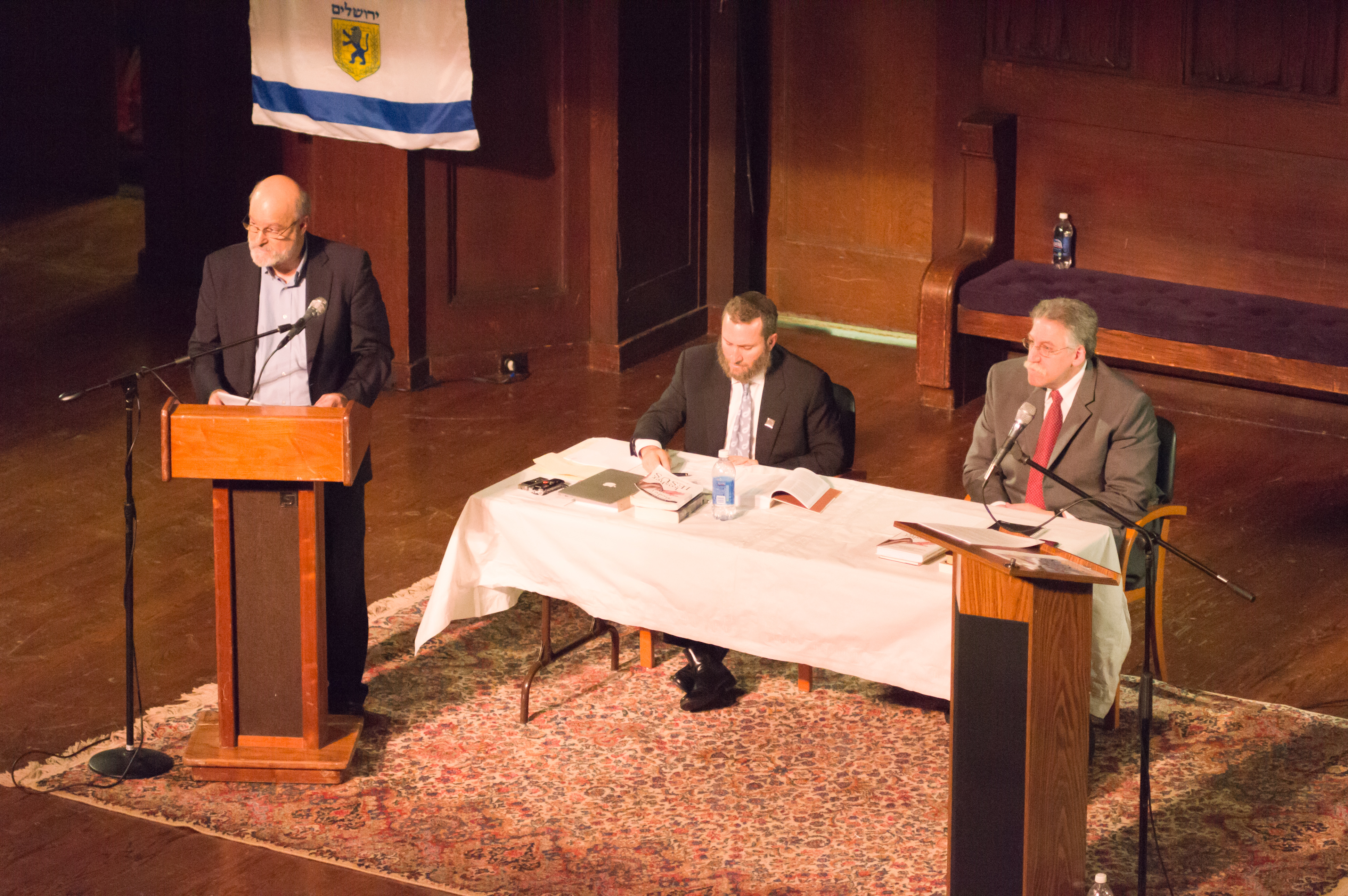
Mike Brown and Shmuley Boteach debated before an audience of more than 700 Jews and Gentiles, believers and non-believers, on the Upper West Side of Manhattan last night.The debate focused on Shmuley’s book, Kosher Jesus, and Dr. Brown’s forthcoming book in response, The Real Kosher Jesus.

Brown summarized Rabbi Boteach’s viewpoint as being completely opposed to any reasonable interpretation of the New Testament.  Brown suggested that Shmuley turned Jesus into a rebel against Rome, who taught nothing new and died because of his treason against Rome.

According to Shmuley, Paul was the person who reinvented Jesus and transformed him into a Divine Messiah who died for the sins of humanity.

In effect, according to Dr. Brown, Shmuley has stripped Jesus of the uniqueness ascribed to him in the New Testament scriptures.

Shmuley responded by painting a picture of Jesus as a Jewish freedom fighter who was both a sincere zealot for Jewish causes and a great rabbi who taught in a way similar to the rabbis of his day.

Mike said that the only way Shmuley could be correct would be to assume that the entire New Testament, from Matthew to Revelation, was edited and influenced by later Christians, inspired by Paul, who elevated Jesus to a status he never claimed for himself.  Mike noted that Shmuley gave very little historical or other type of evidence to justify such a radical reinterpretation of the New Testament.

The debate was successful in raising critical issues about Jesus. Clearly  both Mike and Shmuley agreed that Jesus was Jewish and spoke as a rabbi and a Jewish prophet   But that is where their agreement ended!

There has clearly been more interest in the Jewishness of Jesus within the Jewish community, from Kosher Jesus to a new Jewish Annotated New Testament edited by Jewish scholar Amy-Jill Levine and Marc Z. Brettler.

Hopefully more and more Jewish people will study the New Testament and discover that indeed Jesus is Jewish, and more importantly, the Messiah and Savior of the world.For more information on why the New Testament should be taken more seriously as an historical  document, read the book, Isaiah 53 Explained. It is yours for free at www.isaiah53.com.

1 Comment

Filed under Uncategorized

Rabbi Shmuley is still far from the Truth!

I have been reading the new book by Rabbi Shmuley Boteach, entitled Kosher Jesus. I found it refreshing to read so many positive statements by an Orthodox Rabbi about Jesus… but Rabbi Boteach still does not believe that Jesus is the Messiah or God in the flesh, or that He died for our sins. Instead, he presents Jesus as a good and pious Jewish man who loved his people and who died trying to free His kinsman from oppression.

Shmuley, whom I’ve come to know quite well as a result of our many public debates1 is still waiting for the Messiah to come and reign on David’s throne, like most religious Jewish people today.

However, Shmuley – who is sometimes called “America’s Rabbi” – has caused the debate on the issue of Jesus to take a new turn by publishing this book, which states positive views of Jesus that are at odds with those of many in the Jewish community.

For example, one author on a religious Jewish website writes,

However, writing a book that completely exonerates Jesus and promotes Jewish respect for him is something that I find grossly naive and severely imbalanced in light of the overall picture of history and early gospel texts. “Kosher Jesus” is a one-sided coin that presents a single perspective while being ignorant of all others.2

Another Jewish writer comments,

The vast majority of Jews will never read “Kosher Jesus” and understand that Boteach really referring to a Jesus who had a million-dollar makeover. They will think of the Jesus praised by Tim Tebow! For an Orthodox Rabbi to urge Jews to embrace Jesus is incredibly irresponsible, as it will inevitably facilitate the slide by some down the slippery slope toward Christianity.3

There are many additional – and even harsher – comments by Jewish leaders regarding Shmuley and his latest book, including one prominent Orthodox Rabbi in Toronto who has put a ‘ban’ on the book and says that Jewish people should not read it!

Last month, Shmuley wrote on his own blog:

…Rabbi Schochet declared the book heretical, banned anyone from reading it, banned me from speaking about it, banned others from hosting me, and refused to offer a single reason or explanation as to why.4

It appears that some Jewish leaders simply do not want Jewish people to even think about Jesus or to be exposed to the idea that Jesus was Jewish and that there was value in what He taught and did. I understand this concern – in fact, I was raised with it – and I contend with it regularly in my efforts to help my fellow Jewish people come to know Jesus as Messiah and Lord.

After reading the book, I have come to the conclusion that although Shmuley paints Jesus in a positive light, his approach is short-sighted and even disrespectful to Christians and Messianic Jews. Many of our core beliefs are eviscerated in his attempts to “retell” and reconstruct the Gospel story.

A writer from one of the leading Jewish newspapers in the New York area comments,

Boteach has the noble goal of improving the relationship between Christians and Jews, yet his approach here is problematic, as well. By severing the good Jewish Jesus from bad Christian teachings about him, he casts all Christian beliefs — about, for example, Jesus’ uniqueness and significance — as groundless and fantastic. Far from building a bridge between Jews and Christians, his portrait of Jesus will be rejected by most Christians as irrelevant and even insulting.5

I could not agree more with the above critique.  I believe it is good to try to understand one another’s faiths and engage in respectful dialogue – and yes, even to try to persuade each another to accept what we believe as true. However, Boteach’s attempts to build relationships with Christians on the basis of his own imaginative Jesus will never build the bridges he desires. After all, who among us would want to give our lives in service and sacrifice for a failed first century revolutionary?

A Jewish Messiah who died once and for all to atone for our sins, reconcile us to God, and give us eternal life, however… that’s a Jesus worth loving and serving!


Notes:

[1] A debate entitled, Is Jesus Kosher, between Shmuley and Dr. Mike Borown, will be held in Manhattan on March 13th at 7:30 pm at the Ethical Society building on West 64th street, Manhattan. If you happen to live in the New York area or are visiting the Big Apple, please attend.  You can ask for the details by e-mail or call212-223-2252.

[2] Yehudah Ilan. Kosher Jesus, Treif Christianity, http://chizzukemunah.com/2012/01/16/kosher-jesus-treif-christianity

[3] Rabbi Michael Skobac. It’s Your Own Mess Shmuley – Clean it Up http://www.jewsforjudaism.ca/resources-info/response-to-shmuley-boteach-s-kosher-jesus

[4] Boteach, Shmuley. http://www.shmuley.com/news/details/P2/

[5] Gregerman, Adam. http://www.forward.com/articles/151028/#ixzz1mAbuEuEY

5 Comments

Filed under Uncategorized

Can you be both pro-Israel and pro-Palestinian?

While reading the CNN Belief Blog, one prediction for 2012 struck very close to home. It was penned by the publisher of Relevant Magazine – a more contemporary Christian magazine (worth reading as well):

There’s no question the worldview of most younger Christians already differs from previous generations regarding social justice, cultural engagement and politics. The next issue of probable divergence? The conflict in Israel and Palestine. The American church has largely purported just one theology about the modern state of Israel, but now questions are being asked – especially by younger Christians learning of persecution and human rights issues happening in the region – if the church should have a more active role in peacemaking. Is there a way for the Church to be pro-Israel, pro-Palestine and pro-peace? (“15 Faith-Based Predictions for 2012,” Cameron Strang, Publisher, RELEVANT Magazine)

I believe Cameron Strang is correct to point out this trend among Christian young people. I do wish he had phrased his statement about persecution and human rights issues happening in the region differently. This may have been better phrased, “learning of alleged persecution and human rights violations” – or perhaps “accusations” of the same.

But, he is correct in saying that our younger generation seem to be less supportive of Israel than the previous generation. Why? I can think of a few reasons. One has a more positive origin (though needs to be more balanced), but the other is negative.

Let’s start with the positive!

I am delighted to see our younger generation developing a greater concern for social justice issues, and many are doing a great job of making a very practical difference in our broken and sinful world. Caring for those who are marginalized is part of this concern, and it has led to more prayer, help and support of Palestinians.

I am always happy when God’s love is shown to others. I would be happier if our younger generation would be more circumspect in giving their political support to the Palestinians, but I am sincerely grateful for the love shown to those in desperate need of the Gospel.

The second reason for younger Christians’ dwindling support for Israel is not so good: many churches are no longer teaching about Israel, the Jewish people, the Holy Land, or even about the End Times! This is a problem because the Bible contains a considerable amount of teaching on these matters. Romans 9-11 is just one of many examples – read through it and see what you think!

Perhaps we need to focus on bringing a more verse-by-verse, expository style of Bible teaching back to our congregations and pulpits. There are so many needs in our world – and within our own congregations – that we sometimes miss out on other key areas of Bible teaching, that if taught would eventually reduce some of our needs!

We believe it is entirely possible to love the Jewish people and the Palestinians while believing that the Land of Promise belongs to the Jewish people. This is one of the reasons we are sponsoring another major conference on this very topic – this time on the West Coast!

The conference is entitled Israel, the Church, and the Middle East Crisis, and will be held March 23-24, 2012, on the campus of Biola University. The speakers include author and Middle East expert Joel Rosenberg, Old Testament scholar Dr. Walter Kaiser, and myself. It will be one of the only conferences of this sort that provides Bible teaching about Eschatology and the Future of the Middle East – as well as seminars on how to witness to both Jews and Muslims. Visit the website for further information and online registration!

I appreciate Cameron Strang’s having brought this trend to our attention. My prayer for all of us in this New Year is that we will commit ourselves to understanding the fullness of Scripture – and encourage our congregations, pastors, Messianic Rabbis and home Bible study leaders to delve deeply into the role and calling of God for the Jewish people as revealed in the Scriptures. After all, being chosen was not our idea… it was His! (Deuteronomy 7:6-11)

I look forward to hearing your thoughts on this issue!

7 Comments

Filed under Uncategorized

New Year’s – Twice a Year!

As a Messianic Jew, I have the joy of celebrating New Year’s twice every year!

The exhilaration and hope that comes with the anticipation of new beginnings, the opportunity to close a chapter and even to start over if needed, is medicine for the soul, giving us a sense of forward progress. We are, after all, one day closer to the coming of Jesus!

The New Year is also a time for new resolutions, new plans and new priorities. Personally, I enjoy jotting down a few “predictions” for the New Year, just to see if I get close! I find that my “predictions” of the past usually turn into prayer requests more than prophecies or strategic plans.

I am also keenly interested in your predictions, particularly when it comes to your views on projected trends in our culture, country and church. Like you, I want to be tuned in and more sensitive to the needs and challenges our families and congregations will face in 2012. I know that in order to serve my community, I need to remain rooted in Scripture and stay vigilant in observing the direction of our culture and country.

Would you take a moment to share with me your answers to three questions?

1)      What do you read to keep up-to-date? I would be very interested in your recommendations of at least one website, magazine or publication or resource.

2)      Could you recommend a book or two that you believe would help us to be more faithful and productive in the Lord’s service in 2012? I would be so grateful for this help that if you take a moment and make a recommendation I would be happy to send you a brief, hundred-page book on sharing the Gospel with Jewish people.

3)      What are one or two trends that you think will have an important impact on our ministries this year–whether cultural, political, church-related or theological?

I will compile the results and post them on one of my next entries!

Let me quickly share my own answers.

1)      As I am New Yorker, I try and read the New York Times almost every day. Although it is only one of many sources for news, it does help me to better understand the Jewish community I am called to reach.

2)      I recommend is the biography of Steve Jobs by Walter Isaacson. It is a fascinating look at the life of a man who revolutionized so much of our way of life and culture.  (Yes… I use a Mac!)

3)      One website I enjoy reading occasionally is the CNN Belief Blog. It is also a good place to comment, allowing us to engage with a more “spiritually involved” segment of the population who are not necessarily believers in Jesus.

Happy New Year and I look forward to hearing from you!

4 Comments

Filed under Messianic Jewish

A Hanukkah Miracle: Heroes of Sderot

It’s beginning to look a lot like Hanukkah! A few days ago, I asked a number of Jewish believers in Jesus what their favorite holiday of the year was. Passover was the winner – but Hanukkah took a close second!

This great holiday is not found in the Scriptures, but it is mentioned in the New Testament in John chapter 10, where it is called the Feast of Dedication. Jesus observed Hanukkah, and one of His greatest pronouncements about Himself and His relationship to His father can be found in John 10:10. It was during the holiday that the Messiah declared that He and His Father are one.

The Story of Hanukkah

The story of Hanukkah focuses on the Maccabee family, which was first led by the patriarch of the clan – Mattathias – and then by Judah.  The Maccabees overthrew the Syrian Greeks who came into power after the division of Alexander’s Empire into four parts. The leader of the Syrian Greeks at the time was Antiochus Epiphanes, who remains one of the archetype villains and oppressors of the Jewish people to this day.

Antiochus Epiphanes tried to turn the Jewish people into Greeks – forcing them to worship Greek gods, speak the Greek language and assimilate into the great “uni-cultural” Greek empire that had been part of Alexander’s vision. Of course, this would have been the end of the Jewish people – but the actions of a small priestly family living in the village of Modiin became a symbol for Jewish resistance to religious and cultural assimilation.

After three years of intensive guerrilla warfare, the Maccabees overcame the Syrian Greeks and retook Jerusalem. They marched into the Temple only to discover that Antiochus Epiphanes had desecrated the altar by sacrificing a pig and smearing its blood on the stones of the altar. The Maccabees tore down the defiled altar and built a new one, setting the rocks aside for the coming of the Messiah who would be the only one capable of cleansing stones.

The story continues (though very few people believe this was actually part of the original tale), by describing the fact that there was only one day of oil available to fuel the eternal light in the Temple, and it took eight days to produce the oil needed for this holy purpose. However, according to the story, the oil lasted for eight days so that the eternal light could keep burning without interruption. This is why we celebrate Hanukkah for eight days, light the menorah, and eat fried potato pancakes and special jelly doughnuts (especially in Israel), as these foods are made with a considerable amount of oil.

Hanukkah Heroes

Aside from the presents, the food, the warm glow of candles and the gathering of Jewish families all across the globe, Hanukkah has become a symbol of Jewish heroism and loyalty to God and the Jewish people. This is why I love the holiday. It is an eight-day reminder to strengthen our loyalty to the God, who calls His people to be a light to the nations – not only during the eight days of Hanukkah, but every day of the year

Hanukkah is a holiday in which we honor heroes. As a Jewish follower of Jesus the Messiah–I can think of no better Hanukkah hero to emulate and admire than Him. He is the true light of the world, the reason for the season and the servant of God who shines the light of eternity into a dark world!

I also want to honor a community of heroes that most people never heard of – at least in the United States. These are the citizens of Sderot, a small town of about 20,000 people – mostly Russian Jewish immigrants to Israel – who live “next door” to Gaza. This community has been the unfortunate recipient of tens of thousands of Quassam rockets over the last few years. They literally live their lives between rocket attacks, though this has slowed down over the last year and a half after the Israeli Defense forces did what they could to remove the terrorist cells firing the rockets from Gaza.

I hope that you will take a moment to watch this video entitled 15 Seconds–don’t miss it.

I have been to Sderot and spent time with many of these heroes, and I want you to know how brave they are. Of course, they do not view themselves this way! These fairly new immigrants to Israel are simply struggling to survive, trying to stay safe and build a new and better life for their children and grandchildren. Yet, to me they are like modern Maccabees, loyal to their people and their families, unwilling to even consider giving up the dream of living in the land that God gave to the Jewish people.

Many of these heroes suffered through the Holocaust, the anti-Semitism of the former Soviet Union, and the challenges of leaving all they had to move to a new country and to land in the middle of an internal war that placed them in harm’s way. Many gave up careers, homes and family for the dream of Zion. I am sure they never gave the idea of becoming heroes and role models a moment’s thought!

Many of our best heroes unwillingly and unwittingly take on the role. I would say that the citizens of Sderot of would be surprised to even read these words, but for me, a Jewish man from New York City – I cannot help but view these stalwart members of the Jewish community, as Hanukkah heroes. I hope you will too.

Your prayers for them and for the staff members of Chosen People Ministries who provide food, fellowship and spiritual strength for these heroes mean a lot.

Happy Hanukkah,

Mitch

2 Comments

Filed under Uncategorized

Whoever heard of a Jewish Cowboy?

I just returned from a trip to Argentina – home to hundreds of thousands of Jewish people, including some real Jewish cowboys! These kosher cowboys are called in Spanish “Gauchos Judios”- literally “Jewish cowboys.”

Many people mistakenly think that the Jewish population in Argentina grew as a result of an influx of refugees from the Holocaust. Actually, the Jewish immigration to Argentina began during the same time that there was massive immigration from Eastern Europe to the United States and Canada. Between the late 1880s and World War I, almost two million Jewish people traveled to what was known as “the Golden land”– the United States of America – in order to get as far away from Eastern European anti-Semitism as they possibly could.

The great Jewish leader Baron Maurice de Hirsch knew that the days of the Jewish people in the area known as the Pale of Settlement (including parts of Russia, Ukraine and Romania) were numbered because of the increase of vicious pogroms against the Jews living in that area. Baron Maurice de Hirsch purchased land in the northern part of Argentina (the Pampas) to create a safe haven for the Jewish people. Somehow he convinced the Argentine government that receiving the Jewish people would be good for the country – because they would farm the land, raise animals and add to the economy.

Of course, the Jewish people of Eastern Europe were for the most part tradesmen, rabbis, scholars and professionals – not farmers! But Baron Maurice de Hirsch knew that the only way to get the Jewish people into Argentina and away from the pogroms of Eastern Europe was through farming the land.

This was the genesis of the Jewish immigration to Argentina and the origin of the “Gauchos Judios.” However, as hard as the Jewish people tried, it was soon apparent that only a small remnant of immigrants from Eastern Europe would be able to adapt to this new lifestyle. Many Jewish immigrants to Argentina began trading and opening stores in the northern provinces of the country, and then eventually drifting towards the great city of Buenos Aires.

The Jewish people of Argentina – now more than 300,000 – have contributed greatly to the country’s growth. The second generation of Jewish Argentines built upon the foundation laid by their parents and became business owners, professionals, and politicians, establishing a vibrant Jewish life and culture throughout the country, centered in Buenos Aires.

Dozens of synagogues can be found throughout Argentina today. I visited one during the celebration of Sukkot while in Buenos Aires and it was filled with families; young and old, Ashkenazi and Sephardic!

Today, a dynamic Jewish culture is growing in Argentina – expressed through a variety of social and football clubs as well as community centers. There are also some very important rabbinical training institutions in Buenos Aires that continues to train rabbis for all of Latin America; they have even “exported” some of their best rabbinical students to serve in a number of significant synagogues in New York City.

There has always been a close tie between Argentina and Israel. Over the years, many Jewish people left Argentina because of continued anti-Semitism and immigrated to Israel. Tens of thousands of Argentine Jews now live in Israel.

Argentina also became home to many Nazis who fled Germany and other parts of Europe. There have always been strong German, Spanish and Italian communities in Argentina, and many of these Western European immigrants were sympathetic to the Nazis. By the 1950s there was a strong Jewish community as well as a strong ex-Nazi or Nazi-sympathizing community in Argentina.

By the time of my first trip to Argentina in the mid-1970s, one could easily find Spanish versions of the Protocols of the Elders of Zion on newsstands in Argentina. A number of the Jewish residents of Argentina were politically on the left and became part of the opposition to the military government in those years. There was also a disproportionate number of Jewish people who became “disappearing ones” and lost their lives as a result of their protest against what was viewed as a Fascist government.

There have also been strong communities of Jewish people in Argentina who believe in Jesus the Messiah. Some come from Europe during the early waves of immigration, but many came to Argentina during and after the Holocaust. One group of these Messianic Jews were from Vienna and came to Argentina via Sweden, as the Swedish Lutheran Church helped many Jewish people escape Nazi terror through their Outreach Center in Vienna.

These Messianic Jews traveled from Vienna to Stockholm, but because Sweden was unwilling to allow the Jewish people to remain in their country, many of the Jewish people emigrated to Argentina – still one of the only countries that would allow them to enter.

One of those who escaped Vienna and came to Argentina was Emmanuel Lichtenstein, who was serving as a missionary to the Jewish people with Chosen People Ministries in Vienna, in a partnership with the Swedish Lutheran church.

The work of Emmanuel Lichtenstein grew in Argentina and many Bible studies were established as well as a branch of the Messianic Jewish Alliance (called the Hebrew Christian Alliance at that time). The Bible studies and worship services were mostly conducted in Yiddish, especially since the Messianic Jews in Argentina were mostly Ashkenazi Jews.

The work of Chosen People Ministries in Argentina continues to this day. Argentina’s Jewish community remains vibrant, and after spending a week in Buenos Aires, I can tell you that my love of and burden for the Jewish people of this great country has only increased.

Unfortunately, anti-Semitism continues to rear its ugly head in beautiful Buenos Aires. I saw a number of Swastikas painted on the walls in Jewish areas of the city. The Jewish people continue to associate anti-Semitism with both Nazism and Christianity. It is a real shame – but it is understandable in light of all that has transpired over the last century!

I met many Jewish believers in Argentina during this last trip, and every single one of them came to faith through the loving testimony of a Gentile believer who, in the power of the Holy Spirit, was able to share the Good News with them.

Just imagine a new ministry… Jewish Cowboys for Messiah!

4 Comments

Filed under Argentina, Messianic Jewish

Another Yom Kippur Has Passed


Years ago a Chassidic Rabbi taught me the real meaning of Yom Kippur – the Day of Atonement.

I was handing out pamphlets about Yeshua the Messiah at a New Jersey college when all of a sudden, the campus Chassidic Rabbi ran towards me and began handing out his own literature.  Not only that!  He stopped some of the students who had received a copy of my pamphlet, asked them if they were Jewish and then told them they should not read, what was obviously in his opinion – spiritual contraband.  He virtually took it out of their hands and gave them a copy of his leaflet, telling them about the importance of living a more fulfilled Jewish life; keeping Torah, kosher, going to Synagogue and loving G-d in a more traditional Jewish way.  He represented a group called Chabad, which now has close to 6,000 “missionaries” traversing the globe calling Jewish people – especially on campuses – to return to their spiritual roots and embrace a more faithful Judaism.

At first I was a bit concerned and felt he was unfair in doing what he did and I almost said to him – “go get your own crowd!”  But, in the distance I noticed that students were watching and seemed to be wondering why the Rabbi was helping the man (me), wearing a sweatshirt that read something like. Yeshua is the Messiah – hand out his literature.  I laughed and continued this unexpected few moments of “dueling pamphlets”.

It was just a few days after the Day of Atonement and thought I would take the opportunity to engage my self-proclaimed protagonist in meaningful conversation.  So I asked the Rabbi – whose name I knew – “Baruch, did you have a good High Holiday season”?  He looked at me and said, “of course”.  I then asked if I could ask him a bit of a personal question and he responded with a quick “sure”. I asked Baruch, whose name means blessing, “do you know if you were blessed with the forgiveness of your sins on Yom Kippur”?  He smiled at me, like a father whose young and precocious son had asked a naïve, but potentially reasonable question.  He answered, “you believers in Jesus think it is so easy to be forgiven…you just say a little prayer and bingo…you are forgiven!”  I returned the good-natured smile and said, “Baruch, I really want to know…you spent all day fasting, 10 days intensely repenting and now the Books of Life and Death are closed (according to Jewish tradition) and I am wondering…did you make it into the Book of Life”?  I then in typical New York, Brooklyn fashion – since I knew he had lived in Brooklyn – said – “answer the question, Yes or No.”

He used a fatherly tone with me and said, “How can someone ever know they were forgiven?  You think you get a certificate or something like that?  It is a matter of faith and believing you did the right thing”.   I pressed him one more time and said, “so, you do not know for sure that your sins are forgiven?”  This time he became a bit exasperated with me (I don’t blame him) and using my Hebrew name, said, “and even if I was forgiven, I would walk out of the Synagogue and sin again and have to repeat the whole process the following year”…He continued, “ the point is this…a faithful Jew must keep repenting all the time in order to forgiven of sin…it is a constant process”.

I smiled and said “thank you”.  He asked “why the thank you?” I then said to him that his answer reminded me of why I am so grateful for what Yeshsua the Messiah did for me and for him…that He died once for all, for all sins; for all time and for all people…and that though I do need to repent and live for Him that my eternal future rested in His mighty hands and not my own. He smiled at me and we wished one another a “Chag Sameach” – Happy Festival as we still had one additional Leviticus festival (and the one which was the most fun!), coming up – Tabernacles – Sukkot.

The Rabbi helped me appreciate the words of our Messiah who said, “It is finished”!  It is a source of great personal joy to know that His work of redemption is completed and as the author of the Book of Hebrew writes,

For by one offering He has perfected forever those who are being sanctified. (Heb. 10:14)

Hebrews 8-10 describe His once for all atonement for our sins, but read verses 1-16 of chapter 10 and you will be able to glean the heart of what He did for us through His sacrificial death.

I went to a wonderful Messianic congregation on Yom Kippur day and the Messianic Rabbis’ sermon encouraged us to go beyond repentance – to reconciliation and that reconciliation with God (and with other people) can only come through the death and resurrection of our promised Messiah – Yeshua.  I could not agree more and am grateful for both Rabbis as I reflect upon Yom Kippur 5772.

One last thought.  I am thankful for the forgiveness of sin and gift of eternal life given to all who believe in Yeshua the Messiah, but the encounter with the Chabad Rabbi also taught me another important lesson.  That one’s love for God should never lead to silence!  In fact it should produce the opposite – a joy that compels us to speak to total strangers, to risk our personal dignity and safety and to even respectfully resist those whose goal it is to turn people towards a spiritual path other than the One way we know to be true.  I have a found a new, New Years resolution, thanks to some continued reflection on an event that happened many years ago – I pray that 5772 will be a year of new opportunities to tell others about my love for God and for His Son, and that He will give me the strength to take and even make these opportunities.

And you?

4 Comments

Filed under Uncategorized

Rosh Hashanah in the Lingering Shadow of 9/11

Happy Rosh Hashanah, and may your name be inscribed in the Book of Life!

We had wonderful Rosh Hashanah services at our Messianic congregation in Manhattan, Sha’ar Adonai, where I had the privilege of preaching on Erev Rosh Hashanah. I decided to preach on Psalm 23, which was the same text I preached on ten years ago when we observed Rosh Hashanah a few days after 9/11. At that time, many people were posting the twenty-third Psalm throughout New York City, hanging it on construction sites, hospitals, and more. Both believers and non-believers knew exactly what passage to read in order to find comfort and hope from God during a very trying moment.

Those days after the attack on the World Trade Center, and that first Rosh Hashanah service afterwards, were unforgettable. Months before the holiday, we had rented a space right next to the Empire State building for services. We decided not to change the location, even though many of us thought that the Empire State building could be the next target of the terrorists. Subways and buses were running poorly and the traffic was horrible as almost every other vehicle was stopped at a bridge or tunnel and searched for explosives. These were difficult days for the traumatized citizens of New York City.

In fact, we almost canceled the service, but decided against it. I remember telling one of our staff, “I will only cancel our High Holiday services when the Lord changes the Jewish calendar.”

We had a great service that night, and I was able to remind people that though we walk through the valley of the shadow of death, we need not fear evil because the Lord is with us (Psalm 23:4), and when He is with us, we have nothing to fear. That post-9/11 Rosh Hashanah service was the first service that Steve and Carol Fenchel attended in New York City prior to their coming here to plant a Messianic congregation. And here we are ten years later, still loving the Lord and worshipping Him during Rosh Hashanah – having passed through the “dark valley” of terrorism, yet still able to praise God. And ten years later we are now able to look back and see that our faithful Shepherd was guiding and leading us to better and greener pastures. We are safe, though surrounded by danger, because we are His sheep and He has promised to be with us “until the end of the age” (Matthew 28:20).

This commemoration of Rosh Hashanah 9/11 was supremely meaningful to me and for those who went through the trauma ten years ago. I met one Jewish couple who attended our service ten years ago – it was their first time at a Messianic Rosh Hashanah service as followers of Yeshua (Jesus). I asked when they had come to faith and they replied, “A few days ago.”

I was a bit surprised and asked them to tell me their story. They had heard the message of Jesus from some Gentile Christian friends but were not convinced. They had also watched Jonathan Cahn’s TV show (Jonathan is a Jewish believer in Yeshua and pastor of Beth Israel congregation in New Jersey), but they were still not convinced. However, on September 11, their daughter was in one of the Twin Towers, and when they saw what had happened they prayed and asked Yeshua to save their daughter. They promised Him that if He did, they would both become believers in Him. After God did save their daughter, they became believers and found their way to our service just a few days later.

The same Lord who did such wonders during and immediately after September 11 is the Shepherd who continues to seek His sheep. After our service the other night, I was approached by an older couple, which I noticed had been smiling throughout the very lively and joy-filled service. I asked them how they liked the service and they said, “We loved it! This was unlike any Rosh Hashanah service I have ever attended!”

I asked the wife whether that was good or bad, and she exclaimed, “Good!” She and her husband had been brought to the service by a friend who is Jewish and believes in Yeshua. We compared stories about growing up in Brooklyn and Queens, and then talked a bit about the deeper spiritual issues of the High Holidays. It was a great conversation, but I don’t think I will forget the smile on this dear woman’s face when she went on to ask, “Is this the way your services usually go?”

I told her, “Yes – we are a happy bunch!”

As a Messianic Jew, I love to observe the Jewish holidays, but we must remember that the point of Rosh Hashanah in the Jewish community is that it serves as the “gateway” to the Day of Atonement, Yom Kippur. It is the day Jewish people begin a season of repentance and prayer that will hopefully lead to salvation by the close of Yom Kippur.

Yet as believers in Yeshua, we have forgiveness already! We also know that repentance alone does not save a man or a woman from the consequences of sin – we are  saved through the blood of the atoning sacrifice of Yeshua the Messiah!

And this is why we have such joyful services! It’s not because we do not think we need to regularly repent, turning from our sins every day and drawing closer to God. Rather, we rejoice because we know that our sins are forgiven and we have been eternally bonded to God through the sacrifice of His Son, never to be undone – not even by the sins we commit each day as we do our best to walk with Him.

He is our great Shepherd. He leads us, guides us, and provides for all of our needs. And most importantly, He walks with us. He is our ever-present Companion and Joy, and this is why we view Rosh Hashanah as a celebration and a time to rejoice in thanksgiving to God for His goodness.

Again, I want to wish you a Happy New Year! I pray that you will have a spiritually fruitful week as you draw near to God and He draws close to you.

Mitch

3 Comments

Filed under Uncategorized

Rosh Hashanah and the Middle East Crisis

Shalom!

This has been an eventful and traumatic week for Israel and the Jewish people.  The United Nations heard from President Obama, Palestinian leader Mahmoud Abbas, Prime Minister Netanyahu, and the leaders of Turkey and Iran on the  topic of Israel, her borders and her status within the community of nations.  It is not lost on many of us that these historic conversations are taking place just days before the worldwide Jewish community begins the High Holiday season, beginning with the first night of Rosh Hashanah (the Jewish New Year) on Wednesday night.  Admittedly, this was not  planned, as the General Assembly schedule is set well ahead of time – but still, the timing is notable!

The High Holidays, outlined in the Bible in Leviticus 23, have a privileged position in Jewish tradition and life… especially the New Year and Yom Kippur (the Day of Atonement).  The ten days between the two great festivals have also grown in importance in Jewish tradition and are called The Days of Awe or Ten Days of Repentance.  This comes from the notion that God opens the books of life and death in heaven on Rosh Hashanah and closes them at the last moment of the Day of Atonement.  Jewish people use these ten days to make all things right with their neighbor and particularly to apologize to those they may have offended during the previous year.

The result would then be a sweet and fruitful year, symbolized by our sharing plates of apples and honey with one another! In other words, our sins require repentance and only when this is done can a Jewish person have peace with God, their fellow-man or woman and with themselves.

I love this tradition because it encourages humility and vulnerability and promotes the healing of broken relationships.  If only believers in Jesus the Messiah had a special season of the year when they knew the Lord was especially looking  into their hearts to make sure that they were seeking the forgiveness of others and were ready to forgive any who had offended them.  As our Messiah said,

Therefore if you bring your gift to the altar, and there remember that your brother has something against you, leave your gift there before the altar, and go your way. First be reconciled to your brother, and then come and offer your gift. (Matt. 5:23 -24)

I believe that an annual week of repentance would transform relationships within the Body of Messiah and bring renewal and refreshment to our souls!

However, there is also a way to misuse the Jewish High Holidays – and there are lessons to learn from these instances as well.  For example, in 1973 the Jewish people were getting ready to observe the Day of Atonement. Israeli society stops completely on this holy day.  It was at that very time that hostile Arab nations attacked Israel, as the nation was observing the Day of Atonement and was unprepared for these terrible events.  The enemies of Israel chose this day knowing that Israel would have trouble deploying her primarily volunteer army and put warplanes into the air.  However, seven days later the Jewish nation was victorious.  But – without some help from the U.S. in  particular – this could have been the “end of Israel”!

The themes of the High Holidays could also be misused for the detriment of Israel as described in an excellent article that appeared online in the New Republic a few days ago. Yossi Klein Halevi* of the Hartman Institute in Israel wrote,

If only Israel had apologized to Turkey for killing nine of its nationals on last year’s Gaza flotilla, so the argument goes, Prime Minister Recep Tayyip Erodgan would not be threatening now to send warships against the Israeli coast. If only Israel had apologized to Egypt for the accidental killing of six of their soldiers when Israeli helicopters entered Egyptian territory in pursuit of terrorists last August, an Egyptian mob wouldn’t have ransacked the Israeli embassy in Cairo, as Egyptian leaders refused to take calls from desperate Israeli leaders. And if only Israel had stopped building in settlements and offered the Palestinians a fair solution, they would not now be turning to the U.N. to substitute an imposed solution for the negotiating process.

This convergence of blame comes at a time of spiritual vulnerability for Jews. This is, after all, our season of contrition. As we approach Rosh Hashanah, the process of self-examination intensifies. And as Jewish tradition emphasizes, the basis for penitence is apology. Before seeking forgiveness from God, we are to seek forgiveness from those we have hurt, even inadvertently.

Klein Halevi’s reminder that  the sins we confess before the Holy One and before our fellow-man are for both intentional and unintentional sins is profound. This theme grows out of chapter 16 of Leviticus, where it is clear that although the Israelites were supposed to sacrifice regularly at the Temple for their sins, it was understood that some sins and opportunities to seek forgiveness would be be missed.  The Day (as the holiday is often called in Jewish literature) makes certain that at least once a year these forgotten sins could be handled (through the blood sacrifice of an offering in the ancient Temple) and forgiven.

Certainly, in the midst of a tense situation like war, sins are committed that require forgiveness and this is undeniable.  However, it is a low blow when an alleged offended party attempts to recast their offenses as the other party’s responsibility and demand repentance for an offense they  actually caused or committed.  We each have plenty of hidden sins we commit for which we need forgiveness; we do not need the additional pressure of others trying to manipulate us for our supposed spiritual benefit – especially when we are at our most sensitive and at the apex of our spiritual vulnerability. It is reprehensible for any person or nation to take advantage of another’s desire to please God in order to serve their own selfish purposes.

I appreciate how Klein Halevi clarifies this issue:

But in the present atmosphere Jews should resist the temptation for self-blame. Apology is intended to heal. Yet those demanding apologies of Israel aren’t seeking reconciliation, but the opposite—to criminalize the Jewish state and rescind its right to defend itself.

Klein Halevi concludes,

This Rosh Hashanah I will ask forgiveness for my own sins and for the collective sins of Israel, as the liturgy insists. But I will withhold my political apologies for a time when those confessions won’t be manipulated against me. There is no religious obligation to collaborate in my own demonization. I will not be seeking forgiveness from those who deny my right to be.

I agree with Klein Halevi and believe that during the Ten Days of Awe, all parties engaged in the Israel-Palestinian conflict should examine themselves and repent, seek forgiveness and change the way they treat one another.  We cannot take responsibility for the sins of others – we have enough of our own!

One further thought: as a Messianic Jew – a Jewish follower of Yeshua (Jesus) – I believe that He is the One who is our ultimate sacrifice and that through His sacrifice we can be forgiven of our sins.  You can read more about this at www.Isaiah53.com.

His forgiveness gives us the power to forgive others. As Yeshua said to His disciples,

For if you forgive men their trespasses, your heavenly Father will also forgive you.  But if you do not forgive men their trespasses, neither will your Father forgive your trespasses. (Matt. 6:14-15)

I realize that this is not the complete solution to the Israeli-Palestinian crisis, but is is a good place to start and something to consider this Rosh Hashanah.

*Yossi Klein Halevi is a contributing editor to The New Republic and a fellow at the Shalom Hartman Institute in Jerusalem. (http://www.tnr.com/article/world/95020/un-palestine-israel-security-council-statehood?id=XSXeLNjlOhnXFgs1YTT71kQRmn2lUDfkoW7wSaad/fgUcW6fgf0yUqOtjBHROMqt)

5 Comments

Filed under Uncategorized