Category Archives: Palestinian

The Time for Rebuilding Is Now

I visited Israel recently to spend time with our staff, hear their stories, pray with them, and encourage them in the great work they are doing to reach our Jewish people in Israel during these very difficult days.

Our staff gathered to try to get away from the stress of war and travel around on a brief Jeep tour in the Judean Hills.

During the trip we were able to get to know some of our drivers. One of them was Avi, who lived on a moshav1 a few hundred feet from the border with Gaza. This community is called Netiv HaAsara, which means “the path of the ten” and reflects how the community was formed. The name comes from the ten soldiers who tragically lost their lives in a helicopter crash in 1971 in the Gazan town of Rafah. Netiv HaAsara is known for its various peace initiatives, and prior to October 7, many Gazans lived in the village and worked alongside the locals in different capacities.

MOSHAV NETIV HAASARA

This moshav was created so families who wanted to make peace with Palestinians could intentionally live on the border to be close to their neighbors in Gaza. The families of the moshav created something called “The Peace Wall” (pictured on the cover), where people could paint bright colors as a symbol of their hopes for peace in the region.2 The moshav was established in 1982 and had close to 1,000 individuals living on the land owned by the community. In 2005, with the disengagement of Israel from Gaza, it became the closest Israeli community to the Gaza Strip.

The story of what happened at the moshav on October 7, 2023, is well known: thirty-five Hamas terrorists attacked the community and killed at least twenty people. Their security team fought valiantly, but three of them were murdered during the attack. The Israel Defense Forces (IDF) were able to save the rest of the people on the moshav once they arrived, about six hours after the attack started. They either arrested or killed the remaining Hamas terrorists.

Our new friend Avi, who drove one of the vehicles for our staff, was one of the first to see the paragliders land in the center of the community.3 We kept in touch with Avi after our staff trip, and he invited us to visit the moshav to hear his story. He showed us around to see where the gliders came in and the homes where his neighbors were killed. Avi even took some time to tell us the story of this morning of terror.

AVI’S STORY OF OCTOBER 7

Now, please take a few moments and try to imagine what it was like for the members of this moshav on the Gaza border, surrounded by security walls and barbed wire fences as well as lush terrain growing beautiful roses, olives, and fruit trees. It was very sad to hear how their hope for a peaceful resolution to the conflict with Gaza was crushed by the brutality of the attacks of October 7.

HERE IS AVI’S STORY IN HIS OWN WORDS:

At 6:00 in the morning, like always, I woke up to take the dog for a walk. At around 6:20, I heard the sound of small firearms. There was also the sound of rocket fire, and not the typical ones you hear. It’s usually one rocket or two rockets, but now there were a lot of rockets.

I thought it was a reaction, maybe to an IDF operation where maybe we took out one of the leaders like Sinwar,4 and they’re upset, so they’re firing. But it was something very unusual, something unexpected, this amount of rocket attacks. It didn’t stop. It just kept coming and coming and coming. Normally, we have a rocket or two, or maybe four or five, and then it stops, but it was wave after wave after wave.

Then I understood. I heard the sound of a motor of some kind of aerial vehicle. The first thing I did is I called the security manager for the moshav, but he didn’t answer, so then I called the local IDF coordinator, but he also didn’t answer. And then I heard another motor from another aerial vehicle coming up. So I said to myself, “I have to do something. I’m going to film it.” And so, I started recording it.

So when I started filming the second glider, I realized the first terrorist had already landed and was walking around in the moshav. I wanted to see where the terrorist was going to land so that I could report it to the security squad protecting the moshav. But the terrorist saw me and changed his direction so that I wouldn’t be able to identify where he landed. He probably thought I had a weapon, but I didn’t have any weapons at the time.

I continued to try to call and inform people, and the only one I could reach by phone was my neighbor who said, “I’m not at home, I’m up at the Sea of Galilee.” So I came home and I told my wife and kids to stay home, to stay inside. I didn’t tell them that there were terrorists loose in the moshav. I didn’t want them to be stressed by the situation.

I continued to try to reach people unsuccessfully, and then suddenly there was no water or electricity. And of course, no internet either. The telephone was hardly working, but WhatsApp5 was somehow working. As soon as the terrorists landed, within a few minutes, there was constant gunfire. I heard the firing all around me and at houses nearby and at the house across the street.

I left the bomb shelter because I thought if they’re going to come toward me, I could interact better with them outside than inside the bomb shelter where I can’t do anything. So I left with a knife and a fishing spear gun, as that’s all I had. For some reason the terrorists didn’t come to my house.

The children of my landlord who lived nearby called me because their mom, my landlord, wasn’t answering the phone. They were concerned for her. So, I went to her house. I tried to hide because I wasn’t well armed. So, I was trying to get over there without being seen. The reason I was hiding was not because I was afraid of being seen by the terrorists. I was afraid of being misidentified by the army as a terrorist, so I was hiding. I totally expected the army to be here already, but they didn’t come for hours!

I arrived at my landlady’s house, but she wasn’t there. I didn’t find her in the house, and I didn’t think to look in the bomb shelter. I looked on the street because she’s an older woman. I thought maybe she had fallen or something, but I didn’t see her, and I didn’t want to cross

the street. I didn’t want to be out exposed for too long. I was sure that the army was coming, and they would interact and engage these terrorists, but the army didn’t come so I came home.

When I got home, I was able to finally reach the IDF security coordinator for the area, but our connection was in and out. Sometimes the phone lines would drop, so I used a combination of phones and WhatsApp messages back and forth, and I finally got ahold of somebody. Then I started to relax a bit.

I knew or at least had some idea of what the terrorists were doing because first of all, you could not only hear it, but you could also smell it. But also on the WhatsApp messages, I was getting updates from the security squads about where the terrorists were going and what they were doing. And so I knew more or less what was going on around me as they burned a few houses, and you could smell the smoke.

At 9:00 or 10:00 am more terrorists arrived, in addition to the original thirty. They were armed. One of them even had a bulletproof vest; they came to steal and then to kill. The security team of the moshav captured them but didn’t kill them. They transferred them for interrogation.

Tactical units and the border patrol came in the afternoon, and I understood that the situation was more or less under control, but they didn’t leave because there was still fighting all around them in some of the other towns in the area. And we stayed in our bomb shelter until 5:30 or 6:00 at night, so for about twelve hours.

I heard (but can’t verify the authenticity of it) that the IDF listened to the recordings of the conversations between the terrorists and their leaders back in Gaza, and that they had originally planned to destroy the border wall and completely take over our moshav and kill all of us.

But when the terrorists came and started killing people, they found hardly anyone in their homes or walking the street and reported back that they killed everyone that was here, and that the village was now unoccupied. And so, they decided not to break the wall and completely invade. About 1,000 people were in their bomb shelters. So when the terrorists came, they didn’t see anyone, but whenever they found somebody in a safe room, or a bomb shelter, they threw grenades inside and kept going.

I found out the terrorists had all taken a particular drug (Captagon)6 that removed their fear. It also affected their reasoning and their logic, which is why they may have reported that the town was empty, when in fact, they did meet people, and they knew they were in bomb shelters, but they reported that the town was empty. This drug is big business for Hezbollah in Lebanon. They sell it all over the Middle East. It’s a cheap drug to make, and they make a lot of money on it, and it’s very popular in the West Bank. So it’s hard to know what really happened and why we seemed to be protected from additional murders.

All of this is very unfortunate as I worked regularly with Gazans, and they work really hard. One Gazan worker equaled three regular workers. I don’t know if there’s going to be peace or not, but I don’t hate them. Okay, those who committed atrocities, like murder and rape, there’s no question they just need to be eliminated. But at the end of the day, there’s still going to be two million Gazans.

I then asked Avi about his view of the future of the moshav. He continued,

First of all, we have to eliminate Hamas. That’s the first thing. And then whatever happens, it’s politics. We can’t know. But what we do know is we have to eliminate Hamas. They’re fanatics and they’re murderers, and they need to be removed.

I further asked Avi if he believed the moshav would return to normal and the hundreds of people who used to live there would return to their homes. He simply answered, “Yes, I hope so!” I was greatly moved by his hope and by his bravery. He is a hero and shows the determination of Israelis to survive and thrive even when facing seemingly unsolvable conflict.

A CALL TO PRAYER

So, how can we pray for Avi, his family, and the members of this beautiful moshav where its members were so hopeful to create peace between Gazans and Israelis?

We can pray for the families of those who were murdered. We can pray God will keep terrorists from attacking once again. And most of all, please pray Avi, his family, and many others at the moshav who dreamed about peace will find true and lasting peace through the Prince of Peace, Jesus our Messiah.

As the psalmist wrote, “Pray for the peace of Jerusalem: ‘May they prosper who love you’” (Psalm 122:6).

Thank you for your support, which enables us to help friends like Avi and our workers in Israel and around the globe in all their many efforts to bring the good news of hope and peace through the Messiah Jesus “to the Jew first” and also to the Gentiles (Romans 1:16)!

We would like to have additional funds to help members of Netiv HaAsara, as well as Israelis who cannot yet return to their homes in towns near the Gaza border or on the border of Lebanon. Your gift of any amount to the Israel benevolence fund will support Israelis in this dark time. We so appreciate your partnership.

We want to help Israelis practically and find ways to tell them about the Prince of Peace who brings peace to the hearts of all who call upon Him! He specializes in solving the unsolvable.

1 A moshav is similar to a kibbutz but allows for private ownership of property among some other key differences.

2 “Another inspiring project in Netiv Ha‘Asara is ‘The Path to Peace’ project led by artist Tsameret Zamir. The project transformed a once-plain security wall into a colorful canvas of hope by placing colorful brushstrokes bearing positive messages on the wall. Each stroke of paint symbolized hope for a peaceful future. It was a poignant reminder how, even in the shadow of conflict, the people of Netiv Ha‘Asara were dedicated to the pursuit of peace, one brushstroke at a time” (Kim Paffen, “Life near the Gaza Border: Living amid Ongoing Gaza-Israel Conflict,” Our Planet in My Lens, October 8, 2023, https://ourplanetinmylens.com/life-near-the-gaza-border/).

3 Hamas terrorists used paragliders on October 7, 2023 to get over the border fence into Israel.

4 Yahya Sinwar has been the leader of Hamas in Gaza since 2017.

5 A mobile application popular in Israel and many other countries, WhatsApp supports instant messaging and phone calls through the internet.

6 Joseph Pergolizzi Jr., et al. “The Emergence of the Old Drug Captagon As a New Illicit Drug: A Narrative Review,” Cureus 16 (2), Feb. 2024, https://www.ncbi.nlm.nih.gov/pmc/articles/PMC10977473/.

Leave a comment

Filed under Anti-Semitism, evangelism, Israel, Jewish Christian Dialogue, Jews and Christians, Judaism, Messianic Jewish, Palestinian

Campus Antisemitism on the Rise

On May 14, 1948, Israel declared itself a modern nation. This joyful event is celebrated by the Jewish community every year on May 14. It is called Israel Independence Day (Yom Ha’atzmaut), but this does not mean Israel had never been an independent nation throughout history, including the biblical story.

As Mark Twain wrote so many years ago,

The Egyptians, the Babylonian, and the Persian rose, filled the planet with sound and splendor, then faded to dream-stuff and passed away; the Greek and the Roman followed, and made a vast noise, and they are gone; other people have sprung up and held their torch high for a time, but it burned out, and they sit in twilight now, or have vanished.

The Jew saw them all, beat them all, and is now what he always was. . . . All things are mortal but the Jew; all other forces pass, but he [the Jew] remains. What is the secret of his immortality? 1

The secret to Jewish people’s survival, of course, is God’s faithfulness to His glorious promises for Israel as a land and a people. As the prophet Jeremiah wrote,

Thus says the Lord, who gives the sun for light by day and the fixed order of the moon and the stars for light by night, who stirs up the sea so that its waves roar; the Lord of hosts is His name: “If this fixed order departs from before Me,” declares the Lord, “then the offspring of Israel also will cease from being a nation before Me forever.” (Jeremiah 31:35–36)

I view 1948 as the year when Israel “reasserted” her independence as a nation. As students of the Bible, and especially those who cherish prophecy, we believe the events of 1948 were not merely the fruition of the combined human effort of great men like Theodor Herzl and other early Zionist leaders but rather an act of God. We celebrate this holiday and honor its momentous occasion with Israel and Jewish people around the world, especially in light of the hardships Israelis are facing today. 

As we celebrate Yom Ha’atzmaut in solidarity with Israel, we recognize and pray for lasting peace, which has been so elusive since the first attacks in 1948 by the Arab coalition seeking to destroy Israel even before the ink was dry on their declaration of independence. So, following the words of the psalmist, we continue to pray for the peace (shalom) of Jerusalem, knowing our prayers for Israel come with a promise, as the psalmist adds, “May they prosper who love you” (Psalm 122:6). 

ANTISEMITISM ON CAMPUS

Sadly, it has not been a peaceful time for Israel or Jewish people lately, especially at universities around the globe. I never thought I would come to this stage of my life to witness the growing antisemitism taking place today. It is deeply disappointing for me and many Jewish people. The number of antisemitic attacks on Jewish people rose 700 percent after October 7 compared to the same period the year prior. The social media climate has become an intolerable hotbed of antisemitic tropes and attacks.

Let me give you some facts to consider and, hopefully, this will encourage you to pray and even to take action.

The following reports are from the Jerusalem Post, a reputable Israeli-based newspaper, from February 20, 2024.

The number of antisemitic incidents on college campuses in the United States since the outbreak of the Israel-Hamas war on October 7 passed 1,000 on Monday. Adam Lehman, President and CEO of the Hillel International, revealed during a joint session of the Conference of Presidents of Major Jewish Organizations and the Knesset Committee for Immigration, Absorption and Diaspora Affairs on Tuesday morning. According to Lehman, the number of antisemitic incidents marked a 700% rise since the parallel period a year earlier. Some 44 of these incidents were physical attacks—more than the past 10 years combined; and 56% of Jewish students [said] they feel unwelcome on college campuses, he added.2

The rise of antisemitism on campuses throughout the United States is causing some Jewish high school students to consider this as a factor in where they apply to college!

According to the Jerusalem Post,

A new survey of nearly 2,000 BBYO participants across North America, taken in recent weeks, found that 64% said antisemitism on campus was an important factor in their decision regarding where to attend college.3 More than 60% said they had experienced antisemitism in person. “It made me not apply to some colleges,” Bianca De Almeida, a senior from Miami, told JTA regarding the December congressional hearing, where the presidents of Harvard University and the Massachusetts Institute of Technology also declined to say outright whether campus policy prohibited calls for the genocide of Jews.4

It is a mistake to consider only the “elite” universities problematic. Antisemitism is now everywhere and on almost every campus, including high schools. Earlier this year, a Texas school district reviewed a request to remove a graphic adaptation of Anne Frank’s The Diary of a Young Girl from school libraries. The episode received significant attention. According to a report from the “Texas Holocaust, Genocide, and Antisemitism Advisory Commission Study on Antisemitism in Texas,” this is the timeline of events:

  • A parent in the Keller Independent School District near Dallas challenged the appropriateness of offering the graphic adaptation of Anne Frank’s diary in the school library, saying it should be viewed only in the presence of an adult. 
  • On August 15, Keller school officials temporarily removed all books that had been challenged during the year during their review process, as part of a policy they had just approved. 
  • On August 19, the book was returned to circulation. . . .
  • The school superintendent wrote to parents “Keller ISD is not banning the Bible or The Diary of Anne Frank, as has been suggested in some headlines and shared on social media.”5

My dear friend, antisemitism is a tool in the hands of the devil, and, as believers, we need to OPPOSE ANTISEMITISM wherever we see it. Antisemitism is an attack on God Himself, as Jewish people are still the “apple of His eye:”

For thus says the Lord of hosts, “After glory He has sent Me against the nations which plunder you, for he who touches you, touches the apple of His eye(Zechariah 2:8).

We need to be united, love what our Savior loves, and hate what He hates!

Your Mission to the Jewish People is sponsoring several conferences as we continue to provide resources and opportunities for Christians to stand together against antisemitism. 

THE MOODY CONFERENCE AGAINST ANTISEMITISM

Join us at the Moody Conference against Antisemitism, scheduled at Moody Bible Institute in Chicago, November 8–9, 2024. Michael Rydelnik, vice president of the undergraduate school; Mark Jobe, president of Moody Bible Institute; myself; and many others will explore the spiritual roots of antisemitism.

We will suggest ways believers can support Jewish people and take a united stand against this oldest hatred! 

THE COURAGE CONFERENCE

We scheduled a conference at Moody this summer for younger adults serving the Lord on campuses nationwide. We are expecting up to one hundred students who serve the Lord and support Israel and Jewish people on their campuses.

Jewish students on college campuses are being persecuted, and we want them to know they are not alone. We plan to train these young people how to stand with Jewish people and handle persecution because of their identity and faith. We will also have experts join us to teach these students how to find legal protection if needed and how to work with faculty and university administrators to protect their freedoms on campus.

We hope to build a national fellowship of students standing for the Lord and for Jewish people, and your prayers and support are critical to our success.

Thanks for caring.

Your brother,

Mitch

P.S. Please continue to pray for the hostages held in Gaza!

Endnotes

1 Mark Twain, “Concerning the Jews,” Harper’s Magazine, March 1898, https://sourcebooks.fordham.edu/mod/1898twain-jews.asp.

2 Eliav Breuer, “College Campuses See Disturbing Rise of Antisemitism since October 7,” The Jerusalem Post, February 20, 2024, sec. Diaspora: Antisemitism, https://www.jpost.com/diaspora/antisemitism/article-787895.

3 BBYO (B’nai Brith Youth Organization) is a youth movement for Jewish teenagers. 

4 Jacob Gurvis and JTA, “Jewish Teens Looking at a New Factor in College Search: Antisemitism,” The Jerusalem Post, February 17, 2024, sec. Diaspora: Antisemitism, https://www.jpost.com/diaspora/antisemitism/article-787385.

5 Texas Holocaust, Genocide, and Antisemitism Advisory Commission, “Study on Antisemitism in Texas,” November 1, 2022, https://thgaac.texas.gov/assets/uploads/docs/THGAAC-Study-on-Antisemitism-12-2022.pdf. Emphasis added. 

Leave a comment

Filed under Anti-Semitism, Boycotts against Israel, evangelism, Israel, Jewish Christian Dialogue, Jews and Christians, Judaism, Messianic Jewish, New York City, Palestinian

Pray for the Peace of Jerusalem

The last several weeks have been incredibly difficult as we grapple with the violence and conflict in Israel. This crisis began on Saturday, October 7. Because it was the last day of the Feast of Tabernacles and it was the Sabbath, the Israelis were thoroughly unprepared to fight as they were resting and celebrating the holiday. It was also the fiftieth anniversary of the Yom Kippur War, when Arab invaders chose Yom Kippur in 1973 because they knew the Israelis would be fasting, attending synagogue, and ill-prepared for the attack. 

On October 7, 2023, at 6:30 AM, more than 1,500 Hamas terrorists broke through the Gaza border into Israel and began slaughtering more than 1,400 innocent men, women, and children, including almost 300 soldiers. 

Hamas fired missiles into southern Israel and killed and kidnapped the Israelis in their path. At the southern kibbutz of Kfar Aza, the terrorists murdered more than 100 civilians, decapitating some, including babies! They murdered at least 260 young people at a music festival. Though our staff are safe for the moment, they personally know people, including Holocaust survivors and young adults, who were killed. Some of our volunteers, staff, and their children are now on the front lines of the war. 

This unprecedented massacre of Israelis reminds me of the dire need to pray for Israel and work toward peace for all people in the Middle East. In Psalm 122:6, we are commanded to pray for the peace of Jerusalem. I hope we all take this mandate for prayer seriously. Please pass this along to your family, Bible study groups, and local congregations. The more we pray, the greater we will experience God’s blessing. 

Psalm 122:6 is an often-quoted verse, but the entire psalm has a richness and depth I invite you to explore with me. 

THE PSALMS OF ASCENT

Psalm 122 is considered one of the psalms of ascent. These psalms are known by this term 

because the children of Israel probably sang them as they climbed the craggy and dangerous paths toward Mount Zion to celebrate the three pilgrimage festivals: Passover, the Feast of Weeks (Pentecost), and the Feast of Tabernacles. King David is usually recognized as the author of this beautiful piece of divinely inspired poetry. 

The psalms of ascent include Psalms 120–133. Thematically, this section of Psalms begins with repentance and concludes with the psalmist extolling the virtues of community. You might be familiar with the beginning of the last psalm in this group, “How good and pleasant it is for brothers to dwell together in unity” (Ps 133:1). 

There is a pattern to interpreting the Psalms. Most commentaries or Bible studies on the Psalms identify the central theme as worship. Indeed, there is much in Psalm 122 about worship, as in verse 1, “I was glad when they said to me, ‘Let us go to the house of the Lord’” (Ps 122:1). Then we read, “To give thanks to the name of the Lord” (Ps 122:4b), which could specifically refer to the offering of thanksgiving sacrifices at the Temple, not simply to singing songs of thanksgiving. 

However, a closer reading of the psalm reveals the real focus is the destination of the pilgrims— Jerusalem. The great theme of Psalm 122 is Jerusalem: where their feet are standing (v. 2), built compactly (v. 3), to which the tribes go to give thanks (v. 4)! This city is the home of the Temple, where sacrifice and all other forms of worship took place. David’s intent was to highlight the city. There is no reason for us to do any differently or read other meanings into the words of the text. 

THE FIRST FIVE VERSES

There is much to learn from the first five verses of Psalm 122. They set the scene by describing a pilgrimage whereby members of the tribes of Israel were obedient to God and traveled to Jerusalem to worship the Lord—probably on one of the three great pilgrimage festivals. The phrase “give thanks” may very well refer to the thanksgiving offerings outlined in Deuteronomy 16:16–17: 

Three times in a year all your males shall appear before the Lord your God in the place which He chooses, at the Feast of Unleavened Bread and at the Feast of Weeks and at the Feast of Booths, and they shall not appear before the Lord empty-handed. Every man shall give as he is able, according to the blessing of the Lord your God which He has given you.

Then, in verses 3–5, the psalmist refers to the tight-knit construction of the city, thrones of judgment (referring to the courts), and thrones of David (referring to the role of the Davidic kings). All these images lead to the appeal for prayer in verse six. 

A FOCUS ON VERSE SIX

The psalmist instructs the pilgrims: “Pray for the peace of Jerusalem: ‘May they prosper who love you’” (Ps 122:6).

The psalmist calls upon the people of God to pray for the peace of Jerusalem. The very name Jerusalem includes this hope for peace. The English term -salem in “Jerusalem” comes from the Hebrew word shalom—peace, wholeness, and completeness.1

When we pray for the peace of Jerusalem, we are praying not only for the cessation of temporal hostilities (such as terror and missile attacks, the enmity between Israelis and Palestinians), but most of all for the return of the Messiah—the Prince of Peace (Isaiah 9:6). Our hope is for the personal peace of those who live in the Holy Land!

A COMPARISON BETWEEN PSALM 122:6 AND GENESIS 12:3

The blessing attached to this call to prayer is important and harkens back to the Abrahamic Covenant, in which God promised blessings to those who bless Israel and Jewish people. As the Lord told Abraham, “And I will bless those who bless you, and the one who curses you I will curse. And in you all the families of the earth will be blessed” (Genesis 12:3).

God’s promise to Abraham is clear: The reward for blessing Israel is blessing! However, the benefits God had in mind are not primarily materialistic. The fulfillment of this promise comes to us in many shapes and forms and should not be limited to what this world offers. When we are in a right relationship with Him and obedient to His Word, the blessings we receive will be myriad! 

Psalm 122 parallels the Abrahamic Covenant as David promises those who pray for the peace of Jerusalem will “prosper.” Curiously, the promise is for those who “love Jerusalem,” and therefore, we understand the prayers are motivated by love for God’s holy city, as the psalmist writes, “May they prosper who love you” (Ps 122:6b).

The Hebrew term for “prosper” is shalah, which can easily be translated as “have peace and quiet.”2 The prosperity described is a quality of soul and life. This calmness enables those who love Jerusalem to enjoy a similar personal peace as enjoyed by God’s chosen city. 

If we bless Israel, we are participating in unfolding God’s promises to Jewish people, directly impacting Gentiles. One of the ways we can bless Israel and Jewish people is to pray for the peace of Jerusalem. When we do, we will receive what money can never buy—God’s presence in our lives—the very source of peace and prosperity! 

THANK YOU FOR PRAYING

Thank you so much for joining us as we pray for the Prince of Peace to reign in the hearts of individuals in the land of Israel and worldwide to experience the abundant life the Messiah promised so many years ago (John 10:10). This prayer would include the Jewish people who live in Jerusalem, Israel and around the globe as Jerusalem is often used in Scripture as a stand-in to refer to the entire nation. We must also pray for the Palestinian victims of Hamas who have suffered terribly for many years, especially in Gaza. Join us in praying for those who live in all the lands promised by God to Jewish people—including what is now known as Gaza (Joshua 15:47). 

Please remember to pray for the work of Chosen People Ministries in Israel, especially as the country mourns the tragic deaths of more than 1,400 Israelis and enters what might be a long and complex military conflict. The nation of Israel is in shock, grieving for her lost children and traumatized by the insecurity of living in the Holy Land. Our people desperately need the gospel, and we pray for many Israelis to be open to hearing about the Messiah Jesus. 

As we provide food, needed items for displaced families, love, and counsel for those who have lost loved ones and have family members in harm’s way every day, we already have many opportunities to proclaim the love of Jesus to Israelis. 

We are grateful for your support and prayers, as we could not continue this work without your sacrifice and generosity. 

Thanks for caring.

1 William Lee Holladay and Ludwig Köhler, A Concise Hebrew and Aramaic Lexicon of the Old Testament: Based upon the Lexical Work of Ludwig Koehler and Walter Baumgartner, 12. corr. impr. 1991, reprinted (Leiden: Brill, 2000), 371, 73.

2 Ibid, 370.

Leave a comment

Filed under Anti-Semitism, evangelism, Holocaust Survivors, Israel, Jewish Christian Dialogue, Jews and Christians, Judaism, Messianic Jewish, Middle East, Palestinian

Israel War Update

I remember the day I started writing this letter. It was during the fall Jewish holiday season, and I was filled with hope and excitement for the Jewish New Year, which usually falls in September or October on the Gregorian calendar. I wrote the letter in good faith, and, as usual, I asked God to lead me as I wrote to you. I was satisfied with what I wrote and sent the letter to our Chosen People Ministries publications department for further editing and review.

Then, the world as we know it changed dramatically.

On October 7, more than a thousand Hamas terrorists broke through Israeli defenses. They attacked innocent civilians while the country observed the Sabbath and the last day of the final fall holiday, the Feast of Tabernacles. It was supposed to be a day of rest and rejoicing. But no one on the Israeli side was prepared for what would happen next. By Sunday, October 8, Israelis realized 1,400 men, women, children, babies, and elderly Jewish people were brutally slain by Hamas terrorists, and—horror of horrors—about 200 Israelis were kidnapped and brought to Gaza. Thousands were also injured—many seriously so!

I do not need to go into gruesome detail about what the terrorists did to the individuals they killed and captured. We know the torture and pain were indescribable and inhumane, often leading to death. October 7, 2023, was a day of primal brutality against Jewish people, the likes of which we have not seen since the height of Hitler’s reign of terror.

These atrocities still weigh heavily on my heart each moment of every day. Israelis are grieving lost loved ones, and the families of the abducted are hoping and praying for their release.

THANKFUL AMID TRAGEDY?

It is almost hard to believe we are entering the season of Thanksgiving. It seems so inappropriate to be thankful at this moment in time. I will admit I am having trouble thanking God in light of these last several weeks. I know the apostle Paul wrote, “In everything give thanks; for this is God’s will for you in Christ Jesus” (1 Thessalonians 5:18), but I find it hard to be thankful given the events of these days. I continue to ask the Lord for a deeper biblical understanding of suffering. The pictures of little children and babies kidnapped and killed by Hamas haunt my every waking moment. These are my people—a nation called by God for His holy purposes—yet the sovereign and all-powerful God allowed evil people to perpetrate crimes of the most repugnant nature against my Jewish people.

I am not trying to find some good from what happened. Yet, after what I would call “forced reflection,” I have found some reasons to be grateful amid tragedy.

First, we discovered some friends and family we knew as ordinary people became heroes when Israel needed them. We are only now hearing some incredible stories of heroism during the events of October 7. Parents protected their children and sacrificed their lives in the process. A mom and dad hid their children and distracted the terrorists, but were shot and killed in the process. I am grateful for their love, their sacrifice, and their exemplary actions!

It will take time to uncover all the stories of bravery and heroism we must hear and tell. Jewish people honor their heroes, and I am thankful for this part of my culture, where we remember our heroes for years to come. One example is how we still commemorate those—Jewish and Gentile—who died at the hands of the Nazis for saving others.

I am thankful today for our Israeli staff’s courageous and compassionate response to the tragedy. For instance, one of our staff families heard there was a dire need for baby supplies among those who evacuated southern Israel. They promptly purchased pacifiers, baby food, and other resources to help these people who had to flee their homes at a moment’s notice. They have continually provided emotional, spiritual, and practical support for hundreds!

How can we come to grips with what happened and be thankful? How can we keep ourselves from being consumed by hatred and a desire for vengeance? How can we be grateful during this season of Thanksgiving in light of these tragic events? The answers are all the more elusive because of the graphic nature of the crimes appearing so often on social media, the news, and websites replaying the horrors, not letting us forget. The images stick in our minds, and I, for one, find them impossible to shake!

Yet, I know God wants me to be grateful—not for what happened, of course—but for His grace and mercy we find on the path of suffering. I am so moved by Jesus’ example described in the book of Hebrews:

Fixing our eyes on Jesus, the author and perfecter of faith, who for the joy set before Him endured the cross, despising the shame, and has sat down at the right hand of the throne of God (Hebrews 12:2, emphasis added).

His example is so powerful. Not only can we be thankful, but we can even find joy as we suffer because we know He overcame this world and, one day, all suffering will cease. He will wipe every tear from our eyes, and we will live with Him forever. This hope transforms the saddest experience into a moment of sober joy, knowing one day He will return, reign as King from the land of Israel, and take back His world. We long for His return. Today’s tragedy drives me to the cross to find the comfort and hope needed to live a thankful life.

I can also tell you I am grateful for my fellow followers of Jesus who have called, texted, emailed, and written notes asking if I am okay and if our Chosen People Ministries staff are safe. I cannot believe the generosity of individuals and local churches who have sent funds for ministry in Israel to express their love for the Lord, the Jewish Messiah, and Jewish people. Tragedy often leaves us feeling helpless, so we do what we can to alleviate the suffering and grief of Israelis, for whom Jesus died!

I believe giving to our ministry, especially during this season, is motivated by the noblest of Christian motives. I am grateful to be part of the body of Messiah, which is capable of such great love, compassion, and sensitivity.

We are still renovating a new space near our current Messianic center in Tel Aviv, which will enable us to expand our fruitful ministry to young Israelis. This facility is more than twice the size of where we are now. With so many young Israelis being called up to serve in the military during this crisis, ministering to young adults in Israel is more important than ever! I believe we are building this new center to handle all those who will seek the Lord as a result of the tragedies of October 7. We pray it becomes a haven of hope for Israelis.

To learn more and discover how to be part of the new Tel Aviv Messianic Center, go to http://www.chosenpeople.com/telaviv.

THANKFUL FOR YOU

As I consider how God has blessed Chosen People Ministries, I am humbled by the passion and generosity of those like you who pray for and support this historic ministry, which begins our 130th year of Jewish ministry in January.

On behalf of the entire Chosen People Ministries family, I wish you a Happy Thanksgiving! Remember, your family at Chosen People Ministries is thankful for you!

We need your continued prayers for the Peace of Jerusalem (Psalm 122:6), especially for those who lost loved ones and for those who are seriously injured or being held captive by the terrorists in Gaza. Let us also remember to pray for Palestinian noncombatants whom Hamas put in harm’s way and who need His mercy and grace as well.

Thank you for your love, prayers, and generous support for this historic work among the Jewish people—in Israel and beyond!

Leave a comment

Filed under evangelism, Israel, Jewish Christian Dialogue, Jews and Christians, Judaism, Messianic Jewish, Middle East, Palestinian

How Can a Good God Allow Human Suffering?

Horror and war have erupted in Israel.
 
Our entire team, including our dedicated staff and missionaries, is profoundly saddened and shocked by the terrorist acts.

However, we can find comfort when tragedy strikes as we look forward to the day when our Lord will “wipe away every tear from [our] eyes; and there will no longer be any death; there will no longer be any mourning, or crying, or pain” (Revelation 21:4).
 
Our hope does not mean we do not face suffering before the wondrous day mentioned in Revelation 21:4 (John 16:33). Brutality like what the Hamas terrorists did may stir us to cry out, “Why, God?! How could You allow such crimes to happen?”

Our evangelistic newsletter this year seems especially timely—“Purpose-Filled Suffering.”

Many think a good God would never allow people to suffer because suffering hurts, and a good God should alleviate pain. If removing pain is beneficial, and an all-good, all-powerful God exists, it would make sense for this God to eliminate all pain, right?

Religious and non-religious alike have posed this question. For some, it is the reason they abandon their beliefs. For others, this question is why they commit themselves more deeply to faith. Those who turn from faith see the matter as a logical argument either against the existence of a good and powerful God, against the existence of God at all, or both. They reject the idea of worshiping the God of the Bible in the face of excruciating suffering. Those who embrace biblical faith despite the existence of suffering view the dilemma as resolved by the presence of a good and powerful God. They find peace and solace in following Him.

How do we reconcile these divergent views? One key could be to differentiate between suffering caused by moral failure and suffering caused by other reasons. However, no matter what the cause, pain and suffering are always emotional situations, which adds to the complexity of the problem.

Consequences of Moral Evil

Some suffer because of moral evils like theft, murder, and rape. Yet, people also suffer from cancer, miscarriages, and hurricanes destroying homes. Moral evil is when humans intentionally cause suffering. However, not all suffering is the result of moral evil.

Sometimes, when we consider the problem of evil and suffering, our own experiences can easily blind our hearts and bend our logic. So often, we cannot find the reasons for our suffering or the pain of a loved one. We seek comfort in the answers but find little help making suffering sensible.

Maybe suffering causes us to run from God when we should consider running toward Him instead. Divine help and wisdom are always available by simply reading the Bible. The Psalms have long comforted those who have faith in God and those who do not. The psalmist’s words eloquently mirror our pain and lead us to a God who identifies with our suffering. Knowing this often provides some relief from the loneliness of suffering—we are not alone.

The Intellectual Problem

The Bible and our shared experiences indicate God created humans with self-determination—the ability to choose and perform evil acts. Those choices are ours. Our poor decisions do not stain the One who made us. For example, two virtuous parents can give birth to a child who becomes a murderer, but the child’s evil acts do not mean the two righteous parents are not virtuous.

Why would God create humans and permit them to do evil deeds? It could be because God also wants us to experience love. Love, by definition, can only be freely given. No one can program a robot to love genuinely. No one can force someone to love another person. Love must be a freely chosen decision. Since love cannot be compelled, human beings must have the freedom of choice to experience it.

We should also reconsider whether God abolishing all moral evil is desirable. Choice is a significant theme in the Hebrew Scriptures. If God were to take away the possibility of making the wrong choice, making the right choice is no longer a choice at all. The Bible considers the consequences of bad choices when we are told, “I have set before you today life and prosperity, and death and adversity” (Deuteronomy 30:15). Yet, God still tells us to “choose life in order that you may live” (Deut 30:19). He gives us the ability to choose so we can choose to love.

Suffering and the Existence of God

Now, regarding the problem of suffering not caused by the evil of others, we must ask if human suffering and the existence of a good God are mutually exclusive. Can we show how human suffering does not necessarily negate the existence of an all-good and all-powerful God? Is it possible to show how suffering can produce good?

It is understandably challenging to see how good might come from suffering while we are still going through it. As a result of our circumstances, we may see suffering as an argument against God’s existence or His goodness. We can be prone to viewing suffering as always evil. But if we can show how the experience of suffering might produce something more meaningful than the suffering itself, it might produce the very solace those hurting are seeking. Discovering faith in the midst of suffering takes reflection and courage, especially when you may not have been brought up in a home where God was part of your everyday life. Sometimes, we simply need to see the good suffering can produce when viewed through the eyes of faith.

Good Can Arise from Suffering

We have all experienced temporary pain, especially physical pain, producing some good, including necessary surgery, physical exercise, or a dental visit. Emotional discomfort can also lead to good results when we, for example, forgive someone. Pain and suffering do have obvious benefits at times.

If suffering were inherently incompatible with goodness, then there would not be any benefit from these sources of pain. However, we know this is not the case.

Not only can these discomforts produce positive outcomes, but they may also prevent greater suffering later. The pain endured following heart surgery is inconsequential compared to dying without the surgery. Pain experienced when exercising sometimes helps prevent future injury and sickness. The uncomfortable interactions we endure when apologizing and forgiving sustain relationships and families. Persevering through suffering can sometimes prevent greater suffering later on.

When Suffering Seems Pointless

What about pointless and involuntary suffering?

It is impossible to know precisely why we or our loved ones suffer outside of some obvious physical ailment or disease. We may never find the key to unlock the door to those unfathomably dark moments of personal suffering. The reasons for suffering often remain mysterious.

We often live with doubt, uncertainty, and the temptation to declare life’s greatest struggles meaningless. But we must fight these temptations. Faith while suffering is a much healthier response to our painful situation than logic and an over-analysis of what, in all probability, will remain shrouded in mist. We are the created—not the Creator—and therefore, we do not know everything, even about ourselves. We need to look to One who is above and beyond ourselves and has greater wisdom, understanding, and power than we do.

In the New Testament, the great Messianic Rabbi Saul (the apostle Paul) cried out in one of his letters, “God causes all things to work together for good to those who love God, to those who are called according to His purpose” (Romans 8:28). As difficult as it may be to believe, the Scriptures encourage us to trust God and seek His presence for the healing of our souls during times of suffering. He has a greater purpose for our pain than we realize. As the Hebrew prophet Isaiah wrote, “‘For My thoughts are not your thoughts, nor are your ways My ways,’ declares the Lord. ‘For as the heavens are higher than the earth, so are My ways higher than your ways and My thoughts than your thoughts’” (Isa 55:8–9).

The Ultimate End of Suffering

Still, it is fair to say, “If an all-good and all-powerful God exists and suffering exists, then God should provide a solution to my suffering.” According to the Scriptures, God is our rescuer and redeemer. So much suffering in this world arises from human failure, which the Hebrew Scriptures call “sin”—my sin, your sin, others’ sin, and even our collective sin. Thankfully for us, God provides a way for our sins to be forgiven (Jeremiah 31:34) and for us to be transformed and begin the long process of being remade in His likeness—spiritually, morally . . . and from the inside out. As predicted by Isaiah,

But He was pierced through for our transgressions, He was crushed for our iniquities; the chastening for our well-being fell upon Him, and by His scourging we are healed. All of us like sheep have gone astray, each of us has turned to his own way; but the Lord has caused the iniquity of us all to fall on Him. (Isa 53:5–6)

This prediction of a suffering Messiah who bore the sins of the world was fulfilled in Jesus the Messiah. He is the ultimate example of meaningful suffering as His death and resurrection provide forgiveness for the sins of all humanity—both Jews and Gentiles—by faith. If we submit our lives to Him, Yeshua also invites us to become like Him—someone who brings comfort and compassion to others experiencing suffering, enabling us to show God’s love to those who are suffering. We await His return, when He will wipe away every tear, and suffering will be no more—what joy awaits those who follow Him.

Leave a comment

Filed under evangelism, Israel, Jewish Christian Dialogue, Jews and Christians, Judaism, Messianic Jewish, Middle East, Palestinian

Interview with Joel C. Rosenberg

Shalom, dear friends.

We are living in sensational days! Along with our concerns about COVID-19, the economy, political division, social unrest, the aftermath (hopefully) of wildfires, hurricanes, and more, we also see the unfolding of a new day for Israel and her relationships with her neighbors in the Middle East.

Perhaps this is a reminder that God’s plan for our world marches on in the midst of it all! It reminds me of the verse I latched onto as my guide during these last eight months. The writer of Proverbs says to each of us, “The mind of man plans his way, but the Lord directs his steps” (Proverbs 16:9).

Therefore, we always have hope, and no matter what happens, we know the Lord will fulfill His promises in Scripture. Those of us who know Him as our Savior and Messiah can count on His leading and caring for us throughout this life (Romans 8:28)! I take great comfort in knowing that He never loses control and that His Spirit is never locked down!

We can tangibly know this truth because tiny Israel remains at the very center of God’s prophetic plan. The events in the Middle East are unfolding quickly, and Israel is becoming even more established. I see this as the next phase of the fulfillment of end-times prophecies.

With everything else going on, I would not want us to miss the significant realignment of nations in the Middle East regarding Israel.

There is no one better to give us the backstory of these recent landmark events than our friend, Joel C. Rosenberg. Joel lives in Jerusalem, and we have partnered with him on more conferences than I can count. Joel agreed to let me interview him, so we dedicate the rest of this newsletter to the interview.

Joel is a best-selling author and founder of The Joshua Fund and the brand-new media outlet, Near East Media. I asked him to enlighten us on the importance of the recent Abraham Accords between Israel, the United Arab Emirates, and Bahrain.

So, strap in, and off we go!

Dr. Mitch Glaser:

Joel, thank you for taking the time to tell us part of the backstory behind the recent peace agreements signed by Israel, the United Arab Emirates, and Bahrain on September 15, 2020.

First of all, can you clarify the different terminology used to describe the nature of the agreements recently signed?

Joel C. Rosenberg:

In effect, the Abraham Accords are peace treaties and full normalization treaties between the State of Israel, the United Arab Emirates (UAE), and Bahrain, with the United States as the broker and witness to the agreements. Those who criticize the accords, saying that these are not “real peace treaties,” are mistaken. It is narrow-minded to think, after a century of hostility in the Middle East, that two Arab states making real, warm peace treaties with Israel—the first two Arab countries to make peace with Israel in more than a quarter of a century—is somehow illegitimate or not serious. If you think about it, it is an offensive thought. I think it reflects more of the partisan nature of what is going on in Washington right now than the reality. Regardless of how one feels about President Trump, he deserves enormous credit for brokering these deals.

The most important element is that these agreements will lead to far warmer and far fuller peace relationships with Israel and these two Arab states than with the two previous peace treaty signers, Egypt and Jordan.

The one key difference is that Egypt and Jordan were in direct military conflict with Israel, and those peace treaties ended that. The 1979 and 1994 treaties kept those borders quiet for decades. While the United Arab Emirates and Bahrain never actually entered a military conflict, they were at war with Israel. They participated in the economic sanctions and embargoes against Israel. They constantly voted against Israel with the rest of the Arab world at the United Nations. They fully participated in the isolation and de-legitimization campaign against Israel for many years, though not recently. There has been real warming of those relationships in recent years, but they have decided to go public and make it formal. It is very exciting.

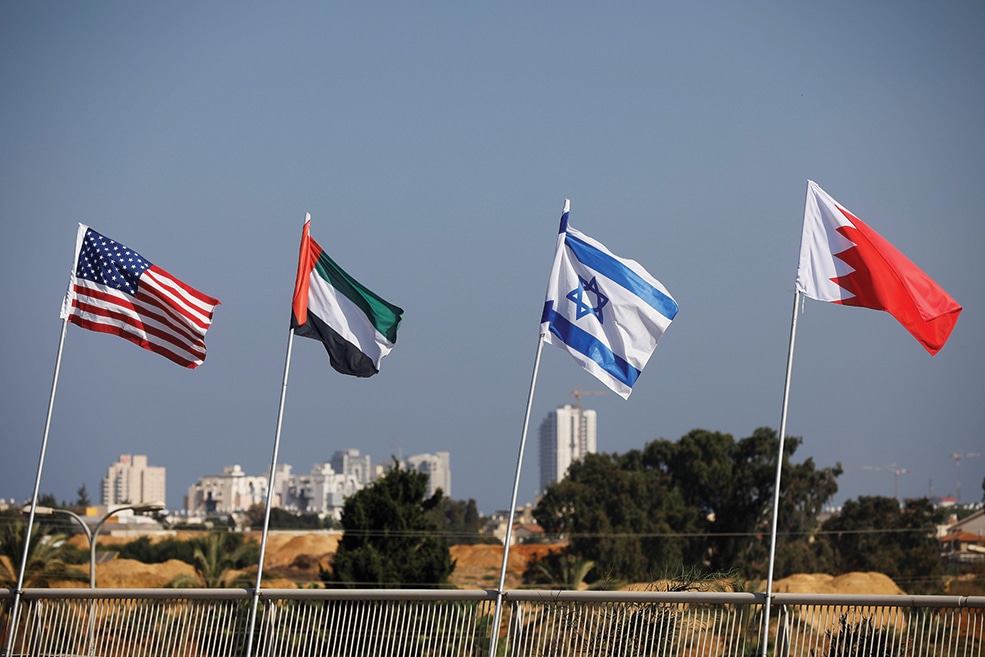
The flags of the United States, United Arab Emirates, Israel, and Bahrain flutter along a road in Netanya, Israel, September 14, 2020. REUTERS / Alamy Stock Phot

Dr. Mitch Glaser:

What practical differences do you think the treaties will make economically, politically, and even to tourism between the Gulf states and Israel?

Joel C. Rosenberg:

Well, if you notice, the first set of memorandums of understanding and other legal documents signed in the days leading up to and following the signing of the Abraham Accords were very practical. They indicate how much benefit both sides will get—or all sides are going to get—from these agreements. There are agreements on civil aviation. For instance, there will be direct flights between Israel and the United Arab Emirates and between Israel and Bahrain. Those are, by the way, going to go through Saudi airspace. The Saudis are not yet ready to make peace with Israel, but they have agreed to let Israeli, Emirati, Bahraini, and other planes fly through their airspace. This concession is a huge step forward.

The other agreements are regarding banking, private property rights, and setting up small business agreements. The United Arab Emirates has now required every hotel in the country to have kosher meals. That has not happened in Egypt; it has not happened in Jordan. We are talking about major financial deals already in motion.

Dr. Mitch Glaser:

Do you think that Oman and some of the other Gulf states are going to follow suit?

Joel C. Rosenberg:

Yes, I think there is a list of countries that are actively considering this. Oman would certainly be near or at the top of the list. The Sultan of Oman invited Prime Minister Netanyahu to visit two years ago, and then publicized that trip with photos and video. That was very dramatic. That sultan has since passed away. There is a new sultan in power, but there is no reason to think that he disagrees with his predecessor. But, does he feel like he has solidified his leadership and is ready to make such a big decision? That is a good question. I do not have an answer for that yet; we will see.

If Sudan were now to make peace with Israel, that would be exciting. It would be dramatic, but I would note that Sudan also figures prominently in a prophecy of a future war against Israel—the conflict known in Ezekiel 38 and 39 as the War of Gog and Magog. I would not hold your breath for a full normalization, but maybe that prophetic war is many, many years off. No one knows for sure, of course.

Dr. Mitch Glaser:

We do not know when these prophetic events will take place, right? So, we should take peace when we can get it!

Joel C. Rosenberg:

Exactly.

Dr. Mitch Glaser:

Have the UAE, Bahrain, or even some of the other countries you have mentioned considered Israel a place where they can invest funds? Such an investment would boost the Israeli economy.

Joel C. Rosenberg:

Yes. In talking to officials from both countries over the last few weeks since the signing of the Abraham Accords, I know that there are numerous business deals and venture capital deals in the works. Again, this is the most significant transformation in Arab-Israeli relations, I think, in the history of the modern State of Israel. These treaties will surpass the peace deals of Egypt and Jordan in the sense that the Abraham Accords are going to set the new model of what peace and normalization can be and what they should be.

Dr. Mitch Glaser:

Joel, I was privileged to follow your travels at times, as your friend, and was even invited to be part of one of those trips to visit some of the Middle Eastern countries. You brought several key evangelicals to visit, get to know, and extend goodwill to those countries. You were able to see the backstory unfolding in a lot of these nations. Can you tell us a little about what you have discovered?

Joel C. Rosenberg:

I would be happy to. It is extraordinary that evangelicals have had a front-row seat to what has been developing over the last several years. The Crown Prince of the United Arab Emirates, Sheikh Mohammed bin Zayed, commonly known by his initials, MBZ, invited me to bring a delegation of evangelical leaders to visit him in the capital of Abu Dhabi in the fall of 2018. I took a group of about ten evangelical leaders with me. Among other meetings that we had in the country, we spent two hours in the palace in an off-the-record meeting with MBZ. There are many things, unfortunately, that I cannot share, but I can share this now:  We communicated to the crown prince that, when it came to the issue of peacemaking and Israel, there were three things we, as evangelicals, wanted him to know.

President Donald J. Trump, joined by Bahraini Minister of Foreign Affairs Dr. Abdullatif bin Rashid Al-Zayani, Israeli Prime Minister Benjamin Netanyahu, and the United Arab Emirates Minister of Foreign Affairs Abdullah bin Zayed Al Nahyan, acknowledge applause and wave to the crowd after delivering remarks at the Abraham Accords signing, September 15, 2020, on the South Lawn of the White House, Washington, D.C. Geopix / Alamy Stock Photo

Number one, we love Israel, and we love the Jewish people, and, for evangelicals, this is a theological position, not a political position. He needed to know that we are deeply committed to Israel’s security, freedom, prosperity, and sovereignty. We wanted him to know that. Number two, Jesus commands us to love our neighbors. We did not want him to think that, because we love Israel, we hate the Palestinians, or Arabs, or Muslims more broadly. Some evangelicals have struggled with language or even positions that are not reflective of Jesus’ command. We wanted to communicate to him that we are commanded to love our neighbors. We do not always know how. We find our way, but we wanted him to know that we do not see it as either/or, that we love both. And while we believe that Israel has a special and unique place in God’s plan and purpose in the region, we want there to be peace today, and we want to build better relations with the Arab and Muslim world.

The third point we made to him was that we are commanded in the Scriptures to pray for the peace of Jerusalem. Sixty million evangelicals in the United States alone are praying for the peace of Jerusalem, and we are looking at who will be the next Arab leader to make peace with Israel. As the leader of the delegation, I was the one that made these three points and stressed a little on the third one, “We would love it to be you.” He shocked us by saying, “Joel, I’m ready. I am ready to make peace with Israel, and I believe that the time is coming very soon.” That shocked us because—and I am not saying that we would say these three things in some pro forma way—we did not expect anyone to say back to us what MBZ said. We have said this to numerous Arab leaders in the region; he was the first to say that he was ready.

The question we began to discuss with him is, “How did you get to that point, and where do you go from here?” In these last two years, I have stayed in very close communication with the inner circle around the crown prince. Even up through the summer, I was in direct communications with them because I am writing a non-fiction book that will come out in the fall of 2021, timed with the twentieth anniversary of the 9/11 attacks. Twenty years after 9/11, the book looks at who the bad guys were, who the good guys were, and how our fight with radical Islam is going. It also looks at which Arab countries are fighting radical Islam very actively, and which countries want a much closer relationship with the United States and are even trending toward peace with Israel. The third section will address, “What is the state of the Church and religious freedom in the Middle East?”

I have been working on this book with a lot of exclusive material from these six delegations that I have led. All that to say, it became clear in July, when I was here in Washington meeting with the UAE ambassador, that they were ready, that they had actually put an offer on the table for Netanyahu, through the White House, and that those negotiations were in motion. I said to myself, “You have got to be kidding me.” I knew they were heading in that direction, but it was dramatic.

I will say that I was surprised by how quickly things accelerated this summer, especially when the big topic in Israel was whether Netanyahu would annex or apply Israeli sovereign law over large swaths of Judea and Samaria, which the world commonly knows as the West Bank. That was Netanyahu’s objective all summer, and that seemed to preclude any possibility of peace with the Arab states.

I was making the argument that, while I support the expansion of Israeli sovereignty in Judea and Samaria—the biblical heartland—over time, I believed that a peace treaty with one of the Gulf states was a higher objective for Israel in the near term. And I was making that case publicly and in quite a lonely fashion. It is in part because I knew it was possible, but it still stunned me. It is like when you have been praying, as Christians, as Messianic Jews, for decades for the peace of Jerusalem. It is a little like praying for Peter to be released from prison, then he knocked on your front door, and you cannot even believe that he is standing there.

Dr. Mitch Glaser:

You are a bit stunned by it all.

Joel C. Rosenberg:

Yeah. We know that God can answer these prayers, but we do not always expect the answer to come so quickly! This summer was a game-changing moment.

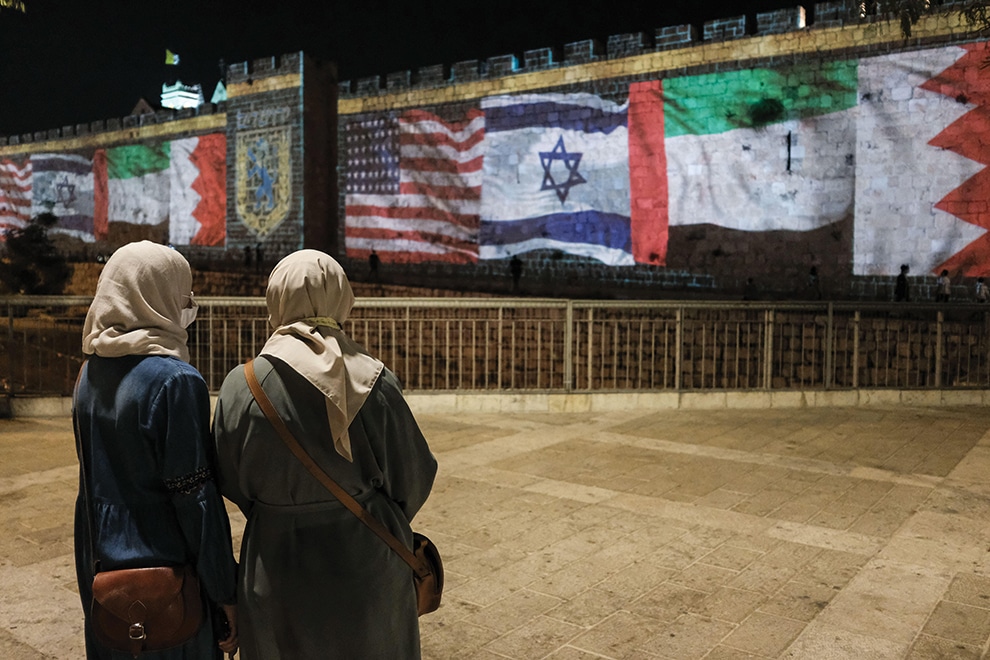
The flags of Israel, the United Arab Emirates, Bahrain, and the United States light up the Old City Walls of Jerusalem to celebrate the signing of the historic peace treaties in Washington, D.C. Nir Alon / Alamy Stock Photo

Dr. Mitch Glaser:

How are the Palestinians reacting to all of this? Then, if you could also tell us, how is the person-on-the-street, the average Israeli, responding to these new events?

Joel C. Rosenberg:

I have not seen any polling yet. Remember, and actually, it is hard to remember at times, that the Palestinian territories are not free societies. They really do not have the freedom to say whatever they want. It does not mean that you will not find Palestinians who tell you, but there, in Gaza, Hamas—the terrorist organization—is in charge. It is very hard to get somebody’s real, direct opinion. In the Palestinian Authority in the West Bank, this is tyranny. Mahmoud Abbas is now serving, I think, the fifteenth year of his four-year elected term. There is no freedom there.

I think we are beginning to see fissures inside Palestinian society. And so, we need to pray, as Christians and as Messianic Jews, for the Palestinian people.

Dr. Mitch Glaser:

Could you take one minute and tell us all about All Arab News and All Israel News, and your role as President and CEO of Near East Media?

Joel C. Rosenberg:

Yes, I am continuing my work to advance the Joshua Fund, which is essentially a mutual fund to invest in the growth and the strength of the Church and the Messianic body in Israel and throughout five neighboring Arab countries, as well as the Palestinian territories. We also believe that the media bias against Israel, against peace, against the values that we hold dear—anti-Christian media—is so bad that I decided to launch two new websites. One is called All Israel News, and the other is All Arab News. All Israel News is allisrael.com, and the Arab news is allarab.news.

We will provide links to all the really good and credible coverage in the Israeli press, Arab press, and American and other media. There is good reporting out there, but most Christians and Messianic Jews do not have the time to go sifting through dozens of websites to figure out what is real, what is important, what is credible. These sites will become what I call one-stop shopping. We link to all the most important stories in the region. We are also providing original reporting, exclusive interviews, and analysis: what is happening, why is it important, and how do we fit it into the larger picture as evangelicals. We are very distinctly and specifically focused on communicating to the world’s 600 million evangelicals what is happening in Israel and the region and why it matters.

Dr. Mitch Glaser:

Joel, thank you so much. I appreciate it, and we pray God’s blessings on All Israel News and All Arab News, and we thank you for your time, so shalom and blessings.

I am grateful for the time you were willing to speak with me. I know that those who read The Chosen People newsletter will appreciate this insightful information and pray for Israel, the Palestinians, the Middle East, and you.

Joel C. Rosenberg:

My pleasure.

I hope you enjoyed the interview! I hope it will help you continue to pray for the peace of Jerusalem. And please remember to pray for our staff who are bringing the gospel to Jewish people worldwide, including Israel.

We are so grateful for you!

Your brother in the Messiah,

Mitch Glaser

P.S. There is much more to this conversation! To hear the full interview, visit ourhopepodcast.com.

Leave a comment

Filed under Israel, Joel Rosenberg, Middle East, Palestinian

Another Look at Zionism

It is not often I offer an article from a newspaper as a blog. But, I want as many people as possible to read this piece by Michael Oren that recently appeared in the Wall Street Journal.

The piece is a passionate, reasonable and well-articulated appeal to those who might find themselves swayed by the current war with Hamas to either question or even denounce the fundamental validity of the Zionist movement.

I usually try to “stick” with the more biblical aspects of the issue but this time, I simply had to send this out. I was personally moved by Oren’s recounting of the rationale for Zionism and his basic theory that the best argument for Zionism is that it has worked! And he does an excellent job of explaining why.

Today many will say they support Israel but try as much as possible to separate support for the modern state of Israel with the term and “philosophy” of Zionism. Even some Christians and Messianic Jews who believe Israel has a divine right to the Land sometimes want to distance themselves today from the term Zionism. Over the years the term Zionism has been battered about and linked with racism in United Nations statements , which was later revoked by UMN resolution 46/86 in 1991. It has become a synonym for Middle East imperialism, racial intolerance and hatred for all Palestinians. Oren will convince you to reconsider if for some reason you are beginning to believe these things.

Unfortunately the problem has deepened, especially in parts of Europe and the Middle East as the line between anti-Zionism and anti anti-Semitism has been blurred leading to anti Jewish violence. Dr. Michael Brown develops this abhorrent shift from politics to racism in an excellent opinion piece written a few days ago. I suggest you read this as well.

So, for once I am not going to develop a line of theological argumentation that establishes the fundamental and biblical “right to the Land of Israel”, though I believe this is part of the overall story of Scripture. I understand that godly believers interpret the Bible differently and choose to respect and love one another and we do need to constantly learn how to disagree without becoming disagreeable. Though this is easier for us to say living safely in the US than for those of our brethren suffering in the midst of the conflict in Israel and other parts of the Middle East – like Mosul!

As you will read in Oren’s article there are some very sound “non-biblical reasons” for people, especially Christians in the West (allow me to be self centered for a moment!) to wince when confronted with the array of Zionist negativity so passionately argued today. I believe Oren provides provides critical information to help us stay balanced in the midst of the current anti Zionist onslaught that is beginning to seriously impact the viewpoint and actions of followers of Jesus.

http://online.wsj.com/articles/in-defense-of-zionism-1406918952?KEYWORDS=zionism

Pass the article along as well and remember that when you pray for the peace of Jerusalem we are praying for all the inhabitants of the Holy Land. (Psalm 122:6)

See: United Nations General Assembly Resolution 3379, adopted on November 10, 1975 by a vote of 72 to 35.
And: http://www.wnd.com/2014/07/the-fine-line-between-anti-zionism-and-anti-semitism/

Leave a comment

Filed under Anti-Semitism, Boycotts against Israel, Christ at the CheckPoint, Israel, Jews and Christians, Middle East, Palestinian

The Ground War Has Begun

The ground war in Israel is raging! We were of course hoping and praying that it would not happen, but Israel had little choice but to “move in” to Gaza and destroy the maze of Hamas tunnels and remaining rocket launch sites. Already thirteen Israeli soldier has been killed, and more will likely follow – the longer the war continues.

There are many news sites that you can utilize to get information, and one that I personally appreciate is JPost, the online version of the Jerusalem Post.

Another little-known source for news on Israel is www.dailyalert.org. This is a site that gathers information from many news sources.

We have also asked our Chosen People Ministries staff to keep us informed of all that is happening in Israel from an insider’s perspective and to make sure we have current prayer requests so that we can uphold the Chosen People Ministries team and various ministries in Israel during this difficult time. We will provide regular updates to keep you posted and praying! Just click here to see the latest news.

You can also listen to the recording of the teleconference we held this week with our leaders in Israel. I am sure you will learn a lot and be better able to pray for the peace of Jerusalem and for the work of Chosen People Ministries during this time – especially among some of the elderly Holocaust survivors who live in Sderot and other towns in the South that have been under incredible duress.

Click here to listen to the recording of the teleconference.

Please feel free to tweet the link so that others can learn more about what is happening in Israel today, and listen to our recent teleconference with our Chosen People Ministries staff on the ground in Israel.

Thanks for praying for the peace of Jerusalem.

Mitch

Leave a comment

Filed under Israel, Middle East, Palestinian

A Response to the Murder of Three Israeli Teenagers

It is hard to think about the usual matters of ministry after hearing about the three Israelis Yeshiva students who were mercilessly slain by terrorists. It is a reminder of how sinful and cruel our world can be and how our Jewish people continue to be subjected to such fierce hatred. These terrible circumstances also remind us that the is little time left for our work of preaching the Gospel.

I received the following note from one of our dear friends and supporters which also reminds me of just how much some Christians are moved by Gods love for the Jewish people.

This brother and friend writes,

Bro. Mitch,

When we learned of the news about the three kidnapped boys, we were deeply moved as we had been following this story daily in the online Israeli newspapers. I am privileged to teach an adult SS class each week and they enjoy being kept up to date on news from Israel. I use Powerpoint to show map locations, headlines, and had shown pictures of the boys with their names. I know people were praying for them.

What an opportunity to support Israel wholeheartedly when the circumstances are so clear. So I can only shake my head and realize that we are seeing prophecy unfold in my lifetime. Soon, Israel will be hated by every nation.

Thanks for your tireless efforts to reach God’s Chosen People with the Gospel about their Messiah.
——————

I am grateful for those who stand with the Jewish people and rejoice with the victories of the Jewish people and who and mourn for our people during the very dark times as we have experienced this week.

Please remember to pray for the families of those who lost their sons and for the people of Israel that they might be encouraged and kept safe during these trying times. As we know, Israel will not simply accept these murders and so times will certainly get tougher and more tense over the next few weeks…so pray fervently.

I prayed this prayer;

Father in heaven, we live in disturbing times. The innocent have been murdered and we have again come face-to-face with the cruelty of mankind. Our world needs redemption through your promised Messiah more than ever. Our hearts grieve for parents and siblings who lost their sons and brothers and for the whole household of Israel. We pray for the perpetrators as you told us to pray for our enemies. We pray that your justice will prevail and that those who killed these three teenagers will be brought to trial and punished for their crimes. Most of all Lord, we pray for peace in the Middle East. Please give wisdom to Israel’s leaders and to our own elected officials as battle against terrorism in Israel, Syria, Iraq and throughout the world. Thank you that we know through the promises of Scripture that your holy purposes will ultimately prevail and that true justice will fill the earth when your Son returns and rules on his rightful throne. Until then, Lord, please be merciful to us and we beg you – help us to find a way to stop terrorism and this continued slaughter of our innocents.

AMEN

3 Comments

Filed under Boycotts against Israel, Christ at the CheckPoint, Israel, Judaism, Messianic Jewish, Middle East, Palestinian

Dispelling Myths About Christians Who Support Israel

There have been a number of conferences, articles and events held recently about the Israel-Palestinian crisis that unfortunately promote myths and untruths about those of us who believe the Land of Israel belongs to the Jewish people by virtue of God’s covenant with the Patriarchs.

As always, there are dedicated and godly believers on both sides of these issues and our posture must always remain respectful in spite of deeply-held differences. However, we must also be honest with one another.

I usually try to remain positive and to keep the dialogue constructive, but this is becoming increasingly difficult. There are a growing number of untruths being promoted in the debate, and I am sorry to say that the rhetoric is also becoming harsher in tone.

This is why I want to take a moment and try and shed more light than heat on five of these critical untruths in the hopes that our dialogue will remain friendly, although it may be passionate. We must seek the truth and always treat each other in a way that honors the Lord. This can only happen when we respond to one another in love and clarity.

Myth #1 – Christians who love Israel do not care about Arabs, Muslim or Palestinians

Nothing could be further from the truth. Most of the Christians I know who support Israel do so because they believe the Bible, which includes John 3:16 – that God sent His son to die for the whole world. This includes Jews, Arabs, Muslims, and all nations and religious groups on the face of the earth. Most of us who support Israel and the Jewish people have a sincere love and compassion for the peoples of the Middle East.

Arguing that Christians who love Israel do not care about Arabs is a straw man argument, overly simplistic, naïve and untrue. Believing that God gave the land to the Jewish people does not mean that one automatically lacks compassion or concern for Palestinians and many others.

Myth #2 – Christians who believe that modern Israel is the fulfillment of prophecy believe that the government of Israel “can do no wrong”

This is also patently untrue. Personally, I do not know any Jewish person or Christian who believes that any government “can do no wrong.” This is once again a straw man argument designed to bolster a more radical fundamentalist Muslim narrative of the Israeli-Palestinian conflict.

We believe the land belongs to the Jewish people because it was promised to the chosen people in God’s covenant with Abraham, Isaac and Jacob (Genesis 12:1-3, 15:18-21, 26:3-5) and reiterated throughout the remainder of the Bible. We also believe that the long-awaited kingdom of God is coming, and the Messiah will reign upon His rightful Davidic throne. Only then will we witness a perfect government.

You might take a moment and go to videos.chosenpeople.com for the messages from our conference, The People, the Land and the Future of Israel for detailed biblical teaching on these topics.

Myth #3 – Christians Who Believe the Land Belongs to the Jewish People Unfairly Favor the Jewish People Over the Palestinians

Of course there are fringe “believers” on every side of an issue, and certainly this is true of Israel’s Christian supporters. It is perhaps less true today than in previous years amidst the euphoria of the formation of the state of Israel. However, many of those who are critical of Christian supporters of Israel do not believe that God granted the deed to the Land of Israel to the Jewish people. Therefore, any support for Israel is deemed “over the top” and “imbalanced.” The biblical teaching on land ownership seems to be getting lost in the shuffle of our varied narratives.

Can people be unfair? Of course – we are all sinners and we need to become more like Yeshua, filled with His love and compassion for all! As a Jewish believer I have felt the sting of anti-Semitism and know from first-hand experience that prejudice is hateful and destructive. We must ask God to cleanse our hearts of all prejudice and for the strength to treat others in ways that please Him.

However, it is unfair for enthusiastic support of Israel as a Jewish homeland, based upon an understanding of the Bible, to be deemed anti-Palestinian. This is indeed prejudice.

As Reb Tevya said in Fiddler on the Roof, “Next time choose somebody else!” It was not man’s idea to choose the Jewish people and give them a Land – it was God’s. Supporting Israel’s claim to the Land is not a question of fairness or unfairness! It is affirming God’s choice and celebrating and supporting His plan.

God regularly makes promises of blessing and judgment to specific groups of people. He even specified future blessings for Israel, Egypt and even Assyria:

In that day Israel will be the third party with Egypt and Assyria, a blessing in the midst of the earth, whom the Lord of hosts has blessed, saying, “Blessed is Egypt My people, and Assyria the work of My hands, and Israel My inheritance” (Isaiah 19:24-25).

Specific promises to specific people and nations are common throughout the Bible. This does not indicate favoritism, as God is fair and just. Yet it does demonstrate that God treats different groups differently according to His holy purposes.

Myth #4 – Jewish people do not yet have a right to the Land because they have not recognized Jesus as Messiah

Clearly, the majority of Jewish people alive today have not yet come to know Jesus as Messiah. If this were true – I would be blessedly and happily unemployed. However, our God of grace did not promise the land to the Jewish people on the basis of their deserving it, any more than the salvation we enjoy was earned (Eph. 2:8-9).

God never rescinded the covenant He made with Abraham, and that sacred agreement endures from generation to generation. The Jewish people have a divine right to the land at all times. God gave the land to the Jewish people as a gift.

Thus, Jewish ownership of the Land is always available to the Jewish people based upon the covenant God made with the Patriarchs, but peace will not come until the Prince of Peace reigns (Isaiah 9:6-7).

We now await the rest of the story as, according to the Bible, the Holy Land will experience the zenith of Shalom (peace) when the Jewish people turn to Jesus and He returns to reign as king (See Zechariah 12:10, Romans 11:25–29 et al.) In that day the nations of the world will join in the celebration as well! (Zech. 14:16-19)

Myth #5 – Jewish people lost their election and right to the land when they rejected Jesus

This is a basic tenet of what we called replacement theology. It goes like this – the Jewish people rejected Jesus, so God rejected the Jewish people – the Church then is the new Israel and has replaced Israel. Therefore, all the promises of God to the Jewish people are fulfilled in the Church. As a result, the promise of the land of Israel has been taken away from the Jewish people and can no longer be taken literally!

My response to this is to simply quote the Apostle Paul, who wrote in Romans 11:28-29.

From the standpoint of the gospel they are enemies for your sake, but from the standpoint of God’s choice they are beloved for the sake of the fathers; for the gifts and the calling of God are irrevocable.

Does this sound to you like God has rejected the Jewish people? Absolutely not!

If we begin our discussion by believing that God gave the Land of Israel to the Jewish people, then we can discuss the ways in which this might be effectuated peaceably and fairly.

On the other hand, if we do not believe the Jewish people have a divine right to the Land, then the discussion is really of a different nature. All we have left to talk about is politics and our mutual narratives and how we might live as believers in spite of our very deep differences. Another good discussion! Either way, the Scriptures reminds us to Pray for the peace of Jerusalem: “May they prosper who love you” (Psalm 122:6).

Our fervent prayers for the crisis can only help and lead us to work together towards the greater end of proclaiming the Gospel, so that individual Jewish people and Palestinians come to know Jesus as their Messiah.

This gives peace a chance!


Understanding the Arab-Israeli Conflict:
What the Headlines Haven’t Told You

Going beyond media images for an in-depth look at the conflict between Israel and the Palestinians, this book places the “crisis that never ends” in its scriptural, historical, and prophetic contexts.

Understanding the Arab-Israeli Conflict challenges the reader to think biblically as we stand with Israel in “praying for the peace of Jerusalem.” By Dr. Michael Rydelnik, professor of Jewish Studies at Moody Bible Institute.

Purchase at the Chosen People Ministries Online Store

10 Comments

Filed under Israel, Palestinian