Tag Archives: israel

Reaching Young and Old In Israel

Shalom in His peace.

I recently received a letter from Adam,* one of our long-standing Israeli staff members, and I was so moved that I wanted to share parts of it with you directly. His words offer a vivid picture of what God is doing day in and day out in the Holy Land through the faithful labor of our team there.

Adam is originally from Ukraine. He immigrated to Israel in his late teen years and came to faith in Jesus while living there. Please read his report and join us in praying for Israel’s remaining Holocaust survivors.

Adam writes:

After a very difficult and intense month, a ceasefire has come. We do not know how long it will last, but we are deeply grateful for these days of quiet. . . . We truly thank the Lord for His protection, mercy, and faithfulness during this time.

Even amid war, God has been moving powerfully.

During this time, the Lord opened many opportunities for us to share our faith. Because of your prayers and faithful support, we were able to reach and help hundreds of people, both physically and spiritually. Many experienced the love of Jesus in a real and tangible way. Dozens prayed for the first time in their lives, and some received salvation and accepted the Lord.

Despite all the challenges and safety restrictions, we continued to gather, study the Word, pray, and support people with the Lord’s help. Once again, we have seen that even in the darkest moments, His light continues to shine.

Ministry Among Holocaust Survivors

We have also remained committed to one of the most important parts of our calling—serving Holocaust survivors.

For more than twenty years, we have been helping these precious people by supporting them, and striving to allow them to live out their lives with dignity. Most of them are from Eastern Europe, with a large number from the former Soviet Union. Many live very modestly, often in need, having to save on even the most basic necessities.

But beyond their physical needs, many carry deep spiritual wounds. Because of the Holocaust, many lost their faith in God. Today, we are doing everything we can to bring them back to the God of Israel and to their Messiah, Yeshua (Jesus).

By God’s grace, over the years, many Holocaust survivors have accepted the Lord. Quite a few, of course, are no longer with us, and we look forward to meeting them again in heaven. Yet, there are precious survivors who have not yet heard the good news or come to know the Savior. We continue to do everything possible to bring the gospel to them.

For example, we recently  helped Jacob,* a 92-year-old Holocaust survivor, receive a hearing aid. At the clinic, I was asked why we help Holocaust survivors. It became an opportunity to share my testimony—how the Lord saved me and helped me—and to explain that we serve others by showing His love.

I shared that Christians around the world are helping a Jewish Holocaust survivor they have never met, simply because they love his people, his God, and his Messiah, Yeshua.

Israel marked Yom HaShoah, or Holocaust Remembrance Day, in April, when we honor the memory of the millions of Jewish people who perished. But we also continue to remember the living.

According to official data, about 111,000 Holocaust survivors are currently living in Israel. All of them are over the age of 80, and about 63 percent are women. Around 28 percent are already over the age of 90. Nearly half—49.3 percent—are widowed, and about 9,300 married couples consist of two survivors.

This group includes not only former inmates of camps and ghettos of Europe but also Jewish people from Iraq who survived intense persecution during the Farhud of 1941, and Jewish people from Morocco, Algeria, and Tunisia who suffered under the Vichy regime. About 70 percent of survivors in Israel were born in Europe, with the largest group—around 46 percent—coming from the former Soviet Union. Approximately 27 percent were born in Asia and Africa. Today, 40,136 Holocaust survivors who immigrated since 1989 live throughout Israel.

These are not just numbers. These are lives—precious souls, many of whom have not yet heard the message of hope and salvation. Please pray with us that Holocaust survivors would find hope and faith in their Messiah.

Ministry Among Children and Families


While we care deeply for aging Holocaust survivors, we also have a great heart for reaching the next generations of Israelis. We maintain a robust schedule of ministries among young families, including children’s camps and family retreats. These programs always include worship and teaching from the Bible. Parents are fully aware that we are Jewish believers in Jesus and that our schedule includes teaching from the New Testament; still, not-yet-believing families regularly participate. We find parents genuinely willing to involve their children in programs that are producing such positive results in their lives.

Adam writes:

Ilona* came to our camp quite recently—and almost by accident.

Her grandmother, a Holocaust survivor, has been attending our Holocaust survivors’ club at the Messianic Center in Jerusalem for many years. She has come to faith in the Lord, loves our ministry deeply, and has always been enthusiastic about our programs.

For years, she asked us to invite her granddaughter to camp. However, we could not do so without parental permission. Ilona’s father is Orthodox Jewish and her mother is more secular, but neither was willing to send her.

Last year, perhaps due to the difficult situation in Israel, they finally agreed.

Ilona loved camp. When she returned home, she shared everything she experienced with great joy. She began singing worship songs at home, and her parents noticed a significant change in her.

Soon after, her mother called us. She said that Ilona was so impacted by the biblical lessons and spoke about them so passionately that she herself wanted to learn more about our faith.

We met together, had a meaningful conversation, and invited the whole family to a family camp. To my great joy, they came—and they loved it.

Today, this is one of the families we meet with regularly. They are very close to coming to faith. Ilona and her parents now frequently attend our events, and we continue to pray that the Lord will draw them fully to Himself.

Camps for children and families have proved especially important in recent years. In the weeks following Hamas’s barbaric attack on October 7, 2023, our staff stepped up once again, organizing day activities and overnight retreats to help traumatized children play, laugh, and simply be kids again. These programs proved a lifeline for families facing profound uncertainty.

This need—to give children who have been through so much a taste of what childhood should be—has only grown. The war with Iran has sent Israelis into bomb shelters day and night. This is especially difficult for young children who, from an early age, have had to learn to live with danger and trauma, and for the elderly who often cannot reach a shelter in time. Even in the bomb shelters, our staff is reaching out to others with hope.

We are always clear about our faith, and we never minister to children without parental knowledge and permission. Many of our programs are family camps, which bring adults and children together for fellowship, fun, and hearing the Word of God. We also make sure Israelis know that we could not do any of this without the loving support and prayers of Christians in the United States—and they are deeply moved to hear it.

What you are reading is just a sample of the faithful work our missionaries do each day. Thank you for your support, which allows us to be the hands and feet of our Messiah in the very land where He taught, died, and rose again.

Leave a comment

Filed under evangelism, Holocaust Survivors, Israel, Jewish Christian Dialogue, Jews and Christians, Judaism, Messianic Jewish, Uncategorized

Reflections from the Bomb Shelter: A Journey from Uncertainty to Hope

Below are some thoughts and reflections from our Chosen People Ministries staff in Israel that we hope will encourage you to pray for us and for Israel.

Since February 28, life has taken on a very different rhythm—one shaped not by calendars or plans, but by sirens, alerts, and the urgent need to move speedily. People have tried to piece together what is happening and what it might mean to the country and to them personally. But beneath it all is a growing awareness that this would not pass quickly. 

What began as rising tension soon became something far more personal and sustained. In the early days, there was panic, confusion, and a quiet disbelief. Phones buzzed constantly with updates. News came in rapidly from all around our small country. Missiles were launched, shrapnel fell, property was damaged, people sustained injuries, and the prayer of our hearts was, “Please Lord, save my family and me.” 

Then the sirens disrupted the day and pierced the night. At first, running to bomb shelters caused an almost surreal feeling. Families moved fast, gathering what they could, and trying to remain calm, especially for the sake of the children. Adrenaline was rushing through us, keeping us alert amid the ever-present danger. Thankfully, we had moments of quick clarity and were able to thank God that humans are fearfully and wonderfully made—especially when threatened.

So, we turned to the Lord: “I will lift up my eyes to the mountains; from where shall my help come? My help comes from the Lord, who made heaven and earth” (Psalm 121:1–2). These words, once familiar, have become deeply lived. Not recited casually, but held onto—sometimes tightly—in moments when there is little else to steady the heart.

As the days turned into weeks, the interruptions changed everything. We were at war, our family routines were hard to keep, and stability was elusive. Life became fragmented. Meals were interrupted. Conversations stopped mid-sentence. Sleep became shallow—never fully settled, we were always ready to respond. The body learned to remain alert. Our minds never fully rested.

The bomb shelters themselves became places of refuge and quiet tension. Adults exchanged glances that carried more weight than words. Some tried to ease the atmosphere for the children by telling stories and making small jokes. Others sat silently, listening for updates, calculating risks, and praying.

In those confined spaces, faith was not theoretical but immediate: “The Lord will guard your going out and your coming in from this time forth and forever” (Psalm 121:8). For many, this promise became a literal lifeline—and not some distant truth. The Lord held us close even as we were in and out of shelters three, four, five, or sometimes six times a day. We would lie awake at night and wonder what the next hour might bring. Would the ballistic missiles be intercepted, and our Israeli defenses hold secure? As the weeks continued, the question of safety shifted. What does it mean to feel safe when unpredictability is what is most predictable? Life advances cautiously, thoughtfully, and sometimes hesitantly. 

For the children, this season has been especially challenging. Days, months, and years of preparation and drills at school had taught the children how to respond. They are strong and resilient yet hold so much fear. On the playgrounds, they drop their balls and jump ropes and swiftly move to the nearby bomb shelter. Some children are anxious and need reassurance over and over again. Others appear outwardly calm, quickly reacting when the siren sounds, yet carrying a quiet angst beneath the surface. You can see it in their eyes, in how closely they stay near their parents, in how they listen, and in their body language. 

Parents are carrying a double burden; they are managing their own fears while absorbing the fears of their children. They try to speak honestly, yet calmly, even when they feel uncertain. They wonder how they will pay their bills while unable to work.

But we are a resilient people. As soon as the ballistic missile and falling shrapnel threats pass, people come back to their seats in the café and continue their work meetings or exercise routines. Life goes on because the Jewish people have been through this before; we have lived through persecution, pogroms, expulsion, and exile. Yet, the people of Israel have survived. We constantly remind ourselves that this time, we get to persevere in our own land! Our people have had it much worse than this. Community endures. In many ways, it has deepened. People check on one another more intentionally, they share what they have, and they show up, even when tired or uncertain.

The hopeful words of the Psalms have taken on new meaning. “Pray for the peace of Jerusalem: ‘May they prosper who love you’” (Psalm 122:6) is no longer merely a sentiment, but rather a deeply personal, urgent, and constant cry to the God of Israel for help. It is prayed in homes, in shelters, and in quiet moments between interruptions.

Spiritually, this season has been both stretching and refining. In the early days, prayers were immediate and direct: “Lord, protect us,” “Keep the children safe,” “Provide for our needs, “Keep our soldiers safe,” and “Let this end quickly.” Those prayers remain, but they have been transformed and internalized so they are now as automatic as breathing itself. We are having honest, unfiltered moments of wrestling. We ask ourselves, “How long will this last?” “How do we reconcile fear with faith?” “What does trust look like when circumstances remain unresolved?” and “Where is hope?” 

Yet, amid this tension, something deeper is forming within our very souls because “we know that God causes all things to work together for good to those who love God, to those who are called according to His purpose” (Romans 8:28). Difficult as it is at times, we grasp this truth; but more importantly, we hang on to the Lord of that promise. Even when circumstances feel chaotic, there is a growing conviction that God is not absent but is still working, even here and now. Faith, in this season, is not abstract. Faith is life itself. It is lived out in bomb shelters, in whispered prayers, and in quiet decisions to trust again and again without full clarity.

We know that national salvation can be a long process, just as it was for the ancient Israelites wandering in the wilderness. National redemption requires endurance. It is a marathon, especially when there is no finish line in sight. The adrenaline has faded, and Spirit-empowered perseverance is the order of the day. We have learned survival lessons that will help us stand the test of time until He comes, and there will be no need to fight! We have learned how to respond urgently, how to comfort children more effectively, how to build small routines in unstable conditions, and how to care for one another. 

Yet, the cost is both real and a burden to carry. There is physical, emotional, and spiritual fatigue. There are moments when the weight feels unbearable. And yet, there is something else: a quiet strength that seeps into our souls. It is not loud or dramatic, but deeply real. We are determined to endure, to serve the Lord above all, to entrust ourselves into His mighty and loving arms, and to stay true to His promises to us personally and to our people. 

We know He has the last word on the redemption of the Jewish people, and we wait in hope for that day to come. As the apostle Paul, our great Messianic Jewish forefather, wrote, “Therefore, my beloved brethren, be steadfast, immovable, always abounding in the work of the Lord, knowing that your toil is not in vain in the Lord” (1 Corinthians 15:58). 

Stand with Our Israel Staff

Our team in Israel continues to serve through this crisis by providing biblical counseling, distributing food and supplies, and sharing the hope of Jesus the Messiah.

Please join us in prayer for: 

Our staff families in Israel—that parents would have wisdom as they carry their own fears while comforting their children through ongoing uncertainty.

The children—that God would guard their hearts and minds and that the trauma of sirens and shelters would not define their sense of safety.

Endurance—that Spirit-empowered perseverance would sustain them through a season with no clear end in sight.

Provision—that families unable to work due to the crisis would have their material needs met and not carry the burden of financial anxiety alone.

The peace of Jerusalem—that God would bring the people of Israel both physical safety and a deeper awareness of the God who redeems.

Thank you for your prayers and support.

Leave a comment

Filed under Israel, Uncategorized

Christians Still Support Israel

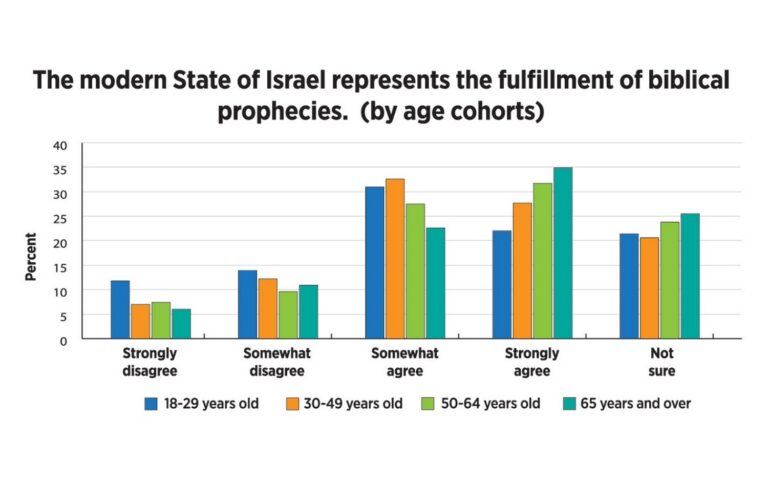
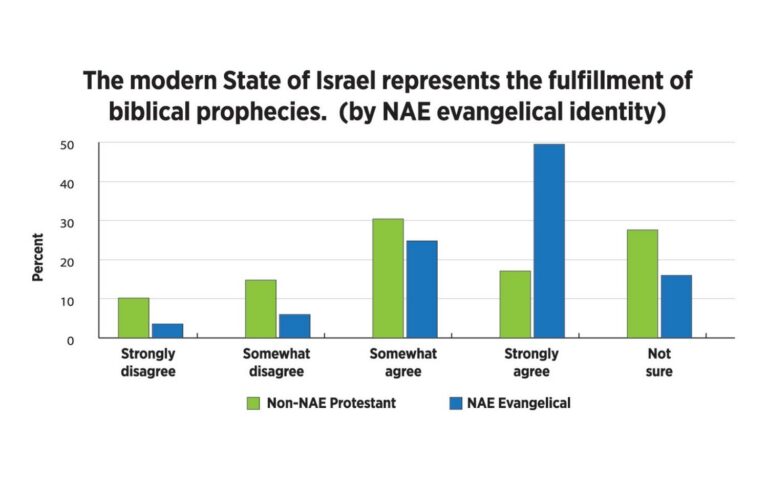
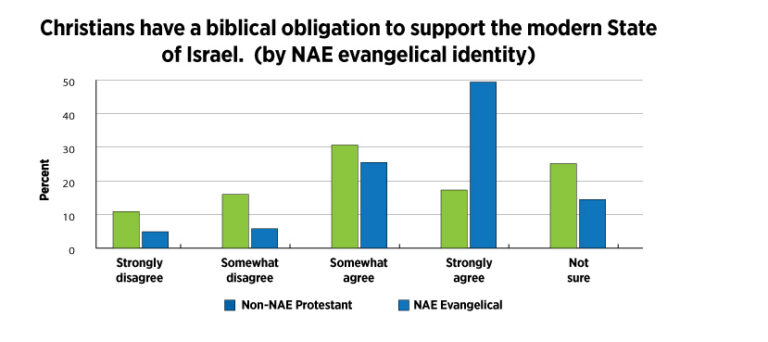
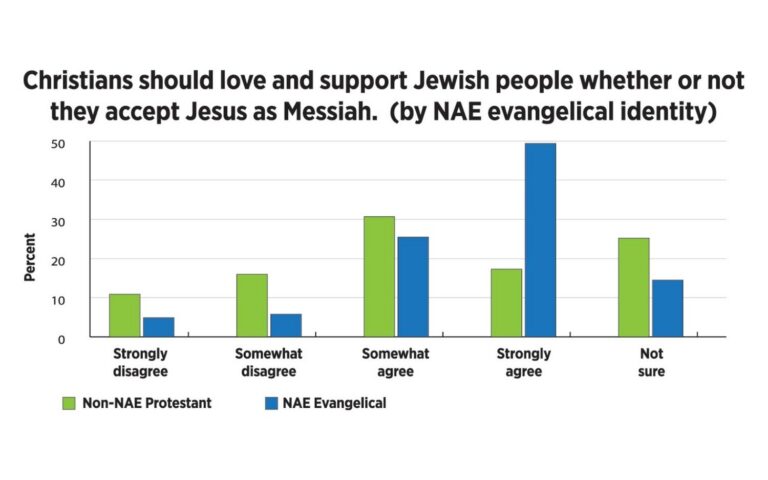
The results of our latest survey are so encouraging! The graphs presented here are only a small sample of the much larger study, but represent the significance of the findings. As you review them, it is important to understand some of the terminology. 

The NAE is the National Association of Evangelicals. For the purpose of this survey, evangelicals are people who hold to the four core beliefs established by the NAE as primary characteristics of evangelicals. An evangelical believes: (a) the Bible is the ultimate authority; (b) people must be transformed through a “born-again” relationship with Jesus; (c) Jesus’s sacrifice on the cross makes such a transformation possible; and (d) faith should find expression in action, especially in sharing the good news of Jesus with others.

We hope you find these results as exciting as we do! The full survey will be available soon, so watch for the link in upcoming letters. Until then, be of good cheer, we are not alone! 

If you think that younger people are turning away from God, think again! Roughly 77 percent of evangelicals sixty-five and older believe that the State of Israel fulfills biblical prophecy. The number drops to just under 60 percent for the fifty to sixty-four group, and remains at 60 percent for those between thirty and forty-nine. Though there are fewer eighteen-to-twenty-nine-year-olds, it is still more than half, at 53 percent, and an additional 21 percent say they are not sure. God is at work in our young people, which we can see across all of the charts.

When you take into consideration how people identify themselves regarding the definition of “evangelical,” it is not surprising that those with a high view of the Bible are more likely to see Israel as fulfillment of prophecy. More than 75 percent of those who identify as evangelical agree that Israel is the realization of ancient prophecy. 

Supporting the modern State of Israel is not political. It is not giving the country’s administration a license to do as they please. However, biblical support of Israel acknowledges their right to exist and their God-given right to the land. Among evangelicals, just under 75 percent view such support of Israel as a biblical obligation for believers.

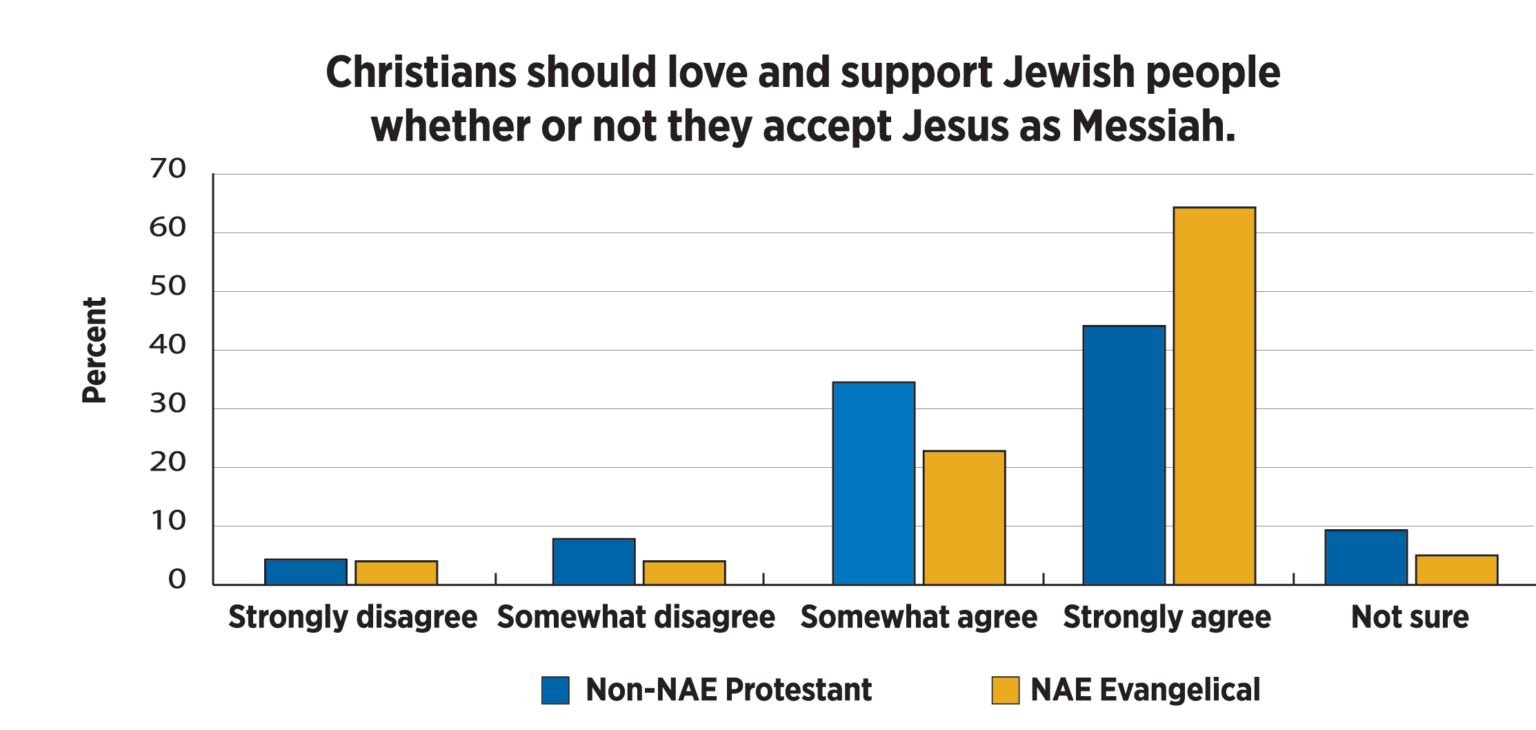
This graph is one of the most encouraging in the study. Many Jewish people view Christian evangelism as self-serving in some way. That is, Christians are only interested in Jewish people to convert them. According to the survey, nothing could be further from the truth! An astonishing 87 percent of evangelical Christians agree that believers should love and support Jewish people without consideration of whether or not they accept Jesus as Messiah.

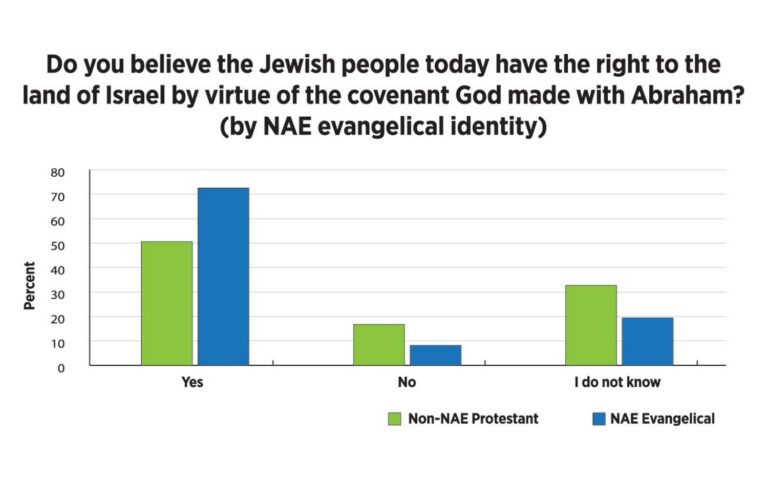
Consistent with other results, evangelicals, who view the Bible as authoritative, generally see the Abrahamic Covenant as the source of the Jewish people’s right to the land of Israel. Less than 10 percent said otherwise.

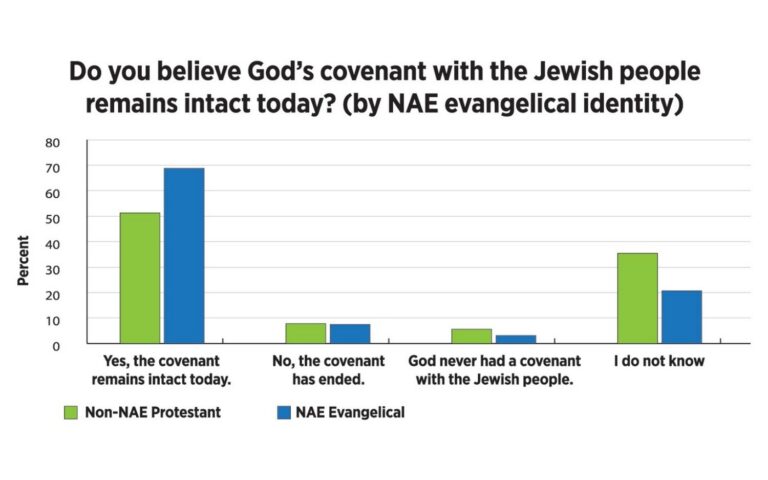
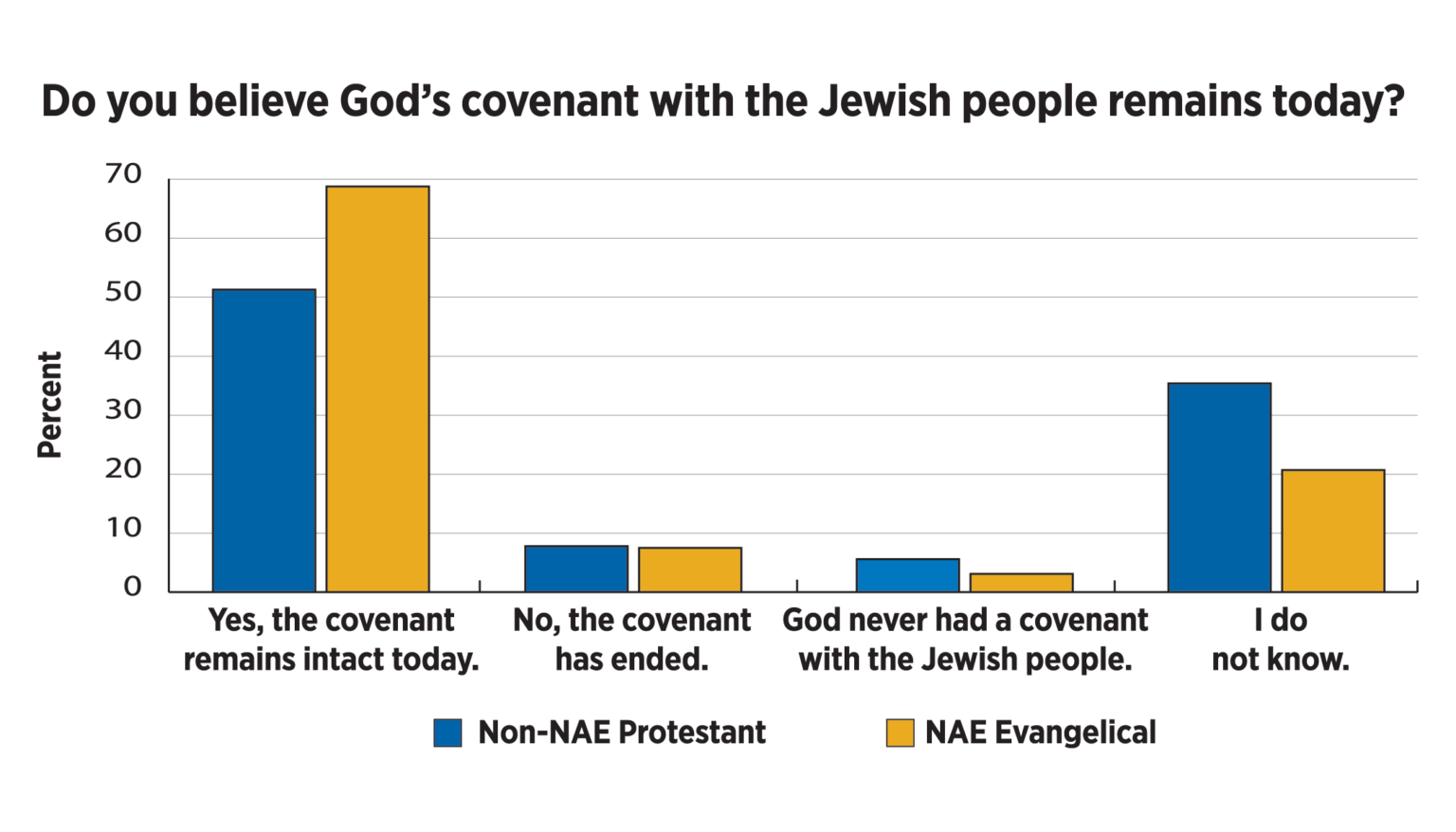
This graph is also very encouraging! As the world grows more and more hostile toward Jewish people, almost 70 percent of evangelicals acknowledge that God’s covenant with the Jewish people is still intact. With this view, God still has a plan and a purpose for the Jewish people and the nation of Israel in the future.

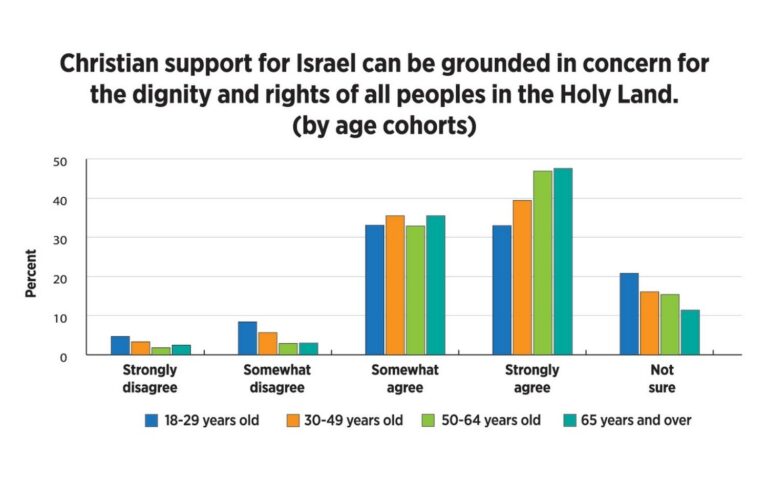
Israel’s right to the land need not exclude non-Jewish residents. Of those evangelicals who believe that the land of Israel belongs to the Jewish people, 82 percent are also concerned with the rights and the dignity of all others in the land. The others include Palestinians, Druze, Muslims, and various Christian minorities.

Leave a comment

Filed under Uncategorized

Most Christians in the United States still support Israel and the Jewish people!

We know this because we sponsored a survey in December 2025 where we asked American Christians about their views on Israel and the Jewish people. An independent firm deployed the survey and analyzed the data to ensure it was high quality and as objective as possible.

We were almost certain that Christians would be less supportive of Israel because of all the negative reporting about Israel and the rise of global antisemitism, especially in the aftermath of October 7, 2023. But I am happy to tell you after our recent and very comprehensive survey of Christians that this fear is unfounded. While the anti-Israel antagonists received a lot of attention, they do not outnumber the number of Christians who still love Israel and the Jewish people.

This letter is my way of saying thank you! Thank you for standing with Israel, praying for Israel, and supporting our work to reach God’s chosen people around the world. I hope you are as encouraged as I am as you read our analysis about these new survey results. Most Christians, especially those with a high view of Scripture, support Israel. As the leader of a historic, 132-year-old Mission to the Jewish people, I know that Christian attitudes toward God’s people make a world of difference in our witness. A genuine love and concern for Jewish people should be our motivation to share the gospel.

Christians Remain Strongly Pro-Israel

The numbers are clear. What encourages me is not only the steadfast support of Israel but the reasons for Christian support of Israel. Far too often Christian Zionists are accused of caring about Israel only because some see Israel as playing a key role in the end times.

While I believe Israel’s critical role in the end times is biblically accurate (Matthew 23:37–39Romans 11:25–29Zechariah 12:10), we found that Christians love Israel for a deeper and very biblical reason! The survey shows that Christians stand with Israel because they believe that God’s covenantal promises to the Jewish people are as true today as in the days of our forefather Abraham.

Let’s take a moment and explore this more deeply.

Why Do Christians Support Israel?

Core Theological Commitments

I need to explain a distinction we made—for the first time—on this round of surveys. We wanted to know how evangelicals’ views compared with other Christians who held positions outside the standard evangelical beliefs. So we asked respondents whether they agreed with these four statements from the National Association of Evangelicals (NAE):

  1. The Bible is the highest authority for what I believe. 
  2. It is very important for me personally to encourage non-Christians to trust Jesus Christ as their Savior. 
  3. Jesus Christ’s death on the cross is the only sacrifice that could remove the penalty of my sin. 
  4. Only those who trust in Jesus Christ alone as their Savior receive God’s free gift of eternal salvation.

Those who strongly agreed with all four statements were labeled “evangelicals,” and we compared their answers to others who identified as Christians but could not strongly agree with these beliefs. This makes a huge difference.

Belief in the authority of the Bible, the centrality of Christ, and the need for evangelism consistently correlate with stronger support for Israel and Jewish people. This connection does not surprise me at all! But now we have the numbers to show it.

The survey also revealed another truth that is foundational to our ministry: Standing with the Jewish people and believing that Jesus the Messiah is the only way to salvation are not mutually exclusive! Respondents were asked whether they agree with the statement “Christians should love and support Jewish people whether or not they accept Jesus as Messiah.” Among those who reported strong agreement that salvation is in Christ alone, 87 percent agreed with this statement.

We do not stand with Jewish people as some type of evangelistic strategy. We share the gospel because we believe spreading the message of eternal life is the most loving act we can do. Our love and concern for Jewish people are not a means to an end. We love because that is what our Messiah calls us to do.

God’s Covenant with Israel

Most evangelicals (69 percent!) and others who profess Christianity (51 percent) believe that God’s covenant with the Jewish people remains intact today. Note that evangelicals (who agreed that the Bible is the highest authority for what they believe) were 18 percent more likely to affirm God’s ongoing covenant. The survey analysis states that this belief “consistently emerges as one of the strongest reasons for why a Christian supports Israel.”

In our most recent survey, those who affirmed that the Abrahamic covenant (Genesis 12:1–3) is still valid were 81 percent more likely to express strong support for Israel. This confirms what I have observed over decades of speaking in churches and meeting Christian leaders from around the world: Affirming the covenant God made with Abraham and taking it literally leads to the support of Israel today. 

God repeatedly and specifically promised to give a particular land to the descendants of Abraham, Isaac, and Jacob (Genesis 15:18–2128:13). If we take these promises at face value, and pair this with the fact that the modern State of Israel is now home to more than half the world’s Jewish community, then we can conclude that Christian support for Israel today is not grounded in ever-changing Middle East politics but in God’s unchanging Word. Believing that God has an eternal covenant with the Jewish people does not mean endorsing everything Israel’s government does. But it does mean we accept the right of the Jewish people to live in, protect, and govern the land of Israel.

Another promising insight from this part of the survey is that 21 percent of evangelicals and 35 percent of other types of Christians were not sure whether the covenant is intact. In a way, this is good news because these people—a significant portion of respondents—are not ruling out the ongoing nature of the covenant. They just do not know either way. This represents an opportunity to educate our brothers and sisters in the biblical view of Israel. These numbers should encourage you to persevere in praying for Israel, sharing the gospel with Jewish people, and equipping other Christians to do likewise.

Our Rebuilding Israel Tour

One of the best ways to experience the importance of Israel—in the Bible, now, and in the future—is to visit. I am excited to invite you on our Rebuilding Israel tour from October 20–30, 2026. This is your opportunity to see the land of the Bible and discover how God is working in Israel today. We will tour biblical sites, visit our Messianic centers in Jerusalem and Tel Aviv, and meet Israelis who have come to faith in the last few years. To learn more and register, go to chosenpeople.com/event/rebuilding-israel-tour/. Again, I want to thank you for standing with Israel. Because of you, we are not alone!

You are a blessing to our worldwide staff who are bringing the good news to Jewish people in Israel, the United States, and a total of twenty countries around the world through Your Mission to the Jewish People.

Leave a comment

Filed under Uncategorized

Finding Hope in an Ancient Song: Psalm 22

Shalom in His grace! We all recognize that we are living in tough times. Wars in Israel and Ukraine, rising domestic violence, political and cultural polarization, and economic uncertainty cast a shadow on our lives as we try to do what is best for our family, ourselves, our communities . . . and our country! We are trying to stay positive and healthy at the same time, which makes hanging on to hope more important today than in days gone by. If we are to be fully honest with ourselves, each one of us is looking for solutions to the everyday stress that plagues our path during seasons of unrest. 

We need to find hope in a dark and difficult world.

So, let us take a few moments and explore how we might find a source for hope that can fuel the inspiration and encouragement we need to keep our lives and those of our families healthy and moving ahead, and to be both happy and productive.

The World is Turning Against Israel and the Jewish People

For those of us who are Jewish, we often feel like the entire world is turning against Israel and the Jewish people! We cannot avoid following what feels like a never-ending war between Israel and its neighbors. We recently memorialized the second anniversary of the October 7, 2023, attacks by Hamas upon the Jewish people. That day remains seared in our collective memory—a day when thousands of terrorists stormed across Israel’s border to murder, rape, and kidnap innocent men and women, young and old.

What makes this tragedy even more devastating, if you know the geography of Israel, is that many of the victims had dedicated their lives to building bridges with their Palestinian neighbors, which is why they chose to live on the Gaza border. Many of those killed believed in the possibility of peace and the dream of a unified society where Israelis and Palestinians could coexist. Hamas and Palestinian Islamic Jihad met their hopeful, outstretched hands with hatred and violence.

The war that followed has so far claimed the lives of more than 1,000 young Israeli soldiers and countless innocent Palestinian civilians—victims of Hamas and other jihadist groups who have shown no mercy even to their own people. The conflict has spread, and Israel continues to face attacks from Lebanon, Yemen, and Iran, while antisemitism surges around the globe. Just when we thought it was safe to be Jewish in the modern world, the oldest hatred has reared its ugly head once again. We live in tumultuous times! It is natural to ask where we should turn for hope and comfort.

A Psalm of Abandonment and Hope

For Jewish people, it is easy to feel abandoned once again by the God who promised us that He would never leave us or break His covenants and promises with our people. After the Holocaust, countless Jewish people asked, “Where was God when six million of our people were being slaughtered?” Today, we find ourselves asking similar questions, such as, “Where was God on October 7?” or “Where is God now amid such intolerable suffering?”

How can we come to grips with our disappointment and find ongoing hope in His promises?? 

These are not new questions. They are as old as humanity itself and find a most soulful expression in the songs of the psalmist king. In Psalm 22, King David cried out with startling vulnerability: “My God, my God, why have you forsaken me? Far from my deliverance are the words of my groaning. O my God, I cry by day, but You do not answer; and by night, but I have no rest” (Psalm 22:1–2).

Here we find a king—anointed by God Himself—feeling utterly abandoned. David did not pretend everything was fine. He did not offer vague statements about God’s mysterious ways. Instead, he gave voice to the question that haunts every human heart in times of crisis: “Where are you, God?”

I love the humanity of the biblical authors, especially as seen in the life of King David. He was worn out and weak, but, unlike many of us, he admitted it! He did not hide behind his throne or shade his real-life struggles with pious language. He simply told the truth about his experience.

David’s raw humanity and honesty are a foundation for healing and hope. He understood his own need for comfort and even transformation. He penned: “Yet You are holy, O You who are enthroned upon the praises of Israel. In You our fathers trusted; they trusted and You delivered them. To You they cried out and were delivered; In You they trusted and were not disappointed” (Psalm 22:3–5).

David placed his personal suffering within the larger story of his people, which is one of deliverance—of promises and hope fulfilled, even in his darkest hours.

From Despair to Declaration

The psalmist continues his journey from asking despairing questions to discovering a quiet confidence of hope and trust in God. By the end of the psalm, David made an extraordinary declaration: “Posterity will serve Him; it will be told of the Lord to the coming generation. They will come and will declare His righteousness to a people who will be born, that He has performed it” (Psalm 22:30–31).

What refashioned David’s cry of abandonment into a song of hope? It was not the absence of suffering, as the psalmist never denies the reality of his personal pain. Instead, David’s songs gave voice to a transcendent hope that rose above his difficult circumstances. The God of Abraham, Isaac, and Jacob called David “a man after His own heart” (1 Samuel 13:14)—not because David was perfect, but because he knew where to turn when attempts to find perfection failed him. David understood something profound about the human condition and the darkness of our hearts—our greatest strength often emerges from brokenness and defeat rather than from victories.

Hope for Today

Whether you find yourself wrestling with trauma, war, regret, or loss, Psalm 22 meets you exactly where you are. It speaks to the parent worried for their child’s safety, the soldier carrying both visible and invisible wounds, the young person questioning their future, and the older person weakened by age and reflecting on a lifetime of many joys and too many regrets.

I invite you, regardless of your background or beliefs, to explore these ancient songs that have sustained the Jewish people through exile and persecution and led to celebration and renewal. David’s words lead us to the hope he enjoyed through his deeply personal relationship with the God of Israel.

For millennia, everyday people have found comfort through the Psalms irrespective of their faith tradition. The Psalms welcome doubters, questioners, and the brokenhearted to encounter God Himself! The Psalms are so helpful for those who are struggling with faith or even questioning the existence of the God through whom King David found strength.   

Hope Amid Rejection

In Psalm 22, David moves from complaint to praise and from suffering to hope. The Psalm reveals the arc of faith itself, which is not a neat, tidy progression, but a genuine journey from darkness to light. When Jesus quoted this psalm from Golgotha, He reminded all within earshot that His story, too, was a journey from death to life, from crucifixion to resurrection, and from apparent defeat to ultimate victory.

Both Christians and Messianic Jews believe the Messiah, Yeshua (Jesus), quoted the first verse of Psalm 22 while hanging on the cross.He cried out,“My God, my God, why have You forsaken me? Far from my deliverance are the words of my groaning.

When we find ourselves crying out, “My God, my God, why have you forsaken me?”, we are joining a dialogue that started with David and one Yeshua reiterated—a conversation that concludes that feeling forsaken is not the same as being forsaken. The God who seemed absent was there all along. The God who appeared silent was orchestrating a symphony of circumstances leading to hope, which one only needed to recognize.

God’s presence is at the very heart of Psalm 22 as He makes His presence known to us during hard times in ways that we can miss when we are riding the tide of success and approval. The hard times teach us to trust the Lord, and so often His presence is far more powerful amid our struggles than in times of great triumph. It permits us to be honest about our pain, enables us to be persistent when we do not hear an answer, and provides the realization that our story does not end with abandonment, but rather with a full-on encounter with His love.

Psalm 22 is one of those great poetic and prophetic moments that leads Christians and Jewish people to seek a deeper and more intimate relationship with God, even when it seems as if our loving Father is not listening! The question we must ask ourselves and of the Lord Himself is, “How do we find this relationship with the God of Israel?” We need to ponder this question and that of the Messiah’s role. More specifically, we need to consider the Messianic psalms like Psalm 22 that find their fulfillment in the person of Jesus the Messiah.

As a Messianic Jew who has found Jesus to be the Messiah, this matter has been settled for me. If you do not yet have a deep personal relationship with the God who loves us, I hope you will continue to search for Him. I encourage you to keep reading, and if you do not have His shalom—a peace that transcends all human difficulties—my prayer is that you will keep reading and discover the One, the Messiah, to whom David pointed and through whom we can find peace with God! 

Leave a comment

Filed under evangelism, Israel, Jewish Christian Dialogue, Uncategorized

Two Years Later: Reflections on October 7 and Our Mission in Israel

As we mark two years since that devastating morning of October 7, 2023, I find myself reflecting not just on the horror of that day, but on what it means to love Israel—both as a Jewish person and as a believer in the Jewish Messiah, Yeshua (Jesus).

A Personal Connection to the Land

I grew up looking at pictures on my grandmother’s wall of relatives I would never meet—family members slaughtered in the Holocaust. So for me, as for so many other Jewish people, Israel represented something profound: a Jewish homeland rising from the ashes of our people’s greatest tragedy.

Now, as a Jewish believer in Yeshua, I feel more connected than ever to the land where He walked, taught, and gave His life. As a lover of Israel, my heart is heavy this month, two years since Hamas’s barbaric massacre in Israel on October 7, 2023. More than a thousand terrorists invaded the country, slaughtered more than 1,200 people, and took 251 as hostages.

The Current Reality: Numbers That Break Our Hearts

The statistics from October 7 and its aftermath paint a devastating picture:[1]

Hostages:

  • 251 precious souls taken hostage on October 7
  • 148 released through exchanges (8 of these are deceased)
  • 49 bodies retrieved by Israeli forces
  • 8 hostages rescued alive
  • 50 remain in captivity—Israel believes 28 are deceased
  • Among those still held, 2 people are from Thailand, 1 from Tanzania (confirmed dead), and 1 from Nepal
  • 4 additional hostages have been held since before the October 7 attack

Military Casualties:

  • 898 Israeli soldiers killed since October 7 in the Gaza war
  • 70 police officers killed
  • 329 (of the total number of Israeli soldiers killed since October 7) died on the Gaza border during Hamas’s initial assault
  • 454 (of the total number of Israeli soldiers killed since October 7) were killed during ground operations in Gaza
  • 80 soldiers and officers killed in operations with Hezbollah and other terror groups
  • Additional casualties from West Bank operations, Iranian attacks, and tragic accidents

Each number represents a family forever changed, dreams cut short, and futures stolen by Hamas and their Iranian backers.

Visiting the Places Where Evil Struck

This past June, I led a dedication tour of Israel with more than sixty supporters to inaugurate our new Messianic center in the Tel Aviv area. Part of our journey included visiting the sites where so much innocent blood was spilled.

In Sderot, we learned that Hamas infiltrated this border city through 191 points of entry, killing about fifty civilians and taking over the police station for twenty hours. This was a city where residents had regularly driven Palestinians to Israeli hospitals for medical care; Hamas destroyed this bridge of compassion with their brutality.

At the Nova Music Festival memorial site, we stood where nearly 4,000 young people had gathered for a weekend of music and friendship. Instead of a celebration, 400 beautiful souls were murdered in cold blood. The memorial displays dozens of photos and stories of students, artists, and dreamers who were mowed down while they were just seeking joy through music and community.

The “car graveyard” hit many of us hardest of all. We saw hundreds of civilian vehicles, twisted and burned, bearing bullet holes aimed deliberately at the people inside. These were not military targets but families simply going about their Saturday morning when Hamas terrorists opened fire indiscriminately.

When the War Came to Our New Center

Our tour took an unexpected turn when tensions escalated between Israel and Iran. After Israel struck Iranian nuclear facilities, Iran retaliated with ballistic missiles and drones. On the morning of June 19, while we were evacuating our tour group through Jordan (since all airlines had canceled flights out of Israel), we heard air raid sirens as missiles flew overhead toward Israel. Moments later, we received devastating news: Our brand-new, recently dedicated Messianic center had been hit by an Iranian ballistic missile.

It broke my heart to learn that the missile severely damaged the condo building that houses our new ministry center in a two-story, ground-level commercial space. However, we are grateful to report the structure is still sound.

Our former rented center directly across the street, which lost all its windows in the blast, has now been repaired. We renewed our lease for another year, allowing us to continue our ministry while completing the repairs to the new center.

Ministry amid Crisis

Even in the chaos, God opened doors for ministry. When we evacuated to Amman, Jordan (our only choice at the time), the hotel where we were staying filled 110 rooms with displaced families, including 100 children whose homes in the Tel Aviv suburb, Petach Tikva, took some direct hits from Iranian missiles and became unlivable. Our Israeli staff immediately sprang into action, organizing games and crafts for the children, providing hygiene products, and offering comfort to traumatized families.

As one staff member wrote, “We sense we are in this hotel for such a time as this. The children are very stressed by the alerts as they now really know from personal experience what can actually happen.” Through art supplies and listening ears, our team ministered to families who had lost everything, showing them God’s love in their darkest hour.

The Heart of the Conflict

What we witnessed reinforced a fundamental truth: This conflict is not simply about land or politics. It is a clash between those who sanctify life and those who worship death. Hamas, backed and funded by Iran, has shown its members value terrorism and destruction over the welfare of their own people. While Israel goes to extraordinary lengths to protect civilian life, Hamas deliberately uses Palestinian civilians as human shields to stay in power.

My heart aches for innocent Palestinians caught in this nightmare. They deserve leaders who build schools instead of tunnels, who seek prosperity instead of destruction, who choose hope over hatred. The tragedy is that Hamas and Iran have stolen their future just as surely as they have tried to steal the same from Israel.

We pray for and grieve for the innocent on both sides who have lost loved ones and for those who are no longer able to live in their homes, like those who lived in the apartments above our new center and who will not be able to get back into their homes for at least a year.

We do believe there is a food shortage in Gaza, which needs to be resolved, but reject the reasons proffered by many blaming Israel for these terrible circumstances. Hamas is at the root of the suffering in Gaza—not Israel, which is now the position of many of Israel’s Arab neighbors.[2]

How You Can Help

Despite the ongoing pain and the damage to our center, we refuse to let terror win. Where Hamas brought destruction, we choose to build. Where they spread hatred, we choose to remember love. Where they celebrated death, we choose to sanctify life.

We also desperately need your prayers. Pray for our staff ministering to traumatized families, for the return of the remaining hostages, comfort for their families, for wisdom in rebuilding, and for the peace of Jerusalem.

Together, we can ensure that the voices of those silenced on October 7 continue to be honored—not for revenge, but for remembrance; not for hatred, but for healing; not for despair, but for the hope found only through Jesus, Israel’s promised Messiah and the Savior of the world.

Thank you for standing with us in our ministry among His chosen people.


[1] These numbers are accurate at the time of writing this letter, but may change by the time you receive it.

[2] Jacob Magid, et al., “In 1st, Entire Arab League Condemns Oct. 7, Urges Hamas to Disarm, at 2-State Confab,” Times of Israel, July 30, 2025, https://www.timesofisrael.com/in-1st-entire-arab-league-condemns-oct-7-urges-hamas-to-disarm-at-2-state-solution-confab/.

You can find further information at the Coalition Against Antisemitism (opposeantisemitism.com).

Leave a comment

Filed under Birthright Israel, Church Planting, evangelism, Israel, Jewish Christian Dialogue, Jews and Christians, Messianic Jewish, Middle East, Uncategorized

Hope in Suffering

Fall is coming. You can feel it in the air. The growing chill of fall brings with it the Jewish high holidays. The Day of Atonement (Yom Kippur), preceded by the Jewish New Year (Rosh Hashanah), is right around the corner. As a Jewish believer in Jesus, I believe each one of these festivals points to Jesus and that He not only fulfills each festival in remarkable ways but He also observed every one of them—perfectly. But because of His perfection, He met the righteous standards demanded by the Law.

Jesus was perfect and the only person qualified to be our sin-bearer. He is a perfect sacrifice . . . He is God in the flesh.

Isaiah wrote, “But He was pierced through for our transgressions, He was crushed for our iniquities; the chastening for our well-being fell upon Him, and by His scourging we are healed. All of us like sheep have gone astray, each of us has turned to his own way; but the Lord has caused the iniquity of us all to fall on Him”(Isaiah 53:5–6).

He died so that we can live and enjoy freedom, forgiveness, and salvation through His death and resurrection.

He made Him who knew no sin to be sin on our behalf, so that we might become the righteousness of God in Him”(2 Corinthians 5:21)!

For millennia, our Jewish people sought atonement in many ways, but as a nation, we failed to seriously consider the possibility that Jesus was our Messiah. Some of this had to do with the way institutional Christianity treated the Jewish people throughout history, which turned the average Jewish person off to Jesus. But thank God this is changing, as many Jewish people today are beginning to turn to Him! Your Mission to the Jewish People is responding to this new openness to the gospel on the part of Jewish people in the United States, Israel, and across the globe.

For 131 years, we have been preaching the same gospel, including the perfection of His person and the redeeming power of His death and resurrection for men and women, enabling Jewish people and Gentiles to find salvation by trusting in Him and Him alone for the forgiveness of sin! 

As the author of Hebrews wrote:

But when Christ appeared as a high priest of the good things to come, He entered through the greater and more perfect tabernacle, not made with hands, that is to say, not of this creation; and not through the blood of goats and calves, but through His own blood, He entered the holy place once for all, having obtained eternal redemption. (Hebrews 9:11–12)

I love the high holiday season because it reminds me anew of the significance of the atonement, as well as the urgency and necessity of preaching the gospel to the Jewish people. We continue to serve because of your faithfulness and generous support in more than twenty North American cities and twenty countries around the globe.

Thank you for your partnership and love for the Jewish people and our staff.

The Message of the Gospel is Often Wrapped in Flesh

Jesus lived the message He preached and calls upon us to do the same. Have you ever thought of suffering as a means of preaching the gospel? There is great spiritual power in our suffering! Jesus demonstrated this, the apostles followed suit, and so did the early Christian martyrs. Suffering is one way God reveals His grace and power—especially when we follow His example and suffer with grace.

The apostle Peter understood this when he wrote,

Beloved, do not be surprised at the fiery ordeal among you, which comes upon you for your testing, as though some strange thing were happening to you; but to the degree that you share the sufferings of Christ, keep on rejoicing, so that also at the revelation of His glory you may rejoice with exultation. If you are reviled for the name of Christ, you are blessed, because the Spirit of glory and of God rests on you. (1 Peter 4:12–14)

Our suffering is not redemptive and cannot take away sin, but it does empower our witness to the One who can.

As the apostle Paul declared, one of his deepest desires was, “That I may know Him and the power of His resurrection, and the fellowship of His sufferings, being conformed to His death”(Philippians 3:10).

Identifying with the Sufferings of Jesus: A Testimony from Tel Aviv

Seventy of us recently learned this powerful spiritual lesson firsthand on a recent trip to Israel. We had the privilege of identifying with the Lord and the Jewish people through suffering, and to a person, we all agree that it was a great privilege to have the experience.

Let me tell you the story.

On June 14, 2025, after several nights together in a bomb shelter alongside other guests and hotel staff, we dedicated our new Messianic Center in Ramat Gan, a suburb of Tel Aviv. Just days later, on June 19, our beautiful new center was struck by an Iranian ballistic missile—an event that deeply marked our ministry, our staff, and our Mission. While we are grateful that no lives were lost, the physical damage to our center and surrounding buildings is significant. Yet, we believe that this suffering is not in vain. It has become a powerful testimony to our identification with the people of Israel and, through them, with the sufferings of the Messiah Himself.

We should be able to rebuild the new center within the next year. Meanwhile, we are continuing our ministry across the street as we have kept our rental facility for another year. Now is the time to bring Jesus’s love and grace to hurting Israelis, and we want to be there for Him and for them!

Sharing in Israel’s—and Messiah’s—Suffering

The missile strike on our new facility deepened our connection with the State of Israel. Our suffering has drawn us closer to the Savior, “a man of sorrows and acquainted with grief,” and to our Jewish people. Paul knew the meaning of suffering as well. He caused believers suffering in his former life. The apostle wrote to the Roman believers, “And if [we are] children, [we are] heirs also, heirs of God and fellow heirs with Christ, if indeed we suffer with Him so that we may also be glorified with Him”(Romans 8:17).

In suffering, we stand in solidarity with Israel—not as outsiders, but as Jewish and Gentile believers who love the Jewish people and have chosen to walk a path of discipleship marked by obedience, rejection, and sacrifice. Our Messiah walked this same path.

A Historical Commitment to the Jewish People

Chosen People Ministries’ connection to Israel is not new. Our roots stretch back to before Israel’s rebirth in 1948, when our early missionaries there ministered to Jewish communities in the land under the British mandate. We helped Holocaust survivors resettle and rebuild their lives, including some who came to faith and became foundational leaders in Israel’s Messianic movement. More recently, our work has grown among Russian-speaking Jewish immigrants and native Israelis alike.

Our commitment to Israel has always had its roots in love—for the people, for the land, and above all, for the Messiah who walked its soil. The bombing of our center is not the first time we have suffered, and it will not be the last. But it serves as a physical symbol of the truth—that we are willing to share in Israel’s sufferings because our Lord did, and we follow Him. 

Witnessing through Suffering

Paul’s words in Colossians 1:24 are particularly poignant: “Now I rejoice in my sufferings for your sake, and in my flesh I do my share on behalf of His body, which is the church, in filling up what is lacking in Christ’s afflictions.”Suffering is not pointless; it is purposeful. It draws us closer to Jesus, conforms us to His likeness, and becomes a testament to our love for Israel and the Jewish people.

Knowing His sufferings and the sufferings of our people motivates our Israeli staff to serve displaced families—and especially their children—in the wake of war by serving in the very places where missiles fell. One of our Israeli staff praised the Lord for the opportunity to care for more than one hundred displaced children and their families immediately after the missile strike. It was nothing short of providential. We were in the right place at the right time, able to bring healing, comfort, and the love of the Messiah to those who were hurting. In the future, we will be rebuilding alongside the one-hundred-plus families who also suffered loss because of the destruction caused by the Iranian missile. 

A Witness for the Future

We believe that the damage to our center—dedicated just two days before the missile strike—will serve as an ongoing testimony. It testifies to our love for Israel. It testifies to our willingness to suffer with our people. Ultimately, it testifies to the Suffering Servant, Yeshua the Messiah, who gave Himself not only for Israel but also for the nations.

In 2 Corinthians 4:17, Paul reminds us, “For momentary, light affliction is producing for us an eternal weight of glory far beyond all comparison.” We cling to that hope, and we press on—not despite our sufferings, but through them.

As we await the day when Yeshua returns to rule and reign from Jerusalem, we will continue to minister in His name among His people and in His love and embrace the privilege of suffering for His glory!

I cannot thank you enough for your faithfulness and pray you will join us in our Rebuilding Israel Campaign.

In light of the rise in antisemitic outbreaks around the world, the ongoing battles in the land, and the public relations war involving Israel, this year will be crucial for Your Mission to the Jewish People and the nation of Israel . . . let’s stand together.

Leave a comment

Filed under Church Planting, Conference, evangelism, Israel, Jewish Christian Dialogue, Jews and Christians, Judaism, Messianic Jewish, Middle East, Uncategorized

Damage to our New Tel Aviv Center: My Reflection on Israel

On the morning of June 19, a powerful Iranian ballistic missile hit our new Tel Aviv Messianic Center. I think the best way to describe my sentiments about the bombing of our new center is by reflecting on my deep connection to Israel and the Jewish people.

My Personal Connection to Israel

I was raised in a traditional Jewish home and brought up to love the nation of Israel. Even though I was a New Yorker, every Jewish person I knew was a Zionist. Our heroes growing up were people like David Ben Gurion, Moshe Dayan, or Mickey Marcus (my grandfather’s favorite), the father of the Israeli Air Force.

As kids, we often talked about Israel, and I had always wanted to go there. Israel was just part of who we were, and I knew it was our true homeland. Israel grew out of the ashes of the greatest tragedy in Jewish history, and if we, as Jewish kids, took pride in anything, it was in Israel, with its Jewish army, its Jewish language (modern Hebrew), and so much more. Just knowing that Israel existed strengthened my Jewish identity and reminded me that if we were again persecuted, we could fight back because we had our own country.

Some critics of the Jewish people believe that what I have just described makes me guilty of dual loyalty, a typical antisemitic trope. This is unfounded. I am a proud Jewish person and a proud American; it has never been an either-or for me. I believe that God connected me to two nations I love and to whom I am loyal. When I became a believer in Jesus at nineteen years old, my feelings about Israel intensified because of my developing belief in God and the Bible. I felt more connected to the God of my fathers through the Jewish Messiah.

As I grew in the faith, my understanding of who I was as a Jewish person grew and matured as well. While Israel has always been part of my heart and soul, through Jesus, I became spiritually connected to Israel and more in love with the land than ever before. My Messiah grew up in Israel, and that is where His ministry and earthly life were centered. This only caused me to love the Lord and the land promised to my forefathers even more.

As the leader of a 131-year-old Mission to the Jewish people, I recognize that Israel now encompasses about half of the world’s Jewish population. I could not be more passionate about finding ways for the message of the Jewish Messiah to be proclaimed in the land of His birth. This commitment has caused me to be intensely involved with the work of Chosen People Ministries—Israel, which I consider to be the privilege of a lifetime. One of the greatest joys I have is caring for our Israeli staff, whom I believe are true heroes for the gospel.

History of Chosen People Ministries—Israel

Let me back up a little bit and tell you about the history of our Mission to the Jewish people in Israel. The Mission began before Israel became a modern state in 1948, with British missionaries under the British Mandate. Our workers served among the few hundred thousand Jewish people in the land, and they were intensively engaged in helping Jewish refugees from the Holocaust settle in Israel.  

The influx of Russian-speaking Jewish people to the land in the late 1980s and beyond transformed Chosen People Ministries, as many Russian-speaking Jewish people came to faith in Jesus and committed their lives to Him. Fifty percent of our work in Israel is now conducted by Russian-speaking Jewish people who immigrated to Israel, found the Lord, and gave their lives to serving Him in the land.

Several years ago, we decided to begin a work among the 4.7 million Israelis in the greater Tel Aviv area. We rented a space in an urban suburb called Ramat Gan, which is immediately adjacent to Tel Aviv, and began holding concerts, Sabbath dinners, Bible studies, moms’ groups, and so much more. The community and the work began to grow. A few years later, we decided that we needed a new center and began looking, but we could not find an appropriate fit for our needs. We then entered the time of the pandemic and paused our search.

Finally, by God’s grace, we found a new facility two-and-a-half times the size of the current one! This was a miracle because properties in the area were mostly larger apartment buildings and commercial retail properties. They were also very expensive—prices similar to Manhattan. But we knew we needed the space. Young Israelis were showing overwhelming interest in our programs. So, we trusted God and purchased this beautiful spot, which is near the light rail, a major form of transportation for young Israelis. We began to build out the space, as it was 4,000 square feet of unfinished cement on two floors when we purchased it.

Then, tragically, October 7 occurred, transforming the entire landscape of life and work in Israel.

I cannot tell you how much I still grieve for the remaining hostages and their families, as well as for all the lives lost. This was a devastating experience for Israel, yet, unfortunately, Israel is being regularly condemned for their response to the tragedy.

We completed the build-out project within two years, which is a major miracle.

In June, we took more than sixty people on our “Dedication Tour” of Israel, as our major goal of the trip was to dedicate the new facility. There was quite a bit of tension in the air because of the ongoing conflict with Hamas, Hezbollah, and the Houthis. We all knew that the fountain of this hatred of Israel and distorted vision of life was coming from Iran. We were amazed that we had so many people coming with us to Israel and that none canceled. The tour was emotionally and spiritually moving, especially our visit to the Nova Music Festival memorial grounds and the city of Sderot, the scene of considerable violence on October 7. 

During our first few days in Israel, we began hearing rumblings of concern about the possibility that Iran could soon manufacture nuclear weapons. The Israeli leadership believed the threat of Iran attacking Israel was growing. So, after about four days of our tour, Israel attacked Iran and, as you would expect, Iran retaliated with ballistic missiles and drones.

In previous trips to Israel, I heard the sirens, fled to bomb shelters, and heard the booms

of missiles from Gaza and Yemen, but the Iranian missiles were far fiercer and caused considerable damage. The experience of running to bomb shelters several times caused our friends and supporters on the trip to grow closer to the Jewish people and Israel in particular.

Damage to Our New Tel Aviv Center

On the day we left to return to the United States, my wife and I had just arrived at the airport when we heard air raid sirens screaming as missiles flew overhead toward Israel. We had no idea at that time that these were the missiles that would hit our brand-new, recently finished, and dedicated center on the morning of June 19. Thankfully, no one died in that attack, which is an incredible miracle.

I believe most of the damage within the new center is cosmetic and can be fixed over a few months. However, our center is located on the first two floors of a large condominium building. Structural damage to the building itself is far more problematic, and we are waiting for the city engineers to inform us of the building’s status. We will keep our lease on our prior rented facility, which lost all its windows from the missile blast. I believe this facility can be repaired quickly, and we will be able to continue our ministry. I will try to keep you further informed about what it will take for us to get into and repair the new center once the structural integrity is determined.

We know that the Lord Jesus will soon return, conquer His enemies, and sit on His rightful throne. We look forward to that glorious day, but until then, He has called us to make disciples of all nations—and that includes Israel. The apostle Paul said that the gospel is for all, but “to the Jew first”(Romans 1:16), so we will continue our work until He comes.

We need your prayers, support, and love more than ever before!

Thank you for taking the time to understand my heart for my own people and for the Jewish state. I deeply appreciate your love for the Lord, the Jewish Messiah.

Leave a comment

Filed under Church Planting, Conference, evangelism, Israel, Jewish Christian Dialogue, Jews and Christians, Uncategorized

Sheltering under His Wings

There is now a temporary peace between Israel and Iran, and we hope and pray it holds and that the actions of both the Israeli and United States military have neutralized the nuclear threat Iran posed to Israel and the free world.  

A New Understanding of Sheltering!

The word “sheltering” is the term our Israel staff families use to let us know they are safely in bomb shelters as missiles rain overhead from Iran, Hamas, the Houthis, and Hezbollah.

This beautiful and impactful Hebrew word for shelter, סֵתֶר (seter), is found throughout the Bible, but especially in the Psalms. For example, one of the most well-known uses appears Psalm 91:

He who dwells in the shelter of the Most High will abide in the shadow of the Almighty. I will say to the Lord, “My refuge and my fortress, My God, in whom I trust!” For it is He who delivers you from the snare of the trapper and from the deadly pestilence. He will cover you with His pinions, and under His wings you may seek refuge; His faithfulness is a shield and bulwark (Psalm 91:1–4).

Seter is often used to refer to the secret place where God hides His saints. The following are some other wonderful and comforting passages where seter is used to describe God protecting His people:

  1.  “You are my hiding (סֵתֶר) place; You preserve me from trouble; You surround me with songs of deliverance” (Psalm 32:7).
  2.  In the secret place (סֵתֶר) of His tent He will hide me” (Psalm 27:5).
  3. “You hide them in the secret place (סֵתֶר) of Your presence” (Psalm 31:20).

This word has taken on a new depth of meaning for me after spending a few weeks in Israel this summer. Over the past year and a half, my dear brothers and sisters in Israel have been bombarded by missiles from various sources: Hamas, Hezbollah, the Houthis, and more recently and intensively, from Iran. Iran sent hundreds of drones and ballistic, cruise, and hypersonic missiles loaded with explosives.

The first two waves came through Iranian proxies—Hamas and Hezbollah—who Iran has been supporting, arming, and encouraging! Let us not forget that on October 7, 2023, thousands of Hamas terrorists stormed into Israel, mercilessly killing innocent young Israelis at a music festival, on an army base, and then turned their ire onto various settlements in what is known as the “Gaza envelope.” By the end of that day, more than 1,200 people were murdered, 250 were kidnapped, and since the defensive war began, more than 1,000 Israeli soldiers have been killed as well.

When the war in 2023 started, almost 700 days ago, our staff—mostly younger Israelis and many with small children—would rush to bomb shelters throughout the night and sometimes during the day. Through their WhatsApp group, they would let everyone know they were safe in their shelters by using the English word sheltering as a code word for safety.

Our Tel Aviv Messianic Center’s Dedication Tour Interrupted

In mid-June, I led a tour of sixty devoted followers of Jesus and lovers of Israel on our dedication tour that marked the opening of our new Tel Aviv Messianic Center. Little did we know that on our way through the tour, Israel would attack Iran’s nuclear facilities and many military positions to prevent Iran from developing nuclear weapons. Soon Iran’s proxies would regularly fire missiles, which drove us to visit the bomb shelters. For days we heard the blasting sirens at least twice a night and sometimes during the day.

Israel’s leaders had sufficient reason to believe that Iran and its military leaders had manufactured enough nuclear material to put together at least a half a dozen nuclear projectiles that would undoubtedly magnify their efforts to destroy Israel. The leaders of the Jewish state chose to act quickly to neutralize this threat, as well as the Iranian military infrastructure. Israel was able to stage a preemptive strike and, though not perfect, the Israeli Air Force was able to significantly reduce Iran’s nuclear capabilities.

However, Iran still launched hundreds of various types of missiles into Israel. Most were shot down by Israel and the United States, but some made it through, killing people and damaging homes, schools, hospitals, and other buildings, including our rented center and our new center, which was dedicated two days before the attack.

Helping Those Displaced by War

Let me tell you what happened immediately after Iran’s intensive bombing on Israel and then give you some idea of how you can help. I received this email from a staff member—at that time still at the last hotel where our group stayed—the day I began leading our sixty-plus tour participants out of Israel through Amman, Jordan:

When the tour group left, we noticed the hotel lobby filling with families from a building that took a direct hit from an Iranian rocket. There were 110 hotel rooms of people who arrived with over 100 children. I immediately went to the manager and asked if we can do something to help the children. They gave us a room that was used for displaced children earlier in the war. It was dirty and disorganized, so we cleaned it up and began offering the parents a place with games and crafts as well as helpers for their kids.

We have now coordinated with the hotel and have a team of social workers, along with a volunteer community group, who works with kids, but it’s not nearly enough. As some of us engaged the kids, others spoke and prayed with moms and offered an ear and comfort to people who were displaced and frazzled. We are also supplying some personal hygiene items and diapers. Since we were still at the hotel after the tour, we decided to prolong our stay for a week to try and serve these newly displaced Israeli families in practical ways and show them the love of God through Jesus the Messiah.

Please pray as the people don’t know how long they will stay here or where they will go. The children are very stressed by the sirens and the level of threat to their families and homes. 

Thank you for your prayers and for the support Chosen People Ministries is providing so that we can serve needy and hurting Israelis and their children.

Helping the Helpers!

Let me share a few ideas about how you can partner with us during Israel’s time of need. Our ministries in Israel must continue and increase more than ever before, as the need is overwhelming.

  1. Chosen People Ministries needs to meet the physical and material needs of Israelis in the name of Jesus, as the Messiah also fed and cared for those He was seeking to save.
  2. Israel needs the prayers and support of the global church:
    • Please pray for Israel’s defense, and for nations of the world and the media to be more supportive of Israel.
    • Pray for the victims of the Iranian regime whose ideology is shared by the Houthis, Hamas, and Hezbollah. Please also pray that, along with Israelis, the innocent in those countries ruled by these terrorist groups discover the love of God and His ability to shelter us from evil.

It is wonderful to see how many Israelis and Jewish people outside Israel recognize that truly devoted Christians have a deep and abiding love for the Jewish people and the State of Israel.

We know Israel is not perfect, nor is any country or human being. Because of that universal reality, we need to live our lives in the shelter of His presence and help others discover the real peace that comes from the presence of the Lord. More than anything else, the Jewish people need to know the Lord, and our global staff is bringing the gospel message to Israelis and Jewish people, young and old, around the globe.

Leave a comment

Filed under Church Planting, evangelism, Israel, Jewish Christian Dialogue, Jews and Christians, Messianic Jewish, Middle East, Uncategorized

Jesus Is Changing Lives In Israel

I recently returned from a difficult trip in Israel; the war with Iran began when I was there with about sixty staff and partners! You may have heard our new Tel Aviv Messianic Center was damaged by an Iranian missile. Please pray for us as we begin the repairs.

Despite these setbacks, we have seen remarkable growth take place since war started in October 2023, including eleven new believers whom our staff are now mentoring and discipling! What an encouraging sign of God’s work in Israel. Attendance at our Bible studies continues to increase, with many eagerly coming to engage deeply with Scripture.

So, allow me to share with you some wonderful testimonies of how Jesus is changing lives and resurrecting hope in the hearts of many forlorn Israelis who live beneath the grim shadow of war and hate.

  • Upon reaching rock bottom and planning to end her life, Devorah* encountered Jesus and came to faith! She began attending our young adult group and read through the entire New Testament. She also meets every other week with one of our staff for mentoring, Bible reading, and prayer. She is passionate about following the Lord and eager to use her large social media platform to share about the radical way Jesus has transformed her life. 
  • One of our ministry staff members, along with his Greek-Israeli friend, an accomplished bouzouki (a stringed instrument) player, unexpectedly found himself in high demand for concerts among Israeli soldiers. What began as an outreach to severely wounded soldiers in hospitals has grown into a broader and greater ministry where our staff member and his friend minister regularly through music and the Psalms to entire units! Our staff member explains, “We always make it clear that we are believers, that they are not alone, and that Christians in the United States are praying for them.” The impact is visible as many respond with weary but grateful smiles, singing, and even dancing! In one particularly moving moment, a young woman suffering from chronic pain was brought to tears as the team gathered around her in prayer. What began as a simple offering of compassion, the Lord has multiplied into a powerful display of love, encouragement, and hope amid overwhelming need.
  • A few months ago, one of our workers came across an elderly believer friend in the mall who needed strength to care for his ailing wife. Our staff members now make regular visits to his family, which has helped our friend better care for his wife. God wonderfully redeemed a dire situation!
  • At a recent Sabbath dinner, one of our staff members engaged in a meaningful conversation with a new believer, Hadas*, who began following Jesus only a few months ago. Hadas came with many questions, which led to a deep and enriching spiritual discussion involving several believers. Afterward, she shared that the conversation had significantly increased her understanding and sparked a desire in her to read and grow in her knowledge of the Bible!
  • Recently, one of our staff joined a ladies’ brunch and small prayer meeting where each woman shared how God had stretched her faith and revealed His faithfulness. One woman testified how the Lord led her to the right apartment outside Tel Aviv and then provided a car within her budget. Another woman shared how, just as her lease was ending and while she was still job hunting, God miraculously provided both a new job and an apartment nearby—right on time! We are grateful for this growing community and sisterhood where younger and older believers alike are able to come together and encourage and pray for one another. Praise God for such sweet fellowship!
  • Our staff recently had the tremendous privilege of exploring the book of Ruth with a group of young adults. We noticed that the young adults were not just listening but were engaging thoughtfully, reflecting personally, and connecting the teaching to their own lives. After the sessions, our staff had meaningful conversations with the men and women in attendance. Many shared how the study opened their eyes to new perspectives, challenged them to think deeply, and even stirred some to action. When the teaching ended, they did not just rush off to chit-chat but lingered, asked hard questions, and shared what was on their hearts. They wanted to pray together, wrestle with the truth of Scripture, and let it shape their lives. The Bible study is alive and bearing fruit! God’s truth is transforming lives!

As we transition into our new facility in Tel Aviv this month, we believe even greater opportunities for ministry lie ahead because of the Lord’s blessing on our work and because of your faithful prayers and support! We could not have made it this far without you. I pray and ask you to continue partnering with us to show the love of Jesus to His own people in this hour of dire need.

Let’s Act Now!

Like many heroes of the faith during World War II who saved Jewish lives and fought antisemitism, the actions we take now will write history, as the next generation of Bonhoeffers and ten Booms rise up to take their stand with God’s chosen people.

First of all, please pray for the peace of Jerusalem and for the safety and well-being of Jewish people in Israel and around the globe. I was recently in England where there are pro-Hamas protests almost every day throughout London. As the psalmist wrote, “Pray for the peace of Jerusalem: ‘May they prosper who love you’” (Psalm 122:6).

This is a prayer with a promise. So, please pray for the Jewish people, for Israel, and for your Jewish friends and associates. Please pray that, by turning to the God of Abraham, Isaac, and Jacob through Jesus the Messiah, the peace of Jesus would fill the hearts of Jewish people who are seeking answers to questions about the fragility of life.

Jewish people feel threatened by the plague of antisemitism spreading throughout the world at this critical moment in human history. As Charles Dickens wrote, “It was the best of times, it was the worst of times.” The worst because Israelis and many Jewish people feel threatened by growing antisemitism in the West, and even in the United States; the best because Israelis are turning to spiritual truth to fill the void in their souls. Many, especially those under forty, are seeking hope, peace, and stability, and they are finding it through the love of Messiah Jesus. Please pray and take action against anti-Jewish and anti-Israel hatred around the globe, and continue to spread God’s Word to the Jewish people.

I always ask my Gentile believing brothers and sisters to think about sharing the gospel with the Jewish people and to keep Jewish evangelism from becoming the Great Omission of the Great Commission! As the apostle Paul shared in Romans 1:16, “For I am not ashamed of the gospel, for it is the power of God for salvation to everyone who believes, to the Jew first and also to the Greek.”

Paul reminds the Gentile believers to make the Jewish people jealous of the Jewish Messiah who lives in the heart of every true follower of Jesus. He wrote in Romans 11:11, “I say then, they did not stumble so as to fall, did they? May it never be! But by their transgression salvation has come to the Gentiles, to make them jealous.

We recently held two gospel proclamation campaigns in both the United States (Shalom New York) and in London (Shalom London). These went well, although we did receive some opposition from anti-Israel protestors, who waved Hamas and Palestinian flags together, making it clear what these misinformed souls supported. The Lord gave us the opportunity to share the gospel with many of these who seem to hate the Jewish people, but for whom Jesus died. We spoke to hundreds of people about the Lord on the streets of these two great cities with a combined Jewish population of about three million.

We are about to walk into the hornets’ nest by beginning a residential university outreach at Columbia University. Undeterred by pro-Hamas and anti-Israel sentiments at the school, we will be renting an apartment and deploying three workers on campus. They will align their schedules with the university calendar and spend each day sharing the good news with students. We are doing the same at New York University, which has similar challenges with anti-Israel activists. 

Leave a comment

Filed under evangelism, Israel, Jewish Christian Dialogue, Jews and Christians, Judaism, Messianic Jewish, Middle East