Category Archives: Uncategorized

Focusing on what Unites Jews and Evangelicals

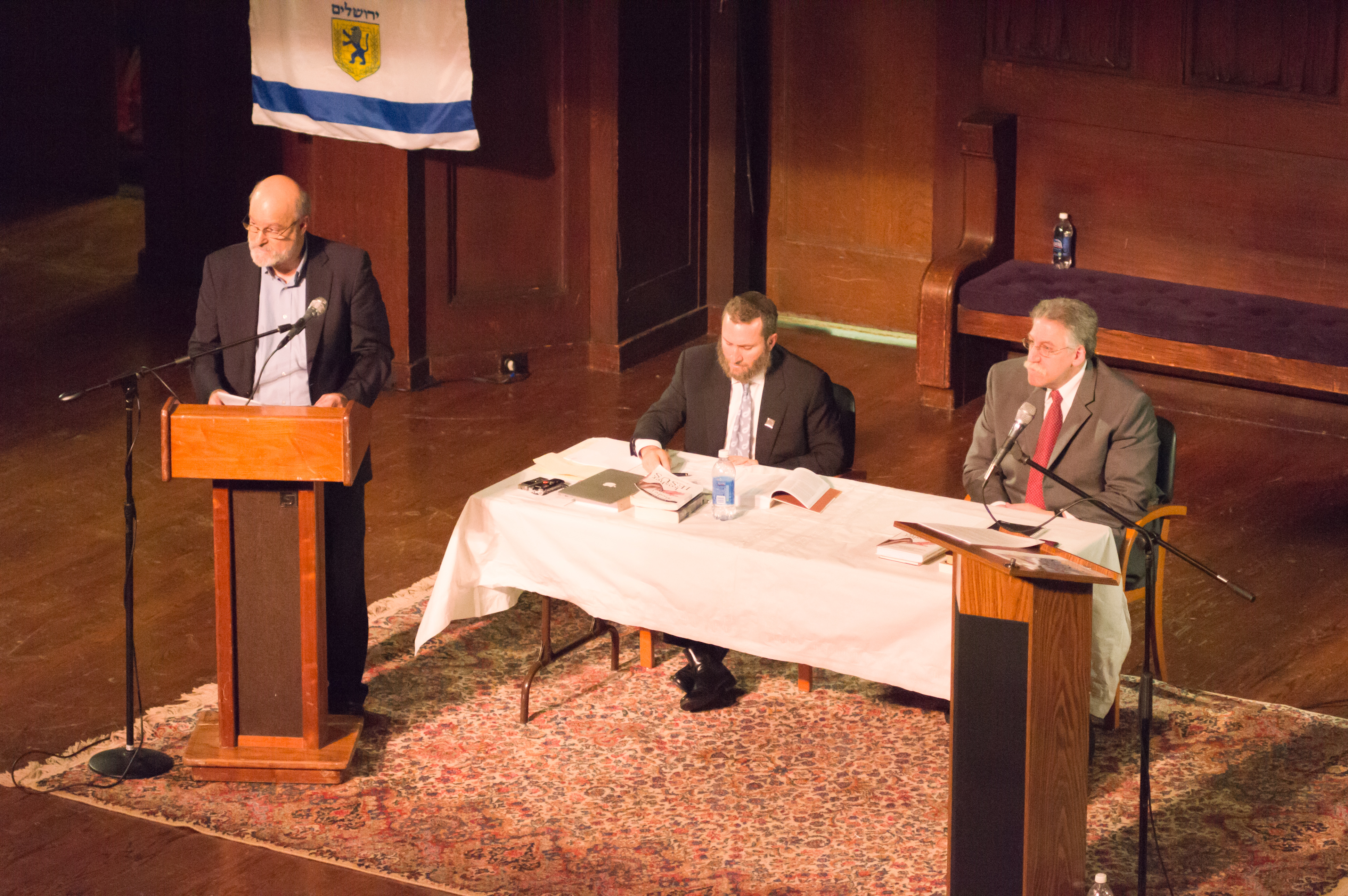
A few nights ago, a dialogue between best-selling evangelical author Joel C. Rosenberg and Orthodox Rabbi Shlomo Riskin took place in an Orthodox Synagogue on the Upper East Side of Manhattan.

I attended the dialogue and am convinced that it was a significant event! I have been a believer for forty-two years, I come from a traditional Jewish background, and I never thought I would hear a clear testimony for Jesus in a modern Orthodox synagogue (the type of synagogue in which I was raised!)

Joel did a wonderful job of explaining the Gospel and was winsome and generous in his approach. Rabbi Riskin is an Orthodox Jew who has a better-than-average understanding of evangelical Christians; he started an organization, based in Israel, which engages Evangelicals, Catholics, Orthodox and others in dialogue. I am sure he understands that believers, like Joel, will not shy away from making the Gospel message clear when dialoguing.

One of our long-term staff members, Olivier Melnick, who watched the event online wrote a commentary that I wanted to pass along to you as I believe he really captures the heart of the dialogue and the issues that are on the table between born-again believers – both Jewish and Gentile – and the Jewish community.

Olivier’s comments primarily reflect the positive side of this dialogue, and next week I will try to point out some of the problems I see ahead of us as the discussions continue.

Enjoy Olivier’s comments!

Focusing on what Unites Jews and Evangelicals

For as long as Jews and Christians have existed, there has been an obvious tension between both groups too often resulting in the ostracizing, force conversions, expulsions and deaths. Both sides have become very good at itemizing what divides them and dwelling on the differences.  Over the years, finger pointing and blame shifting has almost become an art form in Judeo/Christian relations.

To be perfectly honest, I regularly find myself on the forefront of a constant battle to defend Israel and the Jewish people, and I do my own share of finger pointing. Don’t get me wrong, I still believe that there is much to be learned about Christian anti-Semitism through the ages, and even today if we want to successfully defeat the beast. But I often wish that we could focus on what unites evangelicals and Jews more that what divides us.

On April 1st (no joke here!) a dialogue between Rabbi Shlomo Riskin, Chancellor of Ohr Torah Stone and Joel C. Rosenberg, New York Times bestselling author, took place at an orthodox Jewish synagogue in New York. The theme for the evening was “Are We Still Alone?” and was based on Rosenberg’s new novel The Auschwitz Escape.

I resonate with Rosenberg who after visiting Auschwitz in 2011 and reading a book on the few who escaped the death camp, wanted to write a book about those who helped the Jews. That process led him to discover the incredible story of the small French village of Le Chambon sur/Lignon and how all the villagers went out of their ways to save Jewish people from the Nazi furnace. They risked their own lives and many even lost their lives as they were also taken to the camps with Jewish people. But to the villagers, saving the Jews was “the most natural thing to do!” like this elderly woman says in the book by Philip Hallié about le Chambon titled “Lest Innocent Blood be Shed”.

I haven’t yet read The Auschwitz Escape but I can tell you that we can learn a few things from the dialogue that just took place in New York. While I tend to side with Joel Rosenberg theologically, I am also very aware that as a Jew I am a constant target for many different people today. Yet, some of them have never met a Jew in person.

The fear expressed by Rosenberg and Rabbi Riskin, is that a second Holocaust would take place today, especially if or when Iran finishes building the bomb. It is a real fear because Iran wants the eradication of Israel more than anything. Even though President Rouhani sugarcoats his anti-Semitism to the West, his goal is the total annihilation of Israel. Disagree with him all you want (and I do), but at least Ahmadinejad was very clear about his desire to destroy Israel. So the question remains: Will there be Christians to stand for Israel?

Rosenberg made an excellent point when he defined who was an evangelical Christian based on what the Bible has to say. It can be very easy to succumb to some sort of corporate character assassination and put all Christians who didn’t help Jews in the same shameful category. I can even justify it by quoting passages like Psalm 83.

If a Christian is defined by a commitment to follow Yeshua’s teaching based on the Bible, then the boundaries are clear. Christians are forgiven not perfected (at least not yet). Christians can and will make mistakes, wrong judgments and even biased decisions. Yet, in Leviticus 19:18 we read: “You shall not take vengeance, nor bear any grudge against the sons of your people, but you shall love your neighbor as yourself; I am the Lord”. It is then repeated by Yeshua in Matthew 5:43-44 and even taken one step further: “You have heard that it was said, ‘ You shall love your neighbor and hate your enemy. ’ But I say to you, love your enemies and pray for those who persecute you”.

Have Christians fallen short over the centuries? Yes! Are some giving a bad rep to the rest of the Christian community? Yes! Should we then paint with broad strokes? NO!

On one hand, Rosenberg claimed that while some Christians might have made mistakes about the Jews and even some that lead to the death of some, this cannot disqualify them as born-again Evangelicals, and as much as I dislike the divide and its tragic results, I must agree.

On the other hand, I also agree with Rosenberg who stated that if you are characterized by a chronic hatred leading to a constant desire to destroy the Jews or any other human being for that matter, you are not a genuine Bible believing follower of the Jewish Messiah.

One of the most important aspects of true Christianity is the ability to love unconditionally. Christians who love Jews–and they still exist–ought to love them regardless of their ability or willingness to embrace Yeshua (Jesus) and His teaching. Anything short of that kind of love falls short of what Christian love is. Period!

Rabbi Riskin obviously didn’t share Rosenberg’s belief in Yeshua of Nazareth being the Messiah but recognized the common obligation of biblical Jews and Christians. Followers of the one true God must be driven not only by their convictions but also by a constant desire for human decency and justice.

Rabbi Riskin and Joel Rosenberg see the need for Jews and Christian Zionist (a disappearing breed) to unite, and I join them in their honorable effort. Christians failed the test of unconditional love in the 1930’s and 40s. The day might be coming when there will be a retake. Will they fail again? I pray that they don’t.

Christians and Jews are UNITED by the Jewish Scriptures!

Christians and Jews should be UNITED by their love for Israel!

Christians and Jews can be UNITED by Yeshua the Jewish Messiah!

Olivier Melnick is the Northwest Regional Director of Chosen People Ministries. He and his wife Ellen serve in Seattle, Washington.

30 Comments

Filed under Anti-Semitism, Israel, Jewish Christian Dialogue, Jews and Christians, Joel Rosenberg, Judaism, Messianic Jewish, Rabbi Riskin, Uncategorized

PS. A Small Hanukkah Gift for You

PS.  A Small Hanukkah Gift for You

Let’s Talk Turkey About Hanukkah! Download your free Hanukkah E book from the Chosen People Ministries web site – http://chosenpeople.com/main/index.php/hanukkah-e-book

1 Comment

November 28, 2013 · 11:21 AM

Peace at Any Price? Reflections on the Release of 26 Palestinian Prisoners

Over the last couple of days, a controversial event transpired in Israel that has pierced the hearts of most Israelis. Twenty-six Palestinian prisoners who had been held in Israeli jails – most of whom had been convicted of murder – were released during the night before the peace talks planned between Israelis and Palestinians, which are brokered by the United States Secretary of State, John Kerry.


“There will never be peace here; it is very difficult to cope.”

According to YNet, a popular Israeli website, this was the general response from the families of the victims.

YNet adds,

“This is the sentiment of the families of the victims of the 26 prisoners expected to be released as part of resuming peace talks between Israel and the Palestinians. They responded Monday morning with disapproval to the decision to include the killers of their loved ones on the list of those to be released.”

The rest of the story on YNet gives an overview of the sentiments of many of the family members of the Israeli victims of the Palestinians who are being released, and is well worth reading. [1]

The following is a list recorded in J Post (The Jerusalem Post online) – with information provided by the Almagor Terror Victims Association[2] – about the twenty-six Palestinian prisoners released from Israeli jails on Tuesday as part of confidence-building measures offered by Jerusalem in an attempt to bolster recently restarted Israeli-Palestinian peace talks.[3]

I believe that it is worthwhile to simply read through the names of the released prisoners and of their victims – as well as the crimes committed.

1. Fayez Mutawi al-Khur, who established a Fatah cell of twenty members and was jailed in November 1985 for the murder of Menahem Dadon and the attempted murder of Salomon Abukasis. The two had been shot in the Gaza City market two years earlier.

2. Salah Ibrahim Ahmed Mugdad, who was arrested in June 1993 for the murder of Israel Tenenbaum, a 72-year-old security guard at the Sirens Hotel in Netanya. The Fatah member struck Tenenbaum on the head with an iron bar and stole a television set from the hotel.

3. Samir Nayef al-Na’neesh, who was arrested in March 1989 for the murder of Binyamin Meisner, a reservist killed the previous month while on patrol in Nablus. Meisner was confronted by members of al-Na’neesh’s cell, causing him to enter an alley where other cell members were waiting with rocks.

4. Yusef Abdel Hamid Irshaid, who was arrested in March 1993 for the murder of Nidal Rabo Ja’ab, Adnan Aj’ad Dib, Mofid Can’an, Tawfik Jaradat and Ibrahim Said. Irshaid suspected them of collaborating with Israel and killed them after a violent interrogation. He was also convicted of numerous attempts to kill others he suspected of collaboration.

5. Mustafa Othman al-Haj, who was arrested in June 1989 for the murder of 48-year-old Steven Frederick Rosenfeld. Rosenfeld had been hiking in the hills near Ariel and was stabbed with his own knife by a group of shepherds, who hid his body.

6. Salameh Abdallah Musleh, who was charged in October 1993 with the murder of Reuven David two years earlier. David, 59, owned a grocery store in the town of Petah Tikva. He was beaten and robbed by Musleh and an accomplice.

7. Atiyeh Salem Musa, who, along with an accomplice, used an ax to murder a Jewish co-worker, 67-year-old Isaac Rotenberg, during Passover 1994. The murder took place while Rotenberg was kneeling to fix the floor at his place of employment in Petah Tikva. He was struck on the back of his neck and died two days later.

8. Salah Mahmoud Mukled, who was arrested in July 1993 for the stabbing death of Yeshayahu Deutsch, his Jewish employer, and the attempted murder of another local resident.

9. and 10. Mohamed Abdel Majid Sawalha, who was arrested for murder and attempted murder in December 1990, and his accomplice, Hosni Faregh Sawalha, who was charged with murder and for being an accessory to murder.

The two, minors at the time, stabbed to death 24-year-old Baruch Yaacov Heisler, a passenger on a bus from Petah Tikva to Tel Aviv. They attempted to attack other passengers as well. Another accomplice was killed by a police officer.

11. Atef Izzat Sha’ath, who was arrested in March 1993 for being an accessory to murder after driving three terrorists to the crime scene and driving them away afterward. The victim, Simcha Levy, made a living in Gush Katif by providing transportation to local workers. The terrorists were dressed as female agricultural workers and rode in Levy’s vehicle, where they stabbed her to death and fled.

12. Yusef Said al-Al, who was charged in February 1994 with throwing explosives and for being an accessory to murder. He and accomplices threw two hand grenades, which did not explode, at a Border Police unit. He also planted a bomb near a Border Patrol facility and assisted in the murder of a Jewish civilian by passing on information about the lack of soldiers in the area where the killing took place.

13. Midhat Fayez Barbakh, who was arrested in January 1994 for murder. He participated in the ambush of his employer, 61-year-old Moshe Beker, who was in charge of an orchard in Rishon Lezion. Along with two others, Barbakh waited for Beker in the morning and upon his arrival stabbed him to death with a knife and a pair of pruning shears.

14. Ali Ibrahim al-Rai, who was arrested in April 1994 for the murder of Moris Eisenstatt. Al-Rai killed the 79-year-old by striking him in the head with an ax as Eisenstatt sat on a public bench in Kfar Saba.

15. Mohamed Jaber Nashbat, who was arrested in September 1990 for being an accessory to murder. Nashbat threw rocks at 46-year-old soldier Amnon Pomeranz and poured gasoline on his vehicle, after which it was set alight with Pomeranz inside. The murder took place at the Al Burej refugee camp in the Gaza Strip.

16. Samir Hussein Murtaj, who was convicted in October 1993 for the abduction, interrogation through torture, and murder of four local residents: Samir Alsilawi, Khaled Malka, Nasser Aqila and Ali al Zaabot. The victims were suspected of having collaborated with Israel.

17. Faraj Saleh al-Rimahi, who was arrested in July 1992 for the ax murder of 84-year-old Avraham Kinstler in the Sharon region. While in prison, he also engaged in efforts to obtain a weapon for abducting a soldier.

18. and 19. Ala Eddin Ahmed Abu Sitteh and Ayman Taleb Abu Sitteh, who were charged with murder in January 1994 after they stabbed to death David Dadi, 43, and Hayim Weizman, 33. The two were killed while sleeping at Dadi’s apartment in Ramle. The Sittehs, who had been working in a nearby apartment, severed the victims’ ears after killing them.

20. Esmat Omar Mansour, who was arrested in October 1993 for being an accessory to murder. A minor at the time, Mansour helped subdue the victim, 30-year-old Hayim Mizrahi, who was on his way to buy eggs from an Arab-owned farm near his home. Mizrahi’s body was stuffed into the trunk of his vehicle, which the terrorists used to flee.

21. Khaled Mohamed Asakreh, who was charged in May 1991 with murder in the stabbing death of French tourist Annie Ley. Ley was dining at the restaurant where Asakreh was employed.

22. and 23. Nihad Yusef Jundiyeh and Mohamed Mahmoud Hamdiyeh, who were arrested in July 1989 for the murder of Jewish contractor Zalman Shlein. The two minors stabbed Shlein to death with a knife after traveling with him to a construction site where he was building a house. They also beat him with an iron pole.

24. Jamil Abdel Wahab Natsheh, who was charged with being an accessory to murder in December 1992 for acting as the escape driver for terrorists who shot at IDF soldiers at the Cave of the Patriarchs. One soldier was killed and another was wounded.

25. Taher Mohamed Zaboud, who was arrested in February 1993 for murder, hijacking a vehicle and attempting to steal a weapon. Zaboud’s accomplice fired shots at the driver, Avraham Cohen, but fled when they realized he was not carrying a weapon.

26. Burhan Subaih, who was arrested in February 2001 for the murder of Jamil Muhammad Naim Sabih and Aisha Abdullah Haradin.

Israel is often characterized by world opinion – and by some evangelical Christians – as a nation that acts unjustly and lacks compassion. In fact, nothing could be further from the truth, and the release of the prisoners is clear evidence of the extent to which Israeli leaders are willing to go to achieve peace.

I am not going to try and paint Israel or the Jewish people as perfect or without moral blemish. We are all sinners – both individuals and nations. However, since there has been so much criticism of Israel in recent days, I think it is important to show that Israel and its leaders have gone far beyond what even most citizens of Israel would believe to be just and fair.

What other nation in recent days has released its convicted prisoners or offered them early “parole,” as the Israeli government is describing the nature of their actions?

These controversial decisions on the part of the Israeli leadership will be debated for years and perhaps centuries. I do not believe that the Israeli leadership views the release of the prisoners as forgiveness, nor necessarily an act of compassion, even though in some cases this might be the case – especially for the more elderly prisoners.

I assume the release of the prisoners was enacted for the sake of political expediency in hopes that the release will lead towards peace. We might not know the answer to this for a number of years, and even if some type of peace comes about as a result of this effort – many will still feel that the price for peace was too high.

I am writing these reflections to demonstrate to Evangelical Christians who have been so very critical of Israel lately that Israeli leaders are willing to do what might be viewed as reprehensible and politically inexpedient, simply in order move the peace process forward.

Really, this is all about the character of Israeli leadership and of the people of Israel. Look at the great lengths to which they have gone to show good faith in the peace process. There will be continued controversy over the next few days regarding Israel’s moving forward with housing settlements in Gilo and regarding the recent air strike, destroying the Hamas rocket launcher that was aiming missiles into Israel from Gaza. The antagonists of Israel will focus on these things and miss the fact that the leadership of Israel has risked the soul of the nation for the sake of peace.

I believe that evangelical Christians, especially those that have been so opposed to Israel in recent days and have accused Israel of being unjust, need to pause and reconsider their position in light of the renewed tears shed by the families of those who were murdered – and the cheers and celebrations by the communities of those who were released.    

5 Comments

Filed under Uncategorized

Spiritual Trends in Israel and the “Signs of the Times”

If you have been following the news, you know how unstable the political situation is in the Middle East. Whatever this may mean for the unfolding revelation of God’s timetable for history, there is no doubt that Israel is in the middle of it. Right now, Chosen People Ministries has more staff members ministering in Israel than at any other time in our almost 120-year history.

Not long ago, I was sitting on the panel at a conference on “Ministry in Israel,” and the moderator asked me a number of critical questions. I want to share some of my responses with you so that you can at least have my take on what is happening spiritually in the Holy Land!

Spiritual Trends in the Land of Promise

What are some of the most exciting spiritual trends you see in the Land today?

The first is the significant increase of Jewish believers. Sixty percent of them speak Russian as their first language, so there is a tremendous need for resources that they are able to use. Speaking a bit more generally, there is growing ministry among children and a growing unity among the Jewish believers. We are also participating in active efforts to meet the needs of poor Israelis, as well as Holocaust survivors and other elderly people. We’re also seeing the growth of serious Bible college programs and leadership development for Israelis, as well as more Messianic books in Hebrew and higher-quality training opportunities for younger believers.

There are now a number of buildings that are now owned by Israeli believers and ministries in the Holy Land, including the Chosen People Ministries Jerusalem Center, King of Kings, Israel College of the Bible, Grace and Truth Assembly and a number of other congregations.

These congregations are also maturing and growing in their ability to serve the ever-increasing number of believers. The number of Israeli-led congregations has expanded from under a dozen in the early 1970s to more than 150 today.  The continued development of energetic and creative outreach over the web and the increase in Christian television broadcasting are all signs of the vitality of the movement of the Holy Spirit in Israel.

What are some of the most troubling spiritual trends you see in the Land today?

We need to remember first of all that troubling trends are often God’s way of bringing us the greatest opportunities for spiritual growth and ministry fruitfulness. The threat of war and continued terrorism, the challenge of secularism and the deconstruction of a biblically-based morality in everyday culture are all troubling trends that are symptoms of a deeper, spiritual sickness. The continued and seemingly irreconcilable differences (socially, politically and otherwise) between Jews and Arabs and between the Orthodox and secular Jews are another aspect of this same spiritual conflict. Additionally, we see the continued marginalization of both Jewish and Arab believers within their own community, though this is changing slightly.

We see promising trends and the Lord’s work in Israel is becoming more Israeli in nature. The need for indigenous resources and continued leadership development is a critical challenge and a great opportunity for partnership among Western European and North American believers and Israelis. 

The “Signs of the Times”

Do you believe we are heading towards a “Romans 11:26” world in which “all of Israel will be saved”? Why or why not?

Well, first, let’s take a look at the passage in question…

 For I do not desire, brethren, that you should be ignorant of this mystery, lest you should be wise in your own opinion, that blindness in part has happened to Israel until the fullness of the Gentiles has come in. And so all Israel will be saved, as it is written: “The Deliverer will come out of Zion, and He will turn away ungodliness from Jacob; For this is My covenant with them, when I take away their sins.” (Romans 11:25-27)

Yes, we are moving closer, because of the evident signs of the times. If the return of the Jewish people to Israel, the Jewish control of Jerusalem, and the surrounding of Israel by enemies seeking her destruction is evidence of the prophecies of the Old Testament coming to pass – and if we add the additional sign of a remnant of Jewish believers in Jesus, which has been increasing since the establishment of the modern state of Israel – then yes. But my feeling is that we will enter this future incrementally.

Is it accurate there are about 15,000 Jewish followers of Yeshua in the Land of Israel today – up from only a few dozen in 1948?

There is no current scientific survey, but my personal experience would indeed indicate that the numbers are somewhere between 10,000-15,000.

Why are Jews coming to faith in so much larger numbers today? What dynamics have changed since 1948, and just since you came to faith?

There were a great number of Jewish believers in Jesus who perished in the Holocaust, perhaps more than there are today. But now we seem to be growing at a rate throughout the world that will surpass the pre-Holocaust numbers of Messianic Jews. Israel contains one of the fastest-growing movements of Jewish believers in the world.

Why? Aside from the prophetic perspective mentioned above, it could be because of the unrelenting prayers of saints, an unwavering witness by many who have pioneered this effort, and the engagement of the Gentile Church around the world with a heart for Jewish outreach. In addition, we definitely see growth resulting from the development of a contextualized testimony and the emergence of local Israeli spiritual leadership.

Aside from the number of professed believers, how would you assess the spiritual maturity and theological depth of the believers in the Holy Land?

We see great depth and maturity among leaders in Israel who have lived through many difficulties and have become battle-hardened spiritual leaders – but they are often overworked! They need our help – not to do their jobs or tell them how to do it – but rather to provide resources, prayer, and genuine help. We especially need to lend our support to the leadership training Bible colleges in the Land.

What are ways Jewish and Arab believers can and should be working together to share the Gospel with everyone in the Land and make disciples of all nations?

Pray for one another.  Serve in projects together in the Land where appropriate. For example, Chosen People Ministries has had quite a bit of support and help from local Arab believers in our Tel Aviv soup kitchen ministry.

How can believers outside of Israel be praying effectively for the believers in the Land?

First of all, we can pray that both Jewish Israelis and Arabs would become more open to Jesus and be able to effectively disciple the next generation of leaders. We should also pray that both Jewish and Arab believers would become less marginalized and have an impact for the Lord on Israeli society as a whole. The believers also need their own worship and ministry facilities. I believe this would help stabilize the Lord’s work in Israel. Those of us who live outside the Land can also maximize our impact by helping to purchase properties that will be dedicated to ministry and congregational centers.  

2 Comments

Filed under Uncategorized

Reflections on the Boston Bombing

Our eyes have been glued to our televisions watching the manhunt for the Boston Marathon bombers. It now seems to be over – though our hearts are still broken for the families that lost loved ones and for the residents of Boston who will suffer the post-traumatic stress of this act of terrorism in their community.

Mitch Forman, our Vice President of U.S. Ministries and Boston director, wrote a brief piece about his feelings in light of what’s just happened, and I thought you might want to read it. I found his perspective to be personal, biblical and moving. 

I am writing this letter minutes after watching the capture of the Boston Marathon Bomber #2. I was born and raised in the greater Boston area, and now I am raising my family here. This is the place I count as my home, the place where I do ministry and a place I love very much. Even though I left Boston in my twenties and thirties, I returned because all my family still lives here. My grandparents came here in the early 1900s as political refuges, fleeing those who hated them simply because they were Jewish. As a 3rd-generation refugee, I am forever thankful to the United States for allowing my family to come and start a new life.

I say this because as events have unfolded after the bombing at the Boston Marathon, I learned of the history of these two brothers, it resembled that of my family. However, they came to hate this country, whereas my family embraced it. They aimed to hurt and kill people, whereas my family aimed to make the country better.

As I was sitting here watching the TV like all of you, I couldn’t understand why these brothers would want to commit this apparently senseless act of violence. They knew most of the people at the time of the Marathon were there to cheer on a family member. They knew that many of the people present would be small children. They knew the face of Boston would change forever. When my own kids asked, “Why would someone do this?”  I told them: “There are evil people in the world, and people who hate us just for being Americans.”

We live in a world where there is danger, and where people don’t have to believe in God. This is why I do what I do. This is why we must continue to share the Good News of Yeshua (Jesus). The only hope we have is to keep praying and reaching those who do not love us back. How appropriate it is for me to remember the words of Yeshua:

“You have heard that it was said, ‘You shall love your neighbor and hate your enemy.’ But I say to you, love your enemies, bless those who curse you, do good to those who hate you, and pray for those who spitefully use you and persecute you, that you may be sons of your Father in heaven; for He makes His sun rise on the evil and on the good, and sends rain on the just and on the unjust.”  (Matthew 5:43-45)

It isn’t so easy to follow Jesus when asked to do things that go against your own nature, but this is what we are commanded to do. I was living in New York City at the time of 9/11, and now I live in Boston during these times. I had friends at the Marathon who were a short distance away when the bombs went off. I took both of these events very personally; however, Yeshua tells me to love those who hate me and pray for them. I said a prayer for the families who lost loved ones. I said prayers for those who lives have been forever changed. I even said a prayer for this young man tonight – that even though his brother died, he might live and come to trust in Jesus.

3 Comments

Filed under Uncategorized

What Do You Say in the Midst of Unspeakable Tragedy?

Many have written on the disturbing events of the last few days, and I suppose I couldn’t help but add my voice to those who have already spoken. Of course, what I really wish I could do is hug some of the family members who lost children and even more so – to introduce them to the one who 41 years ago wrapped His powerful arms around me and gave me peace and comfort that I did not even know existed.

There are so many thoughts swirling in my heart and mind. For a couple of years, my family and I lived about a mile from the school where these innocent children and brave adults were killed, so I suppose I feel closer ties to the events of the past week. I have good friends who live in the area who are in the thick of the grief counseling, trying to bring comfort to grieving families.

Of course, everyone wants to know why this happened and the answer is as elusive to me as anyone else. One of my closest friends, who is not a believer in Jesus, asked me, as a “person of faith,” how I made sense out of the tragedy. I would like to tell you what I said to my friend, but I’d like to preface this by saying that anything said would sound terribly hollow if I were speaking to the parents, grandparents, brothers, sisters or friends of those who lost their lives.

After all, what can you really say at a time like this? I do not think it is even possible to use words to bring comfort to the mourning at this moment, although so many are sincerely and wholeheartedly trying. Intuitively, most people understand how to behave at this time and thankfully there has been quite a bit of silence as opposed to trying to explain what happened. Most people are sitting with the living victims of the tragedy; holding their hand, listening to them weep, crying with them, offering a hug and a listening ear and just simply being there for them. This is about all you can do right now to provide comfort.

I told my friend that my soul was deeply disturbed by the events of the week and that my faith was rocked and challenged as well. I do not have an answer as to why God allows suffering, any more than what the Bible teaches about our living in a world broken by sin, and that for some reason God has not yet chosen to remove suffering from the palate of human existence.

I quickly added that God’s side is only part of the equation, and that we as humans need to take responsibility for continually doing things that we hope God would prevent. The tragedy in Newtown has again brought us face-to-face with pure, unmitigated evil. This is not a time to blame the poor mother who also lost her life and perhaps taught her son to shoot the weapons and even made these weapons accessible to the perpetrator. It is also sad to find out that the young man who committed these crimes had some type of mental illness that for some reason could not be controlled by his parents, mental health professionals, his friends nor himself. It’s not a time to take political advantage of this terrible moment and promote new efforts towards gun control, though this will surely be considered carefully in the days ahead.

Without ignoring the complexity of human factors, responsibilities and whatever will be concluded at the end of a thorough investigation, there remains no doubt that we have witnessed evil – overwhelming, terrible evil – and our lives will never be the same. We now have a new generation who have lost their innocence and will grow up pointing to the events of this past week as the day they recognized that evil exists. The recognition of evil cannot bring comfort to a mourning parent, nor does it provide an adequate explanation for the tragic events of this past week, but it is a sober reminder of the character of the world in which we live.

We have also been reminded of the goodness of others. We witnessed the outpouring of love towards these families, and there is much to commend in our fellow man. This has also been the case in recent tragedy along the Eastern seaboard when thousands of volunteers helped flood victims recover from the destruction of their homes. Sometimes I find that believers in Jesus focus far too much on evil and man’s sin rather than on the goodness of humanity, which is also part of being created in the image of God.

Yet as much as we might try to focus on the goodness of man in the midst of this tragedy, when the dust settles, most will look back on the horror of the moment as a reminder that evil does exist and that we need to find a way to fight evil.
Many people will also be quoting from the book by Rabbi Harold Kushner, Why Do Bad Things Happen to Good People. The question he articulates weighs heavily on all of our hearts at this moment.

The truth is – we don’t know why bad things happen to good people. We only understand that evil exists and that we do not want to live in its dark shadow, but rather to live in hope not fear – and to find a way to believe in innocence and purity without ignoring the harsh realities of the world which we live. This tragedy makes the underlying dichotomy of life all the more difficult to handle. Evil is usually easier to ignore!

For those of us who do not live in Newtown and might live hundreds and thousands of miles away – our hearts have been broken by these events. For some reason, probably because most of the victims were innocent children and brave teachers, we have felt this corporate pain more deeply and have joined in the sorrow of people we have never met and felt part of a community we might never visit. For the parents, friends and relatives of the victims – there is only a hunger for comfort at this time – not for finding meaning in the midst of the tragedy. But for those who are somewhat removed, we have the luxury of being able to try our best to draw some meaning and understanding of what has happened. We simply need to find some way of processing the deaths of so many innocents.

My only answer is Jesus. Consider with me for a moment.

God sent His only Son – whom He loved as much as any mother or father loved any of the children who were tragically lost this past week – to experience the joy and pain of being human. Furthermore, because of the depth of His love, He allowed His Son to suffer the unthinkable as for one moment the Son of God experienced separation from His heavenly Father, enduring judgment as He removed the sin of mankind in one self-sacrificial act.

I am thankful that, by His grace, I came to believe that Jesus is the Messiah and that He bore judgment for my sin in order to destroy evil. I am thankful that Jesus found me and enabled me to recognize that although evil exists and our world is broken, this is not God’s ultimate design and one day Jesus will return, lift the curse of sin and make everything right.

I’m so glad that Jesus found me, as I now know that a day of ultimate justice will come, when evil will no longer exist. A kingdom is coming that will be characterized by love, joy, purity and goodness. This gives me hope and allows me to live in peace in what at times is a very dark and difficult world. During this season of the year – I hope you will experience the same peace. Let’s pray that those who mourn will be comforted by the sweetness of His presence and His promise to one day restore everything that was broken by evil, sin and death. One day He will return and wipe every tear from our eyes.

For I am convinced that neither death, nor life, nor angels, nor principalities, nor things present, nor things to come, nor powers, nor height, nor depth, nor any other created thing, will be able to separate us from the love of God, which is in Christ Jesus our Lord. (Romans 8:38-39)

7 Comments

Filed under Uncategorized

Letter to the editor of TIME Magazine: Response to “Heaven Can’t Wait”

I found the article “Heaven Can’t Wait” in the April 16, 2012 edition of TIME Magazine to be both enlightening and disturbing. I am a Messianic Jew (a Jew who believes Jesus is the Messiah) and a 60-year-old male who lives in New York City. I reflect both the Jewish and Christian communities’ views on Heaven, as well as those of my generation.

I also lead Chosen People Ministries, an organization founded in 1894, which has been reaching out to the Jewish and Christian communities with the message of a Jewish Gospel for more than a century. This gives me a unique perspective on heaven and hell, the nature of the Gospel, the balance between good works and good deeds, and the Christian and Jewish hope for the future kingdom.

I appreciated Jon Meacham’s insights (perhaps more for their cultural rather than theological value) but was shocked by his misunderstandings about the early Christians – all of whom were Jewish, up to a point.

He writes, “The story of Jesus as interpreted by Paul and as told in the Gospels created a unique understanding of salvation and life after death. No one in first-century Judaism had been looking for a human atoning sacrifice.” (p. 33). Unfortunately, Meacham makes a mountain out of this theological molehill and builds his misunderstanding of the Christian hope upon his under-researched and inaccurate idea.

Inter-Testamental literature and early Rabbinic writings indicate that a substantial group within first-century Judaism believed in the coming of a suffering and even atoning Messiah.

A key passage demonstrating this is Isaiah chapters 52 through 53, which is alluded to by Jesus, quoted in the book of Acts in the early sermons of Peter, and affirmed by Paul in his classic statement on the Gospel found in 1 Corinthians 15:1-3, which Meacham quotes at the end of his article.

Isaiah chapter 53 describes a suffering individual, identified by the prophet as the Servant whose “mission” in life was to die in the place of sinful Israel and the Gentile nations (Isaiah 53:4-6). The prophet clearly describes the atoning death of this individual in verse 8, “He was cut off out of the land of the living for the transgression of my people, to whom the stroke was due.”

The author of “Heaven Can’t Wait” appears to downplay the issue of personal salvation and presents a view of salvation focusing on “heaven coming to earth,” bringing a more corporate version of redemption focused on righting the wrongs and evils of our present day. This implies that the work of Christians today should focus on changing society as a means of preparing for the age to come.

The view of heaven Meacham espouses ignores the hope for a suffering Messiah that is the bedrock of faith for Messianic Jews and all types of Christians. He ignores tomes of scholarship, including the new book entitled The Gospel According to Isaiah 53 (available here), recently published by Kregel Publications and edited by myself and Dr. Darrell Bock, who teaches New Testament at Dallas Theological Seminary – one of the world’s foremost evangelical seminaries. I also teach at the Talbot School of Theology, a part of Biola University, and Meacham quotes form Dr. Erik Thoennes of the same institution.

The Gospel According to Isaiah 53 highlights the views of leading evangelical scholars who believe that Jesus, from His own words in the Gospels to those of other New Testament writers, is clearly understood as the fulfillment of Isaiah 53. Jesus is the Suffering Servant who died a substitutionary atoning death for our sins.

The Apostle Paul, also a Messianic Jew, summarizes the Gospel in 1 Corinthians 15:1-3, claiming that Jesus died for our sins and rose again from the dead, according to the Old Testament Scriptures. Unless one believes that the words of Paul and even the words of Jesus were penned centuries later (which is another discussion), then clearly many first-century Jews did believe that a human atoning sacrifice was expected… especially by those Jews who believed in Jesus and wrote the New Testament!

Meacham quotes the end of 1 Corinthians 15, but should consider that the hope of heaven and admonition to remain “steadfast, unmovable, always abounding in the work of the Lord” would be impossible without the foundational truth of Messiah’s death and resurrection, providing personal salvation for both Jews and Gentiles and ultimately the redemption of a world cursed by sin.

I am glad the author and TIME Magazine tackled such an important topic. However, I believe that the article should have taken a much broader look at the variety of views on heaven. Meacham’s work reads far more like an editorial than a well-researched article, which is how it seems to have been presented.

9 Comments

Filed under Uncategorized

Kosher Jesus?

Mike Brown and Shmuley Boteach debated before an audience of more than 700 Jews and Gentiles, believers and non-believers, on the Upper West Side of Manhattan last night.The debate focused on Shmuley’s book, Kosher Jesus, and Dr. Brown’s forthcoming book in response, The Real Kosher Jesus.

Brown summarized Rabbi Boteach’s viewpoint as being completely opposed to any reasonable interpretation of the New Testament.  Brown suggested that Shmuley turned Jesus into a rebel against Rome, who taught nothing new and died because of his treason against Rome.

According to Shmuley, Paul was the person who reinvented Jesus and transformed him into a Divine Messiah who died for the sins of humanity.

In effect, according to Dr. Brown, Shmuley has stripped Jesus of the uniqueness ascribed to him in the New Testament scriptures.

Shmuley responded by painting a picture of Jesus as a Jewish freedom fighter who was both a sincere zealot for Jewish causes and a great rabbi who taught in a way similar to the rabbis of his day.

Mike said that the only way Shmuley could be correct would be to assume that the entire New Testament, from Matthew to Revelation, was edited and influenced by later Christians, inspired by Paul, who elevated Jesus to a status he never claimed for himself.  Mike noted that Shmuley gave very little historical or other type of evidence to justify such a radical reinterpretation of the New Testament.

The debate was successful in raising critical issues about Jesus. Clearly  both Mike and Shmuley agreed that Jesus was Jewish and spoke as a rabbi and a Jewish prophet   But that is where their agreement ended!

There has clearly been more interest in the Jewishness of Jesus within the Jewish community, from Kosher Jesus to a new Jewish Annotated New Testament edited by Jewish scholar Amy-Jill Levine and Marc Z. Brettler.

Hopefully more and more Jewish people will study the New Testament and discover that indeed Jesus is Jewish, and more importantly, the Messiah and Savior of the world.For more information on why the New Testament should be taken more seriously as an historical  document, read the book, Isaiah 53 Explained. It is yours for free at www.isaiah53.com.

1 Comment

Filed under Uncategorized

Rabbi Shmuley is still far from the Truth!

I have been reading the new book by Rabbi Shmuley Boteach, entitled Kosher Jesus. I found it refreshing to read so many positive statements by an Orthodox Rabbi about Jesus… but Rabbi Boteach still does not believe that Jesus is the Messiah or God in the flesh, or that He died for our sins. Instead, he presents Jesus as a good and pious Jewish man who loved his people and who died trying to free His kinsman from oppression.

Shmuley, whom I’ve come to know quite well as a result of our many public debates1 is still waiting for the Messiah to come and reign on David’s throne, like most religious Jewish people today.

However, Shmuley – who is sometimes called “America’s Rabbi” – has caused the debate on the issue of Jesus to take a new turn by publishing this book, which states positive views of Jesus that are at odds with those of many in the Jewish community.

For example, one author on a religious Jewish website writes,

However, writing a book that completely exonerates Jesus and promotes Jewish respect for him is something that I find grossly naive and severely imbalanced in light of the overall picture of history and early gospel texts. “Kosher Jesus” is a one-sided coin that presents a single perspective while being ignorant of all others.2

Another Jewish writer comments,

The vast majority of Jews will never read “Kosher Jesus” and understand that Boteach really referring to a Jesus who had a million-dollar makeover. They will think of the Jesus praised by Tim Tebow! For an Orthodox Rabbi to urge Jews to embrace Jesus is incredibly irresponsible, as it will inevitably facilitate the slide by some down the slippery slope toward Christianity.3

There are many additional – and even harsher – comments by Jewish leaders regarding Shmuley and his latest book, including one prominent Orthodox Rabbi in Toronto who has put a ‘ban’ on the book and says that Jewish people should not read it!

Last month, Shmuley wrote on his own blog:

…Rabbi Schochet declared the book heretical, banned anyone from reading it, banned me from speaking about it, banned others from hosting me, and refused to offer a single reason or explanation as to why.4

It appears that some Jewish leaders simply do not want Jewish people to even think about Jesus or to be exposed to the idea that Jesus was Jewish and that there was value in what He taught and did. I understand this concern – in fact, I was raised with it – and I contend with it regularly in my efforts to help my fellow Jewish people come to know Jesus as Messiah and Lord.

After reading the book, I have come to the conclusion that although Shmuley paints Jesus in a positive light, his approach is short-sighted and even disrespectful to Christians and Messianic Jews. Many of our core beliefs are eviscerated in his attempts to “retell” and reconstruct the Gospel story.

A writer from one of the leading Jewish newspapers in the New York area comments,

Boteach has the noble goal of improving the relationship between Christians and Jews, yet his approach here is problematic, as well. By severing the good Jewish Jesus from bad Christian teachings about him, he casts all Christian beliefs — about, for example, Jesus’ uniqueness and significance — as groundless and fantastic. Far from building a bridge between Jews and Christians, his portrait of Jesus will be rejected by most Christians as irrelevant and even insulting.5

I could not agree more with the above critique.  I believe it is good to try to understand one another’s faiths and engage in respectful dialogue – and yes, even to try to persuade each another to accept what we believe as true. However, Boteach’s attempts to build relationships with Christians on the basis of his own imaginative Jesus will never build the bridges he desires. After all, who among us would want to give our lives in service and sacrifice for a failed first century revolutionary?

A Jewish Messiah who died once and for all to atone for our sins, reconcile us to God, and give us eternal life, however… that’s a Jesus worth loving and serving!


Notes:

[1] A debate entitled, Is Jesus Kosher, between Shmuley and Dr. Mike Borown, will be held in Manhattan on March 13th at 7:30 pm at the Ethical Society building on West 64th street, Manhattan. If you happen to live in the New York area or are visiting the Big Apple, please attend.  You can ask for the details by e-mail or call212-223-2252.

[2] Yehudah Ilan. Kosher Jesus, Treif Christianity, http://chizzukemunah.com/2012/01/16/kosher-jesus-treif-christianity

[3] Rabbi Michael Skobac. It’s Your Own Mess Shmuley – Clean it Up http://www.jewsforjudaism.ca/resources-info/response-to-shmuley-boteach-s-kosher-jesus

[4] Boteach, Shmuley. http://www.shmuley.com/news/details/P2/

[5] Gregerman, Adam. http://www.forward.com/articles/151028/#ixzz1mAbuEuEY

5 Comments

Filed under Uncategorized

Can you be both pro-Israel and pro-Palestinian?

While reading the CNN Belief Blog, one prediction for 2012 struck very close to home. It was penned by the publisher of Relevant Magazine – a more contemporary Christian magazine (worth reading as well):

There’s no question the worldview of most younger Christians already differs from previous generations regarding social justice, cultural engagement and politics. The next issue of probable divergence? The conflict in Israel and Palestine. The American church has largely purported just one theology about the modern state of Israel, but now questions are being asked – especially by younger Christians learning of persecution and human rights issues happening in the region – if the church should have a more active role in peacemaking. Is there a way for the Church to be pro-Israel, pro-Palestine and pro-peace? (“15 Faith-Based Predictions for 2012,” Cameron Strang, Publisher, RELEVANT Magazine)

I believe Cameron Strang is correct to point out this trend among Christian young people. I do wish he had phrased his statement about persecution and human rights issues happening in the region differently. This may have been better phrased, “learning of alleged persecution and human rights violations” – or perhaps “accusations” of the same.

But, he is correct in saying that our younger generation seem to be less supportive of Israel than the previous generation. Why? I can think of a few reasons. One has a more positive origin (though needs to be more balanced), but the other is negative.

Let’s start with the positive!

I am delighted to see our younger generation developing a greater concern for social justice issues, and many are doing a great job of making a very practical difference in our broken and sinful world. Caring for those who are marginalized is part of this concern, and it has led to more prayer, help and support of Palestinians.

I am always happy when God’s love is shown to others. I would be happier if our younger generation would be more circumspect in giving their political support to the Palestinians, but I am sincerely grateful for the love shown to those in desperate need of the Gospel.

The second reason for younger Christians’ dwindling support for Israel is not so good: many churches are no longer teaching about Israel, the Jewish people, the Holy Land, or even about the End Times! This is a problem because the Bible contains a considerable amount of teaching on these matters. Romans 9-11 is just one of many examples – read through it and see what you think!

Perhaps we need to focus on bringing a more verse-by-verse, expository style of Bible teaching back to our congregations and pulpits. There are so many needs in our world – and within our own congregations – that we sometimes miss out on other key areas of Bible teaching, that if taught would eventually reduce some of our needs!

We believe it is entirely possible to love the Jewish people and the Palestinians while believing that the Land of Promise belongs to the Jewish people. This is one of the reasons we are sponsoring another major conference on this very topic – this time on the West Coast!

The conference is entitled Israel, the Church, and the Middle East Crisis, and will be held March 23-24, 2012, on the campus of Biola University. The speakers include author and Middle East expert Joel Rosenberg, Old Testament scholar Dr. Walter Kaiser, and myself. It will be one of the only conferences of this sort that provides Bible teaching about Eschatology and the Future of the Middle East – as well as seminars on how to witness to both Jews and Muslims. Visit the website for further information and online registration!

I appreciate Cameron Strang’s having brought this trend to our attention. My prayer for all of us in this New Year is that we will commit ourselves to understanding the fullness of Scripture – and encourage our congregations, pastors, Messianic Rabbis and home Bible study leaders to delve deeply into the role and calling of God for the Jewish people as revealed in the Scriptures. After all, being chosen was not our idea… it was His! (Deuteronomy 7:6-11)

I look forward to hearing your thoughts on this issue!

7 Comments

Filed under Uncategorized