Category Archives: Uncategorized

Happy 68th Birthday Israel!

Dear friends,

Mitch_GlaserShalom in the great name of Jesus the Messiah. On May 12 the Jerusalem sky will be lit with beautiful displays of fireworks and thousands of Israelis will be dancing in the streets!—in celebration of Israel’s 68th birthday.

The modern state of Israel is a great joy to those of us who love the Lord Jesus, believe the Bible and affirm God’s plan for the Jewish people.

Let’s face it—the existence of the modern state of Israel is a miracle! Yet, we know there is so much more to come as the Bible is filled with prophecies about Israel’s glorious future. I am sure you are looking forward to that great day when the Jewish people receive Jesus as their Messiah (Romans 11:11-25), and the Prince of Peace sits on His glorious and rightful throne in Jerusalem! Your generous gift today will help us continue to take the Good News of Messiah to Jewish people worldwide.

I believe this great day is coming!

1605PZLW_Israel-Independence-BS62359205Israel: Let Freedom…of Religion Ring

The modern state of Israel is a bastion of hope in the midst of a war-torn Middle East. Israel is a modern democratic nation that practices freedom of religion.

You have never heard of Israel persecuting Muslims, Christians or any other people of faith have you? There has been some discussion about Orthodox Jewish people persecuting Messianic Jews, but most of the reports you hear about the persecution of Messianic Jews in Israel are overplayed.

Let’s Celebrate!
I hope you will find a way to celebrate the 68th birthday of the nation of Israel! We have so many reasons to be thankful: the fulfillment of prophecy demonstrating that the Word of God is true and the fact that Western countries have a friend and ally in the Middle East that is both democratic and practices religious freedom.

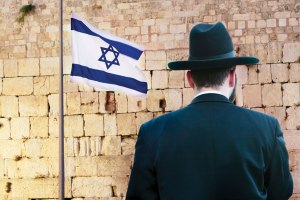
1605PZLW_Kotel-with-israeli-flag-BS6162403Yet there are also hosts of social problems and challenges that face Israel today—just like any other country in the world. Israel is a divided society, and we need to pray every day for God’s peace to fall upon the Promised Land so that both Jews and Palestinians are able to live their lives and raise their children without worrying about their safety.


I believe that this is the dream of every Jewish and Palestinian mother!

We know that these issues will not be solved until Jesus reigns on His rightful throne. This is why it is so important to bring the Gospel to the Jewish people in Israel—and also to the many other groups that live within Israel.

The need is great, but the opportunity is greater.

Your Prayers Are Needed
First of all, may I ask you to pray for the work of Chosen People Ministries in Israel? Please pray for our growing staff. Also, our media evangelistic programs are changing lives! We have produced almost a dozen Messianic Jewish testimonies in Hebrew that are being watched by tens of thousands in Israel today. We now have between 50 and 100 Israelis asking for our Isaiah 53 Explained book in Hebrew each week. I never thought I would see this happen.

Would you honor the 68th birthday of Israel with a gift of $68?

Your gift of $68 or more allows us to:

  • Send twelve Isaiah 53 Explained books to Israelis seeking the Lord
  • Scholarship one child for almost a full week of camp
  • Help us pay the rent on our Tel Aviv facility where our 100-plus-member congregation of Russian Jewish believers meet each week
  • Help us run our Jerusalem Center, which is the national headquarters for our ministries throughout Israel

I hope you will be generous as wonderful opportunities for evangelism are increasing every day! In fact, our budget for the next fiscal year begins July 1 and calls for almost a half million dollars to maintain all of the programs, people, and facilities that Your Mission to the Jewish People supports in Israel.

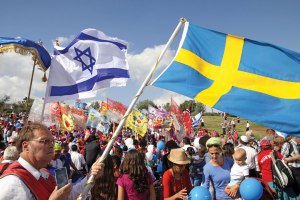
1605PZLW_Christians-Sukkot-BS109412108Your generous investment in the spiritual future of Israel will make a big difference in the lives of everyday Israelis—because they need the Lord! Perhaps you would like to give a more substantial gift to help us support this growing work as we look forward to the great day of the Lord’s return. 

There’s just no place like Israel on planet Earth! Would you help me help our staff reach Israel for Jesus?

Happy 68th Birthday, Israel!

Your brother in the Messiah,

Mitch

1 Comment

Filed under Uncategorized

Reaching Jewish Students

Jewish-Students

Dear friend in the Messiah,

There is no doubt in my mind that the college campus is one of the best places there is to engage Jewish students with the Gospel. According to the recent Pew Report, 60% of the Jewish population in the United States are college graduates, which is twice the number of our general population.1

We know that students are more open to new ideas as they are often away from their parents and other types of community support. Since Jewish young adults are generally taught not to believe in Jesus, this fresh openness to new viewpoints in general is a great time to introduce Jewish students to the Jewish Messiah.

We of course must be careful to be sensitive to the vulnerability of many young adults and respect the way they have been raised. We need to meet the students in the marketplace of ideas and make sure these Jewish students want to hear the Gospel. We need to offer the Good News and make Jesus so attractive that Jewish students will want to hear more and more!

We usually encourage campus evangelism to be primarily done student-to-student if possible, though of course, campus ministries, local churches and Messianic congregations near campuses can be supportive of believing students reaching out to Jewish young adults and provide wisdom, warm fellowship, a home-cooked meal and lots of love!

There are many challenges to reaching Jewish students on campus. Any significant effort will likely be opposed by the campus rabbi, Hillel (the largest national Jewish campus group) and an Orthodox (Chasidic) group called Chabad, which is active on many campuses.

Additionally, antisemitism is on the rise on many college campuses in the United States. More than 50% of Jewish college students said they have experienced some type of antisemitism during this past year.2

This is terrible, but it gives Christians the opportunity to show support and solidarity with the Jewish students, letting them know that true Christians love the Jewish people and oppose antisemitism. This is a great testimony to Jewish students.

Meanwhile, in spite of the challenges, our ministries on campus are going well. May I share some wonderful reports with you?

Michael Cohen, our Los Angeles director, writes,
Our ministry is now fully involved and has partners in outreach on three college campuses in the Los Angeles area. One of the keys to having a ministry to Jewish students on campus is to gather a group of volunteers! At Pierce College, in the very Jewish San Fernando Valley, I met a young student, a Jewish believer, who also comes out and witnesses with me. We also have great opportunities to share the Gospel with Jewish students from other countries.  At the University of Southern California, I spoke with a Jewish student from Australia. As we spoke, he shared that he was once Orthodox but is now more secular. I asked how that happened. He told me that over time he simply stopped participating in religious activity until he finally decided that he was no longer Orthodox. Interestingly, he also has some Messianic Jewish friends back in Australia. As I shared the Gospel with him, I told him that Jesus wanted to set him free and to give him the gift of new life. All of this was very appealing to him, as clearly he had been searching for God. Please pray for Jacob,* as I know that God wants him to know the truth. I have had the privilege recently to work with YWAM’s School of Prayer and Mission. For a week in November I helped equip a ten-person team on Jewish Evangelism and Apologetics, including hands-on training at Cal State Northridge. Together, we have shared the Gospel with many students on campus. Please pray for our continued partnership with them.

Ari Hauben, one of our new staff members serving in Philadelphia, describes the following:
Last week, I attended a citywide event in Philadelphia sponsored by one of the Christian student groups. The leaders of this group found out I was a Messianic Jew, working with Chosen People Ministries, and they were excited. I found out why when they introduced me to a very special female student! This young woman is a believer and is Jewish and both her parents are rabbis! She wanted to hear my testimony and had lots of questions about how my family responded when I told them I was a believer in Jesus. She told me she once tried explaining her faith in Jesus to her mom and that her mom started crying and was very upset. Her mom told her not to spend any more time with the Christian groups, which is a usual response because our Jewish parents view Jesus as a threat. She has not tried talking to her mom about Jesus since—and has never spoken to her dad.

She was especially interested in how I continue to identify as a Jew who believes in Yeshua and how I incorporate some Jewish practices, such as Passover, as part of my walk and identity with Jesus. I am looking forward to following up with her!

I am happy to say our work at New York City area campuses is going well. One of our most experienced campus representatives, Doug P., writes,
The Israel-Palestinian debate is a hot topic on campus and unfortunately questions about Israel are often combined with an underlying antisemitism that seems politically driven at first but is much more…and far more sinister! A recent experience at Columbia University highlights this concern and matter for prayer. One large man on occasion stands at the main gate of the school and holds up a large sign that reads “Divest Israel” and spews antisemitic remarks. Another student stopped by our campus literature table there last Wednesday to tell us that many students at Columbia are against Israel. 

So, you can see that this is a real problem. But God is still blessing!

Doug continues, 
An Israeli professor stopped by the table to say: “Keep up the important work!” and took a copy of the small prophecy booklet on Isaiah 53! Our work at Queens College continues unabated, giving out booklets and many cards for the new ifoundshalom.com website. One Israeli girl especially stands out in my mind as she argued that the idea of a Son of God is not a part of Jewish thinking. When I showed her Psalm 2:7-8 in Hebrew, which speaks about God’s Son, she was silent and told me she would have to look it up and study the text. She left me her email to contact her. We need and deeply appreciate your prayers for these many Jewish students who stop by our tables!

Immediately before the Jewish festival of Hanukkah I stopped by our Charles Feinberg Center in Brooklyn and spent some time with our younger missionaries who were about to go out to witness on the Brooklyn College campus. They decided to try a new strategy—a potato pancake (or latkes for all of you Jewish-cooking aficionados) giveaway! The team made 300 latkes and handed them out to students at one of the most Jewish schools in the country. They had more conversations than they could handle, and besides…it was lots of fun! We have an ongoing ministry at this school, which is barely a mile from our Brooklyn Center!

Most of all, I hope you will pray for Jewish students and encourage Christian young people to reach their Jewish friends. Perhaps your church has a student group and would like additional training in campus ministry among Jewish people. We would love to help.

May the Lord fill you with joy, vision and strength in the Holy Spirit!
Your brother,

Mitch Glaser

P.S. For your gift of $50 or more we will send you a copy of a terrific 100-page book on how to witness to college students!

1     http://www.pewforum.org/2013/10/01/chapter-2-intermarriage-and-other-demographics/
2     https://www.insidehighered.com/news/2015/02/24/bias-reported-survey-jewish-college-students

Comments Off on Reaching Jewish Students

Filed under Uncategorized

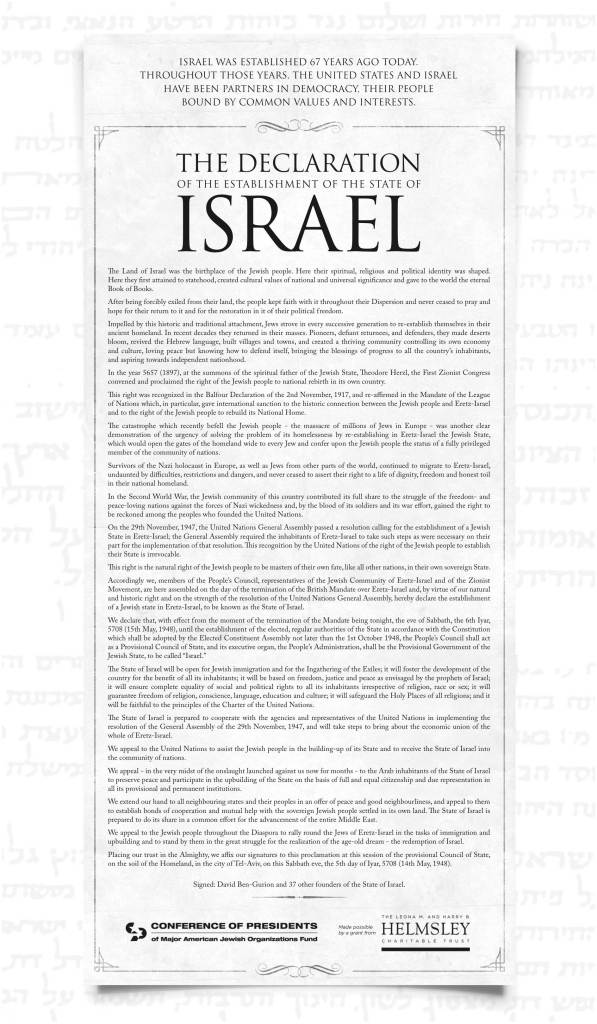
The Declaration of the Establishment of the State of Israel

I though this was a wonderful blog and the document attached is well worth reading!.

Jewish Federation of Springfield, Illinois's avatarTHE REAL ISRAEL

Today, the Conference of Presidents of Major American Jewish Organizations is celebrating 67 years of the special relationship between the United States and Israel, partners in democracy, their people bound by common interests and values.

Credit: Conference of Presidents of Major American Jewish Organizations Credit: Conference of Presidents of Major American Jewish Organizations

They are sponsoring a full-page reproduction of the Declaration of the Establishment of the State of Israel in newspapers across the country (Wall Street Journal, USA Today, LA Times, and Washington Post) in honor of Israel’s Independence Day.

Credit: Conference of Presidents of Major American Jewish Organizations Credit: Conference of Presidents of Major American Jewish Organizations

View original post

1 Comment

Filed under Uncategorized

Prayer for Elections in Israel

Mitch Glaser

The Key Players & the System

Today in Israel, twenty-six different parties are competing for 120 parliamentary seats. These parties represent the broadest spectrum of Israeli society from far-left to far-right. This is a very important election for Israel, as Netanyahu faces possible defeat, something that can be very dangerous for Israel and the free world. Dangerous because other PM’s might be more willing to accept a deal with Iran, a country whose leadership has openly called for the destruction of Israel, murder of Jews and the downfall America.

For Benjamin Netanyahu to win his party must win at least 3.25 percent, which equals 4 seats, in order to secure representation in the Knesset. Even then the parties that receive more than 3.25 percent of the vote are not guaranteed to win, as in Israel’s history no party has ever received an overall majority win. It is the best coalition that most likely ensures an overall win.

Israel is a parliamentary democracy, which means that the Israeli voter selects from amongst lists of parties and the leader of the party with the most Knesset (Parliament) seats becomes the Prime Minister. Also, the whole country of Israel is considered one constituency and the 120 Knesset seats are divided proportionately between the votes that each party wins.

Netanyahu faces Habayit Hayehudi (The Jewish Home) party which is led by Economy Minister Naftali Bennett, whose shares some views with the PM, but is running on a platform which emphasizes the economy and settlement issues. His biggest opponent is the Zionist Union, which is a collation party of the Labor party, one of the oldest parties in Israel, and a few newly formed parties (Yachad and Kulanu). Zionist Union’s platform is focused on addressing social and economic inequalities, as well as diplomatic and foreign policy issues. Other opponents include a Jewish non-Zionist party, an Arab majority party, a few more newly founded parties, some far-right religious parties and Yisrael Beiteinu (Israel is Our Home) comprised of immigrants from the former Soviet Union and led by Foreign Minister Avigdor Lieberman, who leans heavily towards right-wing and nationalistic positions.

The Issues

Historically, Israel has a large voter turn-out. According to some sources, during the January 2013 election 68 percent of eligible voters went to the ballots. Israelis are engaged. This election has two main issues that the voters are asked to consider, and in turn that the Israeli voter is genuinely worried about. First is the security of the land – the platform of PM Netanyahu, and the second, the economy – the platform of his most viable opponents.

The high cost of living is a central issue for Israelis, especially as it continues to rise. Many claim that buying the basics is becoming difficult as housing prices soar. Netanyahu’s primary focus has been security and his opponents have used this opportunity to pledge to the Israelis that they will work on fixing the economic problems of the Land. For Netanyahu it is the existential threat posed by Iran that is of the utmost importance.

Israelis are somewhat torn. The younger generation wants a chance to succeed and provide for their families. Some in the older generation say, “What point is there in having a good job and a full fridge if you’re dead.”

What will it take to form a coalition?

Because no one party is expected to win a majority of seats in the 120-seat Knesset, the party that wins is the party that can put together a coalition with a majority of seats (at least 61). The two leading parties, Likud (Netanyahu) and the Zionist Union (Herzog and Livni) are neck and neck in the polls; each suspended in eagerness around 24 seats. The real question is: “Which one can form the winning coalition?”

Jerusalem Post reported:

An internal Likud poll has shown for the first time that a majority of Israelis do not believe that Prime Minister Benjamin Netanyahu will form the next government, a Likud source said Monday. On March 9, the Likud’s data showed that 62.3% thought that Netanyahu would form the coalition and 19.9 % thought that Zionist Union leaders Issac Herzog and Tzipi Livni would form the government. On Monday, for the first time, the number believing Netanyahu would form the government fell to 49.6 %, while 30.4 % thought Herzog would form the coalition. It marked the first time since the election campaign began that the number dipped below 50 percent. The polls are taken by McLaughlin and associates, the American Republican strategist working for the Netanyahu campaign.

The Foreign Policy Research Institute observes,

With a rightist government, Netanyahu should be able to get a core group of about 53 seats (highlighted in darker blue). As the numbers now stand, the Netanyahu-led coalition would fall just short of the 61 seats it needs should either Moshe Kahlon (Kulanu) or Avigdor Lieberman (Yisrael Beiteinu) refuse to join a Netanyahu-led coalition, as each has threatened.

Netanyahu must work hard to garner votes, as his party is neck and neck with Likud, and be wise in who he sides with. In my opinion it would be wise to join forces with the Kulanu party (All of Us), led by former Likud member Moshe Kahlon. Kulanu is campaigning on promises of lowering the cost-of-living, bridging economic inequalities and fixing the housing crisis.

The Impact for the Gospel

Whoever the winner is, he or she will need to closely monitor Lebanon and Syria, and keep an eye on Hezbollah activities in the Syrian Golan Heights, as well as Hamas in Gaza and Fatah. Yakkov Lappin, writing for the Jerusalem Post observes,

By the time the results of the elections in Israel are clear, and the next ruling coalition emerges, Washington and Tehran might complete a deal that will leave Iran in possession of a large chunk of its uranium enrichment assets, all of its missiles, and all of its regional terrorist proxies and networks intact.

In the midst of all this upheaval and uncertainty, Israelis, especially secular Israelis, are not only responding to the Gospel, but asking for it. Our Tel Aviv based worker reported that many young secular Israelis are seeking out believers to discuss faith, God, and the Messiah Yeshua.

Please pray for the people of Israel and the work of Chosen People Ministries at this crucial time. Thank you.

7 Comments

Filed under Uncategorized

Response by the Baptist Press to Netanyahu’s Speech

David Roach, writing for the Baptist press, prepared an excellent article that is very appropriate for this first day of the Jewish festival of Purim. He elaborates on the parallels between the book of Esther, Netanyahu speech and the relationship of Iran (ancient Persia) today with the Jewish people in the modern state of Israel. Though I don’t do this often, I am including David’s article in full as it better articulates all I would have to say about this dire challenge that faces not only Israel, the entire world. a nuclear armed Iran is more frightening for the Jewish people and  our global community then an out of control Haman!!

Netanyahu: Iran’s threats parallel OT Esther story
by David Roach
Date: March 04, 2015 – Wednesday

WASHINGTON (BP) — A genocidal chapter in the ancient relationship between Israel and Iran could be the result of a nuclear agreement the United States may sign with Iran, Israeli Prime Minister Benjamin Netanyahu told a joint meeting of Congress March 3.

Threats by the modern Persian state of Iran to annihilate Jews, Netanyahu said, are frighteningly reminiscent of the murderous Old Testament plot hatched by the Persian viceroy Haman — whose plan to kill all Jews was foiled by the Persian queen Esther, a Jew, and recounted in the biblical book bearing her name.

Iran’s threats could translate into horrific violence if a nuclear deal reported widely in the media is signed, the prime minister said, noting that the day following his address, Jews would begin celebrating Purim, a feast commemorating their deliverance under Esther.

“Today the Jewish people face another attempt by yet another Persian potentate to destroy us. Iran’s Supreme Leader Ayatollah Khamenei spews that oldest hatred of anti-Semitism with the newest technology,” Netanyahu said, lamenting that the “very talented” Iranian people were “hijacked” by the “religious zealots” of the 1979 Islamic Revolution.

Khamenei tweeted in November, “This barbaric, wolflike & infanticidal regime of #Israel which spares no crime has no cure but to be annihilated.” In a separate tweet, Khamenei said he was not suggesting “the massacre of the Jewish people,” but he advocated arming Muslims in the West Bank to fight Israel.

Netanyahu told Congress that striking a nuclear deal with Khamenei’s regime would not inspire Iran to decrease its aggression toward Israel and that the specific deal under consideration “would all but guarantee” that Iran obtains nuclear weapons — “lots of them.”

The nuclear deal being considered by Iran, the U.S. and five other nations would allow Iran to keep around 6,000 uranium enrichment centrifuges while limiting development of more efficient centrifuges. It also would limit stockpiles of material that could be developed into nuclear weapons and subject Iran’s nuclear facilities to inspection, as described by the Washington Post. The agreement likely would last 10-15 years, and a March 24 deadline has been set for establishing the framework of a final accord.

Not “a single nuclear facility” would be demolished under the agreement, Netanyahu said, and Iran could amass a “full arsenal” of nuclear weapons legitimately after the accord expires. He urged legislators to press for a “much better deal” that would:

— Further restrict Iran’s ability to produce nuclear weapons.

— Maintain restrictions on Iran’s nuclear program until it ceases aggression toward Israel and other neighbor states.

— Demand that Iran stop supporting terrorism around the world.

America must secure a “better deal that Israel and its neighbors may not like, but with which we could live — literally,” Netanyahu said.

President Obama, who did not watch the speech but reviewed a transcript, said Netanyahu’s demands are unrealistic and would cause Iran to walk away from negotiations with an unchecked nuclear program, the New York Times reported. A senior administration official told the Times that Netanyahu is inconsistent to insist that Iran change yet simultaneously portray its government as unchanging.

<b>Evangelical reaction</b>

Evangelical commentators said Netanyahu’s comparison of modern Iran with Haman of the Old Testament was appropriate.

Jim Sibley, a professor of biblical studies at Israel College of the Bible in Netanya, Israel, called the timing of Netanyahu’s speech “remarkable.”

“The day following Netanyahu’s address to Congress marks the beginning of the Feast of Purim, which celebrates the deliverance of the Jewish people from an Iranian anti-Semitic plot to exterminate them. At that time, God raised up Esther, who was willing to breach protocol in order to plead for their deliverance,” Sibley told Baptist Press in written comments.

“Iran and others who turn against Israel have fallen under the curse of Genesis 12:3 and may well be paving the way for the great end-times enemy of Israel and God,” Sibley said. In Genesis 12:3, God promised to bless those who bless Abraham’s descendants and curse those who curse them.

Sibley added, “God is dealing with the Jewish people on the stage of current events, drawing them back from the four corners of the earth to the land of Israel. This, together with the rapidly growing number of Jewish believers in Yeshua [Jesus], increasingly amplifies the cognitive dissonance inherent within any view that claims that Israel no longer occupies a unique role in God’s purposes.”

Mitch Glaser, a Jewish follower of Jesus and president of Chosen People Ministries in New York City, agreed that Netanyahu’s citation of Esther was appropriate.

“The story of Esther provides a very obvious and powerful parallel for the modern Hamans of Iran who are incessantly trying to destroy Israel through arming Hezbollah, Gaza and others seeking the destruction of Israel,” Glaser told BP in written comments. “The prime minister pointed out the blatancy of the religious leadership of Iran, Ayatollah Khamenei.”

<b>Israel & ancient Persia</b>

Not all of the Persian Empire’s Old Testament dealings with Israel were as destructive as those recounted in Esther. The Persian king Cyrus defeated Babylon in 539 B.C. and allowed Jews to return to the Promised Land and rebuild the Temple (Ezra 1:1-4). After a break in construction, Jews completed the Temple under the Persian monarch Darius I, with Darius funding the project, protecting the builders and donating animals and other materials for Temple sacrifices (Ezra 6:6-12).

Daniel began his ministry under Babylonian rule, but it continued under the Persians. He prophesied their rise to power (Daniel 5:1-31), and King Darius placed him in a significant position of authority within the Persian Empire (Daniel 6:1-3). Although Daniel was cast into the lions’ den when he prayed to God rather than the Persian king, Darius announced upon Daniel’s miraculous rescue, “I make a decree, that in all my royal dominion people are to tremble and fear before the God of Daniel” (Daniel 6:26). Later, the Persian king Artaxerxes allowed his Jewish adviser Nehemiah to lead an effort to rebuild Jerusalem’s walls, guaranteeing Nehemiah’s safe passage to Judah and providing timber for the project (Nehemiah 2:1-8).

At the height of its influence, the Persian Empire stretched from Egypt in the south to southern Russia in the north, from Greece in the west to India in the east. The empire fell to Alexander the Great and the Greeks in 334 B.C. However, Persian influence continued in the New Testament, as when Jesus told the repentant thief on the cross, “Today you will be with me in Paradise” (Luke 23:43), using a word for heaven derived from the Persian term for “park.”

Relations between Jews and Persians became more strained in the seventh century A.D., when Muhammad founded Islam and Muslims conquered the region inhabited by Persians. Because most Jews did not accept Islam, Muhammad grew hostile toward them, beheading at least 600 in Medina in 627 and executing others elsewhere, according to a classic Muhammad biography published in English as “The Life of Muhammad.”

<b>Israel & contemporary jihad</b>

Netanyahu told Congress that contemporary Iranian aggression is a continuation of Islamist jihad. The main difference between ISIS and the Iranian regime, he said, “is that ISIS is armed with butcher knives, captured weapons and YouTube, whereas Iran could soon be armed with ballistic missiles and nuclear bombs.”

Fred Fleitz, senior vice president for policy and programs at the Center for Security Policy in Washington, agreed with Netanyahu’s reservations about the nuclear accord being considered by the U.S. and Iran. Fleitz told BP the deal is a “giveaway.”

“Iran is a radical Islamic state,” Fleitz said. “It is pushing Islamic supremacism. It is trying to push its brand of Shia Islam around the world, and it sees the United States and Israel as enemies.”

Some in Iran, like past president Mahmoud Ahmadinejad, Fleitz said, believe that a messianic figure known as the “12th Imam” is alive today and will reveal himself at the end of time. Known as “Twelvers,” those who hold this belief think the 12th Imam’s return will be precipitated by a series of cataclysmic events that presumably could include nuclear war.

Although Iran claims its nuclear program is peaceful, Fleitz said there is “no conceivable way” the nation’s uranium enrichment activities are merely to produce nuclear power. There is “every possibility” Iran is lying in nuclear negotiations because it has violated past agreements multiple times.

“We should be trying to work cooperatively with Iran, but the price the Obama administration is trying to pay to get a deal is simply too high,” Fleitz said.

The U.S. demanded in the past that Iran give up centrifuges and plutonium reactors and answer questions about its military activities, Fleitz said. But America has wrongly conceded those demands in recent negotiations.

An acceptable deal would be to sell Iran discounted nuclear fuel rods to power its nuclear energy program and convert the nation’s enriched uranium stockpile into fuel rods. In exchange, Iran would abandon its uranium enrichment capability, Fleitz said.

That recommendation aligns with the views of Netanyahu, who contrasted the U.S. Constitution’s celebration of “life, liberty and the pursuit of happiness” with the Iranian regime’s celebration of “death, tyranny and the pursuit of jihad.”

Netanyahu closed his address by applying Moses’ words in Deuteronomy 31:6 to Israel and America’s relations with Iran.

“Be strong and resolute,” Netanyahu said. “Neither fear nor dread them.”
The original story can be found at: http://www.baptistpress.com/44328/netanyahu-irans-threats-parallel-ot-esther-story

DISCLAIMER: Baptist Press should be credited for any reprinted stories that originate with BP.
Suggested credit line: Reprinted from Baptist Press (www.baptistpress.com), news service of the Southern Baptist Convention.

Please note that Baptist Press periodically carries stories from other sources by permission. Individuals interested in reprinting non-BP stories should contact the entity where the story originated to seek reprint permission.

1 Comment

Filed under Uncategorized

The Ten Days of Awe

We are in the midst of the Ten Days Awe which began with the first day of the Jewish New Year, Rosh Hashanah.  The other name for this season is the Ten Days of Repentance as the traditional Jewish belief for this season is that God will judge our hearts and actions during this period of time and determine our future.  The culmination of the ten days is the observance of Yom Kippur, the Day of Atonement which begins this coming Friday evening.

I have written a series of devotionals on the themes of atonement and forgiveness and hope you will read them.  The following is the text of the first devotional…

We are about to observe the Civil Jewish New Year, Rosh Hashanah, which literally means, the “Head of the Year.” The festival is one of the seven great festivals, appointed by God to be celebrated on the first day of the seventh month of the Jewish calendar, Tishrei. All seven of these Holy Days are found in the Bible in Leviticus chapter 23, as well as in a number of other passages in the Pentateuch/Torah. There is also a vast amount of rabbinic material describing the festivals and how they should be observed.

The Holy Days are prophetic in nature and over the course of the year provide a roadmap to redemption; Passover, Unleavened Bread, First Fruits, Pentecost, the New Year, Day of Atonement and Tabernacles. The holidays are similar as each one involves a rest from labor, worship, offerings and usually a reminder of a great event in the history of Israel. Oftentimes a holiday is also tied to the agricultural season and in one way or another is connected to the harvest.

It is important to note the Hebrew word translated as “holiday” in Leviticus 23 is better when understood as “appointments.” God asks Israel to remember what He did for them in history over 150 times in the Hebrew Scriptures. He set up these “appointments” (or “appointed times”) to help His people commune with Him and “remember” His good works in their history. Each of these Holy Days was established by God and revealed to the children of Israel by Moses, who received the calendar as part of the Sinai revelation.

I also believe that every one of these festivals (“appointed times”) was fulfilled in the person of Jesus the Messiah and, along with many scholars, believe the first four Spring festivals pointed to His first coming and the latter three in the Fall are related to His second coming.

These holidays have a variety of themes and customs and are observed in a similar manner by most Jewish people, whether they be Ashkenazic (Eastern European decent) or Sephardic (primarily from Spain and North Africa)—New Yorkers, Brooklynites or Israelis. The major themes of the Jewish New Year are Kingship, Remembrance and the Blowing of the Shofar.

Over the centuries, our rabbis and sages have complied a book entitled the Machzor, which is used in the synagogue as the prayer book and service guide for Rosh Hashanah and Yom Kippur (See Leviticus 23: 23- 25; Numbers 10: 10; 29: 16 for the biblical details).

Rosh Hashanah is the first of three great festivals to be celebrated in the Fall. The other two are Yom Kippur, (Day of Atonement) and Sukkot (the Feast of Tabernacles).

The great theme of Rosh Hashanah is repentance and the overarching theme of the High Holiday season is forgiveness. In fact, the first day of Rosh Hashanah begins a season of ten days of repentance, often called the Ten Days of Awe by the Jewish people. The observance of the Day of Atonement concludes these ten days. It is understood by most Jewish people that repentance is the path that leads to salvation and the forgiveness of sin, which is secured at the closing moments of Yom Kippur.

Though it is difficult to explain the difference, forgiveness is stressed in the Jewish community far more than personal salvation, especially as understood by most Christians. Jewish people are not as apt to think about personal salvation or a secured future beyond the grave in the same way Christians do.

However, Jewish people do think about forgiveness during this time of year and are usually eager to repent before God and reconcile with whomever they may have offended as well. But, forgiveness is viewed as temporal, needing annual renewal and received on the basis of God’s grace as well as our repentance and willingness to be obedient to His Law found in the Five Books of Moses. At least this is the traditional Jewish teaching on the subject.

The Ten Days of Awe or the Ten Days of Repentance are observed during the time between Rosh Hashanah and Yom Kippur. Jewish tradition calls upon us to ask for forgiveness and to forgive others as one vital part of receiving God’s forgiveness at the conclusion of the ten-day period.

The Purpose for the Devotionals:

During the Ten Days of Repentance, we will be providing our readers with ten devotions, one for each day.

These devotional thoughts will hopefully be a blessing to you and help sensitize you to what your Jewish family and friends are observing as well. We also will present a passage or two from the Bible for you to meditate upon and will allow the Lord to speak to you through His word during this important season of the year.

The Apostle Paul suggests the importance of understanding and even experiencing the Jewish festivals in his letter to Timothy. He writes,

All Scripture is inspired by God and profitable for teaching, for reproof, correction, for training in righteousness; so that the man of God may be adequate, equipped for every good work. (2 Timothy 3:16-17)

Scripture Meditation:

I have found the above verses to be very helpful and practical in understanding the role of the festivals in the lives of believers in Jesus the Messiah.

In using the term Scripture, Paul is referring to the entirety of the Old Testament. Certainly, we can infer that this is also true of the New Testament, but specifically Paul has the Hebrew Scriptures in mind. Every part of the Bible is useful to us in the process of growing to spiritual maturity. This would include the Jewish holidays.

Paul is not suggesting that we must keep these festivals in any particular way nor is he suggesting that we are under obligation to keep them! Rather, he tells us that every verse in every one of the 39 books of the Old Testament is helpful and may be utilized for spiritual benefit. This would be true of the festivals outlined in Leviticus 23 and would include the three Fall events; the New Year, the Day of Atonement and Tabernacles.

Therefore, learning more about these “Feasts” is helpful for your spiritual journey. And for me, the emphases of the first two holidays on repentance and forgiveness create a magnificent backdrop for understanding the work of Jesus the Messiah, who died that I might live.

To read the rest of the devotional go to:

http://www.chosenpeople.com/main/index.php/holidays-and-festivals/836-ten-days-of-awe-devotionals

4 Comments

Filed under Uncategorized

Time to Protest! Presbyterian Anti Israel Tactics

I do not usually step into the fray of denominational politics, but this time I am compelled to raise my voice!

The Presbyterian Church USA will be meeting in General Assembly this week.  The representatives to the Assembly will consider taking actions against Israel that go beyond the call of Christians to preach the Good News to all people.

The PCUSA should be more concerned with sharing the love of God with both Israelis and Arabs and less concerned with solving political problems through coercive financial messages and promoting materials for local congregations that are overly simplistic, unfair and mean-spirited.

The Presbyterian Church USA (PCUSA) has made repeated efforts over the last two decades to minimize Jewish evangelism, to encourage PCUSA churches to openly criticize Israel, and to urge churches to divest their shares of companies doing business with Israel.

A number of Overtures initiated at the 221st General Assembly of the Presbyterian Church USA (PCUSA) this week will take a politically pro-Palestinian posture – going so far as to compare today’s Israelis to Nazis who murdered six million Jews.

This movement within the PCUSA has gone too far. Those who identify themselves as followers of Jesus must raise their voices in protest.

As Messianic Jews and Gentile followers of Jesus Christ supportive of Israel’s right to the land promised to the Jewish people in the Bible, we boldly protest these outrageous efforts by the PCUSA.

We urge the leaders of the PCUSA to stop vilifying Israel. We should be focused on evangelism – concentrating on sharing the Gospel with both Jewish people and Palestinians.

Less of politics, and more of the Gospel, leads to enduring peace.

Please click on http://bit.ly/1sj1aan and sign the petition and please send this out to all your friends that love the Lord and the Jewish people… and to those who do not, as the actions of the PCUSA must be opposed by all followers of our Messiah Jesus who believe the Gospel should be our primary focus and tool of reconciliation.

Click here to sign the petition to stop the anti-Israel movement


23 Comments

Filed under Uncategorized

Shavuot – The Day of Pentecost and The Festivals of Israel

Shavuot – The Day of Pentecost The Festivals of Israel

The festivals of Israel were designed by God to focus the hearts and minds of the Jewish on various elements of God’s person and plan.   In addition, the Festivals, as much as any other portion of the Hebrew Scriptures also point to the coming of the Messiah. This is especially true of the seven great festivals outlined in Leviticus chapter 23.

I believe the four Spring Festivals were fulfilled in the first coming of Jesus.   The three Fall Festivals will be fulfilled in His second coming.

The Fourth Spring Festival

The Biblical Names

Shavuot – Weeks – 7 weeks after Passover

The fourth and final Spring Festival is called Shavuot. This word means seven because seven-sevens – or seven, seven-day weeks are to be counted by the Jewish people; beginning with Passover and then Shavuot is to be observed on the 50th day.

Pentecost – Fifty – 50th day after Passover

In Christian tradition the festival is called Pentecost – the Greek term which means 50, as this fourth spring festival is observed on the 50th day after Passover.

The Traditional Jewish Names

Zman Matan Torah – ‘the season of the giving of the Law’ – One of the Hebrew titles for the holiday in Jewish tradition is Zman Matan Torah – ‘the season of the giving of the Law’ as the Rabbis believed that the Torah was given on the day of Pentecost.  We eat special holiday bread – a reminder of the Jewish tradition that Moses climbed a ladder to heaven to receive the Law.  Shavuot is a Jewish holiday that celebrates the giving of the Torah to the Jewish people and the Talmud tells us that God gave the Ten Commandments to the Jews on the sixth night of the Hebrew month of Sivan.

The Biblical Commands

  • Sheuvot always falls 50 days after the second night of Passover. The 49 days in between are known as the Omer.  A later Jewish tradition teaches that the Torah was given on Shavuot.
  • The counting for the 50 days was to begin on that ‘day after the Sabbath’(Lev. 23:15), the day when the First Fruit/sheaf was waved occurred on the day.
  • They offered two leavened loaves of bread concluding the grain harvest. (Lev. 23:17), which was the Tithe (Lev. 27:30).
  • The two-loaves were the results (symbolically) of the one sheaf, waved before the Lord on the Day of First Fruits mentioned in Lev. 23:11
  • Shavuot is also one of the three pilgrimage feasts when all Jewish males were required to appear before the Lord in Jerusalem.

Jewish Traditions

  • There are many Jewish traditions associated with Pentecost.
  • The reading of the Book of Ruth as it is a harvest time story – King David was born and died on this festival and Ruth took on the burden of the Law.
  • Many religious Jews commemorate Shavuot by spending the entire night studying Torah at their synagogue or at home.
  • Chanting the Ten Commandments.

The Messianic Fulfillment of the Festival

Now if Passover was fulfilled in the death of the Lamb of God and unleavened bread in his sinless character and His resurrection the fulfillment of First Fruit then we must ask ourselves – how was the of day Pentecost fulfilled by the first coming of Jesus?

It is no coincidence that God selected this Jewish festival as the day when he would send his Holy Spirit.  In Acts, chapter 2 we see this festival fulfilled in some remarkable ways. To understand why God would choose to pour out His Spirit on the day of Pentecost – we must rehearse the relationship between all the Spring Festivals.

  • Passover – redemption – death of Christ
  • First Fruits – first results – Resurrection (1 Cor. 15:23)
  • Pentecost – Fruition – Birth of the Church

In Acts, chapter 2 God fulfills this festival in some remarkable ways.

The Promise

The 120 Disciples (Acts 1:15), were in one place, in one mind, praying and focusing on God’s work. They were waiting in obedience to the command of Jesus (Acts 1:4-5) and also in obedience to the Laws of Shavuot regarding “no work’ – Lev. 23:21.  Many were pilgrims who had left their homes in other places to be part of this Festival. God would bless their obedience now in a powerful way – some of those waiting were pilgrims as Pentecost was one of the three Festivals where Jewish people were commanded to go “up to Jerusalem’ to worship.

God would bless their obedience.

And He opened their understanding, that they might comprehend the Scriptures. Then He said to them, “Thus it is written, and thus it was necessary for the Christ to suffer and to rise from the dead the third day and that repentance and remission of sins should be preached in His name to all nations, beginning at Jerusalem. And you are witnesses of these things. Behold, I send the Promise of My Father upon you; but tarry in the city of Jerusalem until you are endued with power from on high.” (Luke 24:45-49)

And further, before His ascension to the right hand of the Father He says to His disciples,

… He commanded them not to depart from Jerusalem, but to wait for the Promise of the Father, “which,” He said, “you have heard from Me; for John truly baptized with water, but you shall be baptized with the Holy Spirit not many days from now.”(Acts 1:4-5)

Signs and Wonders

After some days of patient waiting – the presence and power of the Holy Spirit fell upon the disciples on the 50th day after Passover.  It was a new revelation given on a new Pentecost!  The initial giving of the Torah by Moses at Mt. Sinai had come with signs and wonders in the heaven as seen in Exodus 19.

Then it came to pass on the third day, in the morning, that there were thunderings and lightnings, and a thick cloud on the mountain; and the sound of the trumpet was very loud, so that all the people who were in the camp trembled. And Moses brought the people out of the camp to meet with God, and they stood at the foot of the mountain.

Now Mount Sinai was completely in smoke, because the LORD descended upon it in fire. Its smoke ascended like the smoke of a furnace, and the whole mountain quaked greatly. And when the blast of the trumpet sounded long and became louder and louder, Moses spoke, and God answered him by voice. (Ex. 19:16-19)

There were now signs and wonders in the Upper Room marking this new Pentecost as well.  It was the birthday of a new revelation and the fulfillment of God’s promises to pour out His Spirit in the last days! (Joel 2)

Hearing the Good News in their Own Language

The Tradition of All Israel Being Present at Sinai

According to our Sages, every Jew who would ever live was at Mount Sinai, pledging their obedience to the Law.  According to Jewish tradition this was not limited to the Jews alive at this time.  The Rabbis believed in the pre-existence of the soul and that every Jew who would ever live – was at Mount Sinai – with or without a body! The rational for this is that every Jewish person at that moment agreed to keep the Torah.  The verse used to teach this is,

Ex. 24:7 Then he took the Book of the Covenant and read in the hearing of the people. And they said,  “All that the LORD has said we will do, and be obedient.”

In light of this, it makes sense that there was also a Jewish tradition that every Jew present at Mount Sinai that day actually heard the giving of the Law in their own native tongue – after all how could they obey what they did not understand.

The fulfillment on the day of this new Pentecost, which took place 50 days after Jesus the Lamb of God died for our sins, is obvious.  There were signs and wonders, just like at Mount Sinai and those who heard the disciples preaching heard this new revelation in their own native tongue.  Can you imagine what it would have been like to be present at this new Pentecost?  It would have been amazing especially as the Jewish people realized that the new had come with the power of the old!

How gracious of God to use a tradition of man to communicate His truth to the Jewish people.  God Himself is our role model for missionary service and evangelism.   He seeks to communicate with us in ways we can understand…He could prove His point otherwise, but He deigns to prove Himself in ways that we humans can understand…as our ability to understand spiritual truth is so limited.  Perhaps the best example of this is the Son of God Himself, who took on flesh in order to communicate with you and me…to show us His love and to help us better understand the Father through His role model and example.  We too need to incarnate the Good News in ways that our families, friends and neighbors understand …through love, helping in practical ways and doing whatever it takes to help those we pray for understand that God is not far away, He is close and He loves them.

Happy Shevout/Pentecost and may the Lord fill you with the presence and power of His presence. 

3 Comments

Filed under Holidays & Festivals, Israel, Jewish Christian Dialogue, Jews and Christians, Judaism, Messianic Jewish, Uncategorized

Because of the Blood of the Lamb

A Passover Devotional:

            Lessons on the Lamb of God Part 2

            Rev. Dennis Keating, Pastor,  Emmanuel Faith Community Church, Escondido, California

Today is Good Friday and I thought you might enjoy these thoughts on the Lamb of God from my friend Dennis Keating. Have a joy-filled end of Passover, Good Friday and Resurrection Day!

I hope these six outcomes will encourage you to give praise to the Lord today and prepare your heart for the celebrations that are coming next weekend.

Because of the blood of God’s Lamb we are:

            1. Released from sins penalty

            Remember what John the Baptist said when he was preaching in the wilderness and Jesus first appeared on the scene? John 1:29, “Behold, the Lamb of God who takes away the sin of the world!”

John said, “There He is. God’s Passover ‘Lamb’ who [airo] ‘takes away’ (or literally) ‘lifts and carries away’ the penalty of the world’s sin.”

2. Redeemed from sin’s slavery

Not only has the penalty of sin been lifted from us, but its addictive power that binds us in slavery to sin has also been broken. That’s what the biblical term “redemption” is all about. Peter said it this way in 1 Peter 1:18-19,  “You were not redeemed with perishable things like silver or gold from your futile way of life inherited from your forefathers, (19) but with precious blood, as of a lamb unblemished and spotless, the blood of Messiah.”

The original word (lutroo) translated “redeemed” means to purchase release by paying a price. The Greeks used it as a technical term for the spending of money to buy back a prisoner of war.

In the yearly, historic Passover celebration, the innocent lamb’s blood reminded us of the price paid to purchase and free the lives of Israel’s firstborn sons.

That was a divinely ordained illustration of what the blood of Yeshua would do for you and me at the moment of our salvation. It “redeems” us from the sinful “futilities” of life that paralyze us in our unregenerate state.

3. Rescued from God’s wrath

            According to the biblical account of the original Passover, God was offended by Pharaoh’s idolatry. The result was that the Lord poured out His righteous and justified anger against Pharaoh through the plagues. God experienced the same anger against our my/your/our sin as well, as according to Ephesians 2:3, in our unregenerate state, we were all “children of wrath even as the rest.”

But the shedding of Jesus’ blood on Calvary as our “Passover Lamb” rescued us for that well-deserved wrath. Paul said it this way in Romans 5:9, “Much more then, having now been justified by His blood, we shall be saved from the wrath of God through Him.”

4. Revel in heavenly worship

            According to the book of Revelation, the Apostle John saw an uncountable number of angels and people around God’s throne in heaven. Do you know what they were all exclaiming in worship? Revelation 5:11 tells us they were saying…“Worthy is the Lamb that was slain to receive power and riches and wisdom and might and honor and glory and blessing.”

5. Relieved of Satan’s accusations

            It may come as a surprise to you that, according to Revelation 12, the devil spends much of his time up in heaven “accusing” you before God the Father of being “unworthy” of salvation. See how he’s described in Revelation 12:10-11. The devil is…“he who accuses them before our God day and night. (11) And they overcame him because of the blood of the Lamb…”

Beloved, the devil can accuse a believer all he wants, but is powerless to bring a condemning judgment against any of us! Why? Because the fundamental basis for our spiritual victory over sin is “the blood of the Lamb.” It’s what allows us to victoriously overcome all accusations.

It’s why Paul asked in Romans 8:33, “Who will bring a charge against God’s elect?”

6. Restored Under a New Covenant

            If you read through your Hebrew Scriptures you will see that the agreement God made with mankind to forgive their sins by the shedding of innocent animal blood was an intentionally designed, imperfect system in that the blood sacrifices had to be repeated over and over again each year. Animal blood only provided a temporary covering.

Well, according to the New Testament, when Yeshua’s blood was shed, a “new covenant” or agreement was established by God with humankind because it was based upon the sacrifice of His Son’s perfect blood that cleanses the sinner permanently. That changed everything. Now the cleansing occurs within and not just without. It’s not based upon “law” but upon “love.” The “heart of stone” is replaced with a “heart of “flesh.” This is why at our communion services we read from 1 Corinthians 11:25, “This cup is the new covenant in My blood…”

The Lamb’s provision must be accepted BY FAITH. That was certainly true for the Hebrew people when the Passover ceremony was first revealed. Every Hebrew household had to decide, “Do we believe what God has said or don’t we?” It was even true of Moses. This is why the author of Hebrews wrote, “By faith he kept the Passover and the sprinkling of the blood, so that he who destroyed the firstborn would not touch them.” (Hebrews 11:28)

Beloved, that is true for believers and unbelievers alike. As a believer, I/you/we must accept these biblical truths as our own or their impact will be diminished. When doubts enter in, when faith is weak, our experience with these six realities will be muted. But when we study them, we are assured that our “Passover Lamb” has paid for our sin in full. To prove it true, after He died, He was buried; and after He was buried, He arose and is alive today.

If you have not yet responded to Him, you should, and by doing so you will experience His grace and overflowing goodness…and have life more abundantly. (John 10:10)

Leave a comment

Filed under Holidays & Festivals, Israel, Jews and Christians, Judaism, Messianic Jewish, Uncategorized

The Lamb of God Who Takes Away the Sin of the World!

A Passover Devotional:

Lessons on the Lamb of God Part 1

The Hebrew Scriptures conclude with two prophecies in the Book of Malachi describing a Messenger (also the meaning of the prophets name!) who would prepare the way for the Lord.  The first of these prophecies is found in Malachi 3:1,

Behold, I am going to send My messenger, and he will clear the way before Me. And the Lord, whom you seek, will suddenly come to His temple; and the messenger of the covenant, in whom you delight, behold, He is coming,” says the Lord of hosts.

This Messenger would purify the priests so they might once again offer sacrifices on behalf of the Jewish people.  As the prophet writes, Then the offering of Judah and Jerusalem will be pleasing to the Lord as in the days of old and as in former years.(Malachi 3:3)

The Jewish people would be judged because of disobedience, but also left with hope. In fact the very last words recorded in the Old Testament (Malachi 4:5-6), predict that this messenger identified as the prophet Elijah would call the Jewish people to back to God and reconcile both fathers and sons.

“Behold, I am going to send you Elijah the prophet before the coming of the great and terrible day of the Lord. He will restore the hearts of the fathers to their children and the hearts of the children to their fathers, so that I will not come and smite the land with a curse.

This call to repentance was God’s way of preparing the Jewish people for the One whom Elijah would introduce to the Jewish people. Jesus believed that John the Baptist fulfilled these prophecies and that He was the Elijah like messenger who came to turn the Jewish people back to the Lord.  Jesus affirms this in the Gospel of Matthew,

As these men were going away, Jesus began to speak to the crowds about John, “What did you go out into the wilderness to see? A reed shaken by the wind? But what did you go out to see? A man dressed in soft clothing? Those who wear soft clothing are in kings’ palaces! But what did you go out to see? A prophet? Yes, I tell you, and one who is more than a prophet. This is the one about whom it is written, ‘Behold, I send MY messenger ahead of You, Who will prepare Your way before You.’ (Mt. 11:7-10)

John repeatedly denies that he is the Messiah and tells those gathered that the One they have really been waiting for is coming and it is simply his job to introduce Him.

Now they had been sent from the Pharisees. They asked him, and said to him, “Why then are you baptizing, if you are not the Christ, nor Elijah, nor the Prophet?” John answered them saying, “ I baptize in water, but among you stands One whom you do not know. It is He who comes after me, the thong of whose sandal I am not worthy to untie. (John 1:24-27)

The earth shattering moment comes when John’s introduces this One place at Bethany beyond the Jordan. (John 1:28). He was immersing Jewish people in water as a symbol of their desire to be cleansed from sin. But now he declares that the One who was to come – had come! John describes Jesus as the Lamb of God who takes away the sin of the world.  The Jewish people on the banks of the Jordan would have understood this to be a reference to the Passover lamb in Exodus 12 with additional information provided by Isaiah in chapter 53.

John declares,

The next day he *saw Jesus coming to him and *said, “Behold, the Lamb of God who takes away the sin of the world! This is He on behalf of whom I said, ‘ After me comes a Man who has a higher rank than I, for He existed before me (John 1:29-30)

John mentions this again a moment later to two future disciples when he said,

Again the next day John was standing with two of his disciples, and he looked at Jesus as He walked, and *said, “Behold, the Lamb of God!” The two disciples heard him speak, and they followed Jesus. (John 1:35-37)

This theme of Jesus as the Lamb of God would become a major teaching theme by the writers of the New Testament. Peter, also establishes this link, as he was the brother of Andrew, one of the two disciples who heard John’s statement about Yeshua.

Peter writes,

…knowing that you were not redeemed with perishable things like silver or gold from your futile way of life inherited from your forefathers, but with precious blood, as of a lamb unblemished and spotless, the blood of Messiah.(1 Peter 1:18-19)

This link between Yeshua and the Lamb had already made by Luke in the Book of Acts in reference to the encounter between Phillip and the Ethiopian eunuch. Luke records,

Now the passage of Scripture which he was reading was this: HE was led as A sheep to slaughter; And as A lamb before its shearer is silent, SO HE does not open His mouth. (Acts 8:32), which is our first indication that Jesus was not only compared to the lamb in the Book of Exodus, but the Lamb as well in Isaiah 53.

Rabbi Saul, the Apostle Paul takes this link one step further and declares,

Your boasting is not good. Do you not know that a little leaven leavens the whole lump of dough? Clean out the old leaven so that you may be a new lump, just as you are in fact unleavened. For Messiah our Passover also has been sacrificed. Therefore let us celebrate the feast, not with old leaven, nor with the leaven of malice and wickedness, but with the unleavened bread of sincerity and truth. (1 Cor. 5:6-8)

The links between Jesus and the Passover Lamb are overwhelming. In describing the crucifixion of Yeshua John adds,

For these things came to pass to fulfill the Scripture, “ Not A bone of Him shall be broken.”(John 19:36), looking back to Exodus when Moses tells the Israelites how the lamb was to be sacrificed,

It is to be eaten in a single house; you are not to bring forth any of the flesh outside of the house, nor are you to break any bone of it. (Exodus 12:46)

The Lamb in Exodus 12 is a prophetic portrait of the One who would come and shed His blood for the sins of the world.

The Lamb of Isaiah 53

The prophet Isaiah develops the significance of the lamb as an atoning sacrifice.

There are two key passages in Isaiah 53 which conjoin the idea of the Messiah with the Passover lamb…

He was oppressed and He was afflicted, Yet He did not open His mouth; Like a lamb that is led to slaughter, And like a sheep that is silent before its shearers, So He did not open His mouth. (Isaiah 53:7)

Admittedly, this can be a reference to the lambs that were regularly sacrifice at the temple and especially on some of the holidays. Yet, when you look at the entire passage it does seem that the prophet had the Passover lamb specifically in mind.

And additionally in Isaiah 53:1,

Who has believed our message? And to whom has the arm of the Lord been revealed?

The key link in this passage is that the term for arm is zeroah,which refers to the arm or forearm, but is more often used in passages which refer to God’s saving power and intervention in human history.  This idea easily brought the mind of an Israelite back to the deliverance from Egypt as a picture of God’s redemptive work on behalf of His people.

Exodus chapter 6, quoted in the Hagaddah teaches this very clearly,

Say therefore to the people of Israel, ‘I am the Lord, and I will bring you out from under the burdens of the Egyptians, and I will deliver you from slavery to them, and I will redeem you with an outstretched arm and with great acts of judgment. (Ex. 6:6)

Jesus is the saving zeroah of God who intervened in Egypt and into this world to deliver Israel and the nations from spiritual bondage.  And when a man or woman, Jew or Gentile, boy or girl, by faith “smear” the doorposts of their hearts with His shed blood with blood of the Lamb that the wrath of God passes over us and pass from death into life.

This is the way to begin the Passover season and Holy Week – knowing that God’s promises are true and that He has provided the Lamb of God to be the Savior for us all.

Happy Passover.


13 Comments

Filed under Holidays & Festivals, Israel, Jewish Christian Dialogue, Jews and Christians, Judaism, Messianic Jewish, Uncategorized