Hurricane Sandy: One-Year Memorial

Dear friends,

It was only one year ago when Hurricane Sandy stormed through the East Coast of the United States, leaving terrible destruction in its wake. The homes and hopes of families were destroyed, tens of thousands were out of work, personal property – from family pictures to cherished memorabilia – were swept away in the floods, and many were left homeless and helpless for weeks.

In the midst of this tragedy, God’s people were faithful and generous, as many followers of Yeshua the Messiah gathered clothing, food, electrical generators and so much more – distributing them to needy families in many areas. Chosen People Ministries focused on the thousands of Russian Jewish homes lining the shores of Staten Island, New York City, where there was tremendous loss and suffering because of the hurricane. We cleaned homes; distributed food, blankets, electrical generators, heaters, small refrigerators and stoves; and wept with those who wept… prayed with those who did not know how to pray… and stood alongside the victims of this terrible event that still traumatizes many of the families who suffered the most.

In the midst of what was a very difficult season, we saw God’s faithfulness and care for individuals and families, which was nothing short of amazing. Believers from all over the country came to the eastern seaboard, and many focused on some of the poor residents of Staten Island – mostly Russian Jewish people, who suffered tremendously – and showed God’s love in the most tangible ways.

Our ministry developed many personal relationships with folks who needed help, and those relationships continue until this day. Very few of us on the Chosen People Ministries staff were experienced in disaster relief, but we knew that God wanted us to love those who were hurting. We spent weeks and even months serving the hurting, and it was really wonderful to see how that love was received by many Jewish people in particular… who knew that the One motivating our love and actions was the Messiah Jesus – the Savior of the world.

We actually distributed tens of thousands of dollars to those who needed to rebuild their homes and lives, from paying contractors to rebuild their homes and having funds to survive!

I want to thank those who helped support the hurricane victims during this very difficult and dark time – because of you, the Light of the Messiah was able to shine brightly through us and others who served the suffering of Staten Island and many other communities during this time.

As we look towards November and the celebration of Thanksgiving – which of course falls on the Jewish holiday of Hanukkah – I remember setting up tables outside with Hanukkah menorahs, gifts for children, hot chocolate and some Hanukkah foods in devastated neighborhoods of Staten Island. It was during those dark and gloomy nights that the lit candles on these tables reminded me of Messiah’s presence among us in ways that I personally will never forget. This passage from the writings of the prophet Isaiah became very dear to me:

But now thus says the Lord,

 he who created you, O Jacob,

he who formed you, O Israel:

 “Fear not, for I have redeemed you;

 I have called you by name, you are mine.

 When you pass through the waters, I will be with you;

and through the rivers, they shall not overwhelm you;

 when you walk through fire you shall not be burned,

and the flame shall not consume you.

 For I am the Lord your God,

the Holy One of Israel, your Savior… (Isaiah 43:1-3)

Please remember to keep praying for some of the victims who have yet to rebuild their homes and be restored in their finances, jobs and family lives.

Perhaps one of the lessons that we learned from this tragic event was that God wants us to be willing, and though we may not always be able or have the resources to do all we want – we can always do something, and that something might make a huge difference in someone’s life. I learned this lesson as a result of Hurricane Sandy, and I’m grateful to God for all that He did through so many to show His presence in the midst of the storm.

Your brother in the Messiah,

Mitch

1 Comment

Filed under New York City

A Response To – Iran, Assimilation and the Threat to Israel and Jewish Survival: Will Jews Exist?

Blog:

Iran, Assimilation and the Threat to Israel and Jewish Survival: Will Jews Exist?

Part 1:  A Very Jewish Dialogue

I attended the above event held a couple of evenings ago on the campus of Yeshiva University in Manhattan and felt I needed to respond.  It is a little long so feel free to read part one and then part two.

The subject matter was broad, ranging from Israeli national security, the threat of Iran, to the results of the recent survey of the United States Jewish community. The topics were of great interest to the hundreds of attendees who, like me, only heard about the event a few days before. The dialogue lived up to the intensity of the title! The panelists discussed potential threats to Israel – which impact all Jews everywhere – and also some deep concerns brought to the surface by the recent Portrait of American Jews, a survey by the Pew Research Religion and Public Life Project.[1]

The speakers were well chosen by the director of This World: The Values Network, Shmuley Boteach,[2] and included Sheldon Adelson,[3] Chairman and CEO of the Las Vegas Sands Corporation, who is a Jewish philanthropist and major benefactor of the Birthright Israel program.

Additionally, recent Pulitzer Prize-winning reporter, Bret Stephens,[4] was on the panel, as was Dr. Richard Joel,[5] the current president of Yeshiva University. Joel is a well-known and respected Jewish leader who formally led the Hillel organization – a part of the B’nai B’rith, which focuses on college campuses.

One of the critical political questions asked of the panelists was whether or not current Israeli Prime Minister Benjamin Netanyahu would “go it alone” if he felt the Iranian nuclear threat needed to be handled militarily in the immediate future.

Bret Stephens suggested that Netanyahu would not act without the blessing of the United States and chided him for being overly concerned with what other nations, including the United States, would think about such action.

Sheldon Adelson, who knows the Israeli Prime Minister well, believed he would act and take military action with or without the support of other countries – including the United States.

The discussion was fascinating but the views of the four panelists were not all that different, as each one believed that a secure and safe Israel was critical for the Jewish people, as well as for the United States and the West. Each one agreed with Netanyahu in his recent speech before the United Nations, believing that the current president of Iran would continue the same policies as his predecessor and maintain the same attitude towards the West and Israel.

The most vehement critic of Iran was the more secular Jew, Bret Stephens, who suggested that the real problem is not the current president, Hassan Rouhani but rather the supreme commander of Iran, Ali Khamenei.

Adelson concurred with those who believed that Rouhani was a believer in a form of Muslim eschatology held by former President Mahmoud Ahmadinejad and the military leadership of Iran. He specifically mentioned their belief in the Twelfth Imam, who is expected to come and save Islam and establish the Islamic view of a perpetual Islamic kingdom. In order for this to Imam to come – who is currently allegedly hidden – there must be chaos in the world. This viewpoint is well described by popular author Joel Rosenberg in a recent series of fiction books.[6]

Adelson thinks that Rouhani believes the use of nuclear weapons by Iran would create that chaos. In light of this, he believes that nothing but force will stop the Iranian nuclear threat, as it is theologically driven. He called upon Israel and the United States to take military action (even nuclear) to force Iran to back down from their nuclear program, but believed they should be able to utilize non-weapons grade plutonium for the creation of energy.

Part 2 of the Very Jewish Dialogue

This first part of the program was quite engaging, but the second part was even more interesting and evoked greater differences between the panelists during the discussion over the Pew survey results.

Boteach posed the possibility that within a short time all Jewish people – aside from those who are Orthodox – would disappear. Stephens suggested that the only way for the Jewish people to survive is to hitch their star to Israel. He added that though he was a totally secular Jew he was also glad that some Jews practice the Jewish religion in a more traditional way, as knowing that more religious Jews exist brings him a certain level of peace and security.

Boteach suggested that reaching out to Jewish young adults on university campuses who for the first time are faced with various lifestyle choices would be the best way to help so many Jewish young people feel part of the greater Jewish community. The Pew research demonstrated that the numbers of disenfranchised Jewish people was growing at a significant rate.

Fully 93% of Jews in the aging Greatest Generation identify as Jewish on the basis of religion (called “Jews by religion” in this report); just 7% describe themselves as having no religion (“Jews of no religion”). By contrast, among Jews in the youngest generation of U.S. adults – the Millennials – 68% identify as Jews by religion, while 32% describe themselves as having no religion and identify as Jewish on the basis of ancestry, ethnicity or culture.[7]

Adelson affirmed Boteach’s suggestion and said that this is why they are committed to funding Birthright Israel to bring young Jewish people to Israel. The program has strengthened the Jewish identity of literally thousands of young Jews. Adelson also raised the flag for his new site entitled Rethink Israel which is going to be the focus of your effort to help young people think that Israel is “cool”.[8]

Dr. Joel took issue with Boteach’s suggestion that the key to strengthening the identity of a new generation of Jews could and should happen on the college campus. He said that while all of this is important, the most important part of helping new generations of Jewish people grow in their Jewish identity is through reshaping and strengthening the Jewish home.

Boteach seemed to be the one most concerned with the Pew study about the declining numbers of Jewish people having involvement in Jewish life. The other three seemed concerned, but not as shaken as Boteach by the results.

I tend to agree with Boteach and believe that the Pew study is going to have a significant impact on the Jewish community in the United States. It is going to take some time before the results of the survey are assimilated, but I believe the Jewish community will start developing various programs to strengthen what the survey pointed out as problematic.

I am sorry that Boteach, who is usually a very fair and reasonable person, mentioned the Pew finding that more than 34% of the Jewish community felt that a Jew can believe in Jesus with evident disdain and as evidence of how far the American Jewish community is drifting from the true faith.

According to the Pew report and commentating on their own survey,

The only clear no-no, though, is believing Jesus was the Messiah, which clear majorities of most subgroups say is incompatible with being Jewish; even so, about a third (34%) of Jews say a person can be Jewish even if he or she believes Jesus was the Messiah. (Our researchers didn’t include so-called “Messianic Jews,” as part of the main survey population; they were considered people of Jewish background or Jewish affinity.)[9]

The above is terribly unscientific and shows both a flaw in the study and reflects the prejudice within the Jewish community against Jewish believers in Yeshua – especially those who maintain a Jewish lifestyle. Most Messianic Jews, like myself (I was raised as a nominal member of the Young Israel movement), have strong ties to the Jewish community and Israel and share many of the same values of those who believe God spoke to humanity at Sinai. Perhaps it is precisely this religious bigotry when expressed in other areas that is turning many of our young people off to a more traditional expression of Judaism?

This continued prejudice against Messianic Jews, who have a Jewish identity, love Israel and consider themselves as part of the Jewish community, has got to stop.

The mainstream Jewish community cannot continue to heap thousands of years of reaction to religious persecution by alleged “Christians” at the feet of Messianic Jews whose ancestors experienced this same persecution.

Perhaps the most distressing part of the mainstream Jewish community recent behavior towards Messianic Jews has been the unfortunate way Messianic Jewish young adults have been barred from participation in Birthright Israel and goes against everything Birthright is trying to accomplish. Messianic Jewish young adults who have either been asked to leave a Birthright trip or were barred at the last moment from participation have been alienated from mainstream Judaism.

These prejudices against Messianic Jews need to be reconsidered; and rather than distancing Messianic Jewish young adults from the Jewish community, they should be embraced.

I was happy to find out that a third of the Jewish community is changing in their attitudes towards Messianic Jews, which gives me some hope for the future.

This Part is Really Important!

In general it was a great evening, but I felt the question Boteach asked near the end of the program was both profound and worth pondering.

Boteach, asked, Can you have a Jewish future without the Jewish religion?

My answer would be NO… but in order to survive and thrive, the Jewish religion must reshape and recast itself for a new day. Sometimes I think Moses would never recognize the “religion” revealed at Mt. Sinai!

May I offer a few suggestions, based upon the survey results that express what many Jewish people today are looking for in Judaism?  I hope that Jewish leaders will begin promoting something slightly different than a very traditional religious faith and go beyond the religion to show the relevance of the God of Israel to the people of Israel.

1.  Many Jewish people and young Jews in particular are looking for a personal relationship with God and not an institutional religion – no matter how old and beautiful it is. Sometimes the beauty of Jewish tradition (and it can be very beautiful) eclipses our ability to develop a deeper and more personal relationship with God!

2.  I also think that Judaism needs to tone down the emphasis on the Hebrew language. Who wants to follow a faith we literally cannot understand – and why should we learn a new language in order to speak to God? It is a real turn-off to so many and yet there is little serious, non-guilt-producing discussion on this important issue.

The survey reported,

Half of Jews (52%), including 60% of Jews by religion and 24% of Jews of no religion, say they know the Hebrew alphabet. But far fewer (13% of Jews overall, including 16% of Jews by religion and 4% of Jews of no religion) say they understand most or all of the words when they read Hebrew.[10]

The Reform movement had it right in thinking that Jews should be able to pray in the vernacular, but sometimes veered from a more traditional and Scripturally-founded understanding of the One to whom we prayed.  We need to find a balance between prayer in our native tongue, salted with the Hebrew language of our forefathers and brothers and sisters in Israel, and spontaneity of conversation that is expected between those who love one another.

3. We have made far too much of institutional religions. For many, community is more important than the performance of religious ritual. What so many love about being Jewish is what Richard Joel referred to as “telling our story.” And in this he refers to our Jewish story – which goes far beyond religion.

Our relationship to God, to our community and to our Land will be forever intertwined. Some emphasize one over the other. After all, there would be no modern state of Israel if Theodor Herzl had sought religious solutions to Jewish survival. I am convinced that far less emphasis on formal religion and more focus on understanding our Jewish story as a community with a history, culture and a land, would bring many young Jews back to the Jewish people as a whole. We cannot allow the Jewish religion to become the only gateway to the Jewish community, or the words of the Pew survey will become prophetic.

May I suggest that connecting to the God of Israel is really the mortar or cement that Adelson talked about, which has the power to build an intergenerational Jewish community? It is God Himself who gives Jewish identity meaning that transcends both formal religious expression and secularism. This is what will give Judaism the dynamism to survive and give the Jewish people a future.

We are a theocentric community, whether we know it or not, and the relationship of the Jewish people to the God of Israel rises above the mundane and lifts the heart and soul to new heights of values, ethics, hope and faith…and commitment to the Jewish people.  Our young people need a way to know Him.

Yeshua the Messiah was my gateway back to the community, and I am convinced that the deep and rich relationship I now have with the God of my Fathers through the Messiah has made me a better Jew.

Thanks for the dialogue, Shmuley – it was thought provoking and fruitful!

4 Comments

Filed under Birthright Israel, Judaism, Messianic Jewish, Middle East, Shmuley Boteach

Rebalancing Evangelical Views about Israel

PLFI-Videos

This past weekend, we held a conference at the historic Calvary Baptist church in Manhattan – entitled The People, the Land and the Future of Israel. The videos from the conference are now available online for you to watch and share with others!

Visit videos.chosenpeople.com

I believe that these lectures, by some of the most influential and outstanding evangelical scholars in America, can potentially bring biblical balance to the growing numbers of evangelicals who are rethinking their commitments to Israel and the Jewish people.

It is no secret that an increasing number of evangelical Christians are very critical of Israel. Some of these brothers and sisters believe that the ongoing election of the Jewish people was buried at the cross and that there is no biblically justifiable present or future for ethnic Israel.

Some do see a mass conversion of the Jewish people at the end of the age (Romans 11:25-27) – before the second coming of Jesus – as argued by the Apostle Paul. As one brother once told me, “this passage does not fit into my theological system, but I must believe that it is true – because Paul wrote it under the inspiration of the Holy Spirit.” My suggestion to him was that he might consider very prayerfully and carefully changing his theology of Israel and the Jewish people!

Nonetheless, I understand there are faithful believers who do not believe in the future or present election of Israel, based upon their reading of the Bible. This is a well-known and historic position held by a portion of evangelicals, which I disagree with but do not believe is necessarily dangerous or anti-Jewish. Sometimes the position is called Supersessionism or Replacement Theology, and there are many versions of this viewpoint.

However, this position can be dangerous and quite harmful when combined with accepting – rather naïvely – the current Palestinian narrative that has been produced by primarily non-Christian authors, those who hold to a strong belief in a Palestinian version of Liberation Theology. This has led to a growing syncretistic viewpoint that is more anti-Israel than pro-Palestinian.

This viewpoint is sometimes tied to the emerging social justice agenda of a newer generation of evangelicals who tend to “root for the underdog” and uncritically accept this anti-Israel narrative because of their concern for those viewed as politically and socially oppressed.  Previous generations who believed in a future for Israel based upon Scripture and were moved to compassion by the Holocaust felt differently. But, to quote a Jewish poet from the state of Minnesota – the times they are a-changin’!

The question of whether or not Israel has a biblical and covenantal right to the Land must be addressed without being influenced by the political debate, and the lectures from the conference do this quite well. The historical narrative regarding the formation of the modern state of Israel and the accompanying politics also need to be better understood by today’s evangelicals – especially those who, led by compassion, tend to accept the anti-Israel agenda promoted by the active pro-Palestinian evangelical lobby through their many books, films and conferences.

I believe that more light than heat will be gleaned by listening to the lectures from the recent conference, as well as in reading an excellent article recently written by a Christian writer in a Jewish magazine. Robert Nicholson does a superb job of charting the history of this discussion, how it impacts Christian-Jewish relationships, and gives some excellent suggestions on building better bridges between born-again Christians and the Jewish people.

I hope that you will both enjoy the lectures from the conference and the article by Robert Nicholson. Both will give you an in-depth understanding of the issues swirling around the current debate regarding Israel and the Palestinians. The following was my response to Robert Nicholson’s article, which I hope will be published in the forum.

I applaud the well-reasoned and researched article by Mr. Nicholson.  I am a Messianic Jew and appreciate the support of evangelicals who have a love for Israel based upon their reading of the Bible.  This is a more unshakable love that leads to a belief in the ultimate legitimacy of the Jewish state as part of God’s design for humanity.

As part of a historic, 120-year-old “mission” to the Jewish people, we do hope to see many Jewish people favorably consider Jesus – or Yeshua as we call Him – and even believe He is the Messiah.  I also hope that those Jewish people who do become followers of Jesus become more committed Jews, believe in the modern state and future of Israel, and encourage support of Gentile evangelicals for Israel. 

Our organization does tell Jewish people about Jesus, as this is part of our theological conviction and that of all evangelicals.  We also work very hard to help evangelicals learn more about the Jewish people and Israel and speak in many churches, hold conferences and produce literature that hopefully deepens the support of evangelicals for the Jewish people and Israel.   

I have found that most of my fellow evangelicals also accept a fundamental value of Messianic Jews, like myself, and a viewpoint which our organization has stood by for 120 years – that Jewish people who believe in Jesus should remain Jews, be loyal to the Jewish people and Jewish causes, and seek the general welfare and good of the worldwide Jewish community. 

One of the ways we do this is to encourage a thoughtful, biblical, pro-Israel position that continues to extend compassion and grace to others, including Palestinian evangelicals and those raised Muslim or in Historic Christian homes, and works towards genuine reconciliation and peace – which means that we do not readily accept the new anti-Israel narrative and agenda promoted by the groups so well-described in this excellent article.

Please feel free to pass along the link to the conference media (videos.chosenpeople.com) – by doing so, you will be helping to create the balance described above.

What might a new balance produce?

The understanding that evangelicals should pray for the peace of Jerusalem and for solutions to the political and social tensions within Israel, the threat of terrorism and the ever-present efforts to destroy the Jewish state by Hamas, Syria and Iran. And for humble and Jesus-centered communication between evangelicals on both sides of these issues!

Pray for the peace of Jerusalem: May they prosper who love you. (Psalm 122:6)

5 Comments

Filed under Middle East

Stunning survey results on Jewish beliefs in America

Shalom!

Just a few days ago, some amazing statistics were published regarding the significant changes in the lives of Jewish people in America.

This survey was conducted by the Pew Research Center’s Religion & Public Life Project – and the results are stunning!

One of the most interesting points is that over 30% of the Jewish people surveyed affirmed that believing in Jesus is NOT incompatible with being Jewish!

As a Messianic Jew and leader of Chosen People Ministries, it is incredible to think that hundreds of thousands of Jewish people in the United States are now open to the concept that you can be Jewish and believe in Jesus.  This is a dramatic change from the times when I first became a follower of Jesus in 1970.

Over the years, I and many others in our ministry have labored to challenge the long-held concept that Jewishness and belief in Jesus were incompatible – so I am greatly encouraged by these findings, and I believe that this is just one step closer for many Jewish people to explore and even accept the claims of Jesus as the Jewish Messiah.

Further, the survey indicated that 1.7 million Jewish people identify themselves as Christians. This is absolutely staggering to me!  However, the number of these individuals who might be considered ‘Christians by conviction’ remains to be seen.

At the same time, I am concerned about other aspects of the survey results, because it revealed that many Jewish people are no longer interested in practicing the Jewish religion, or even in being Jewish.

Two-thirds of Jews do not belong to a synagogue, and one-fourth does not even believe in God!

This trend seems to be intensifying among members of the younger generation.  According to the survey, 32% of those born after 1980 say they have no religion. Rather, their “Jewish identification” expresses itself culturally and politically – especially in support of Israel.

Clearly, these trends might indicate a greater openness among the Jewish people to consider belief in Jesus as the Messiah, yet as a Messianic Jew I also believe in the importance of sustaining the uniqueness of the Jewish people as described in the Hebrew Scriptures.

Though I am glad to see Jewish people coming to faith, I am also troubled to see that the Jewish community is fragmenting and becoming more secular.

According to the Bible, the God of Abraham Isaac and Jacob established the Jewish people as a nation to glorify Him and to serve His holy purposes (Genesis 12:1-3, Deuteronomy 7:7-8). Even the great Apostle Paul viewed himself as a both a Jewish person and a follower of Jesus the Messiah, and maintained that those Jews who believed in Jesus remained part of the Jewish community (Romans 11:1-5).

Leading by his example, I believe Paul encouraged Jewish followers of Jesus to be a visible and vocal part of the broader Jewish community. Further, the Bible does not distinguish between having a relationship with God and maintaining community loyalties as a Jew.  In fact, the Bible views being a “good Jew” as one who has faith in God and desires to be obedient to His expectations outlined in the Scriptures – both the Old and New Testaments.

As Messianic Jews, we understand that Jesus is the Messiah and that the God of Israel wants us to follow the Messiah of Israel – as Jews!  This will obviously be interpreted and expressed differently by Jewish believers. Some will express their love for God and His Messiah in more traditionally observant Jewish ways, and others in a manner that is more culturally and community oriented.

The survey also highlighted the large dichotomy between the more Orthodox Jews who are remaining loyal to the Jewish religion, and the younger generation that is beginning to search for answers outside of Orthodoxy.  This is one more reason why the new Charles Feinberg Messianic Jewish Center in the heart of Orthodox Jewish Brooklyn is needed, as our outreach will appeal to both groups.

Furthermore, about 10% of the Jewish people in American – more than half a million – are Russian Jews.  The largest concentration of Russian Jews, numbering over 300,000, happens to be within a few miles of our new Brooklyn Center.

In sum, the survey is indeed fascinating and will have a profound influence on the Jewish community in the days ahead.  I will continue reflecting on its implications, especially the impact it will leave on the movement of Jewish people believing in Jesus.  Perhaps the remnant Paul describes in Romans 11:5 is larger than we thought!

You can click here to read the full survey.

Also see:  http://www.nycreligion.info/?p=10529

4 Comments

Filed under Messianic Jewish

Sukkot – The Feast of Tabernacles

etrogandlulavWe made it! That’s the way I feel today after observing two of three Jewish High Holy days. Both Rosh Hashanah and Yom Kippur are hard holidays. During this time, we repent, fast, pray all day and take measure of our souls and sins against God and our fellow man. After all, we must first recognize our sins before we can authentically repent and seek His forgiveness.
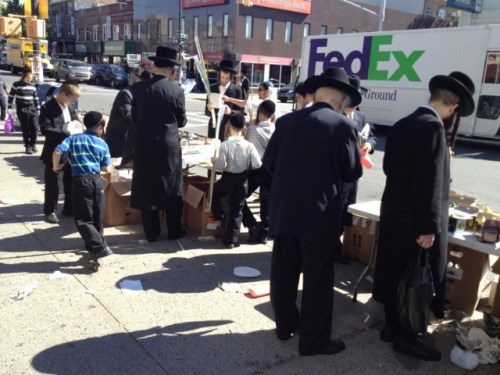

The other day I was riding on the subway, and I sat next to a young Hasidic boy. He was a senior in a Jewish religious school for boys – a Yeshiva – and I asked him how his observance of the holy days had gone so far. He looked at me and said, “it was hard.” When I asked why, he recounted for me the difficulties inherent in the Day of Atonement observances: self-denial, fighting the worshiping crowds in a room that seemed far too small for this most holy day of the year, and going hungry from one evening to the next.

I sympathized and told him that this was the way I grew up, and that although I looked like a secular Jew, my love for God and need to be close to Him was strengthened by my own observance of the holiday. I did not go much further than this, but I did make the point that one does not need to be a religious Jew to desire a deeper proximity to the Holy One of Israel.

Some of my Christian friends seem to think that Jewish followers of Jesus, like myself, should not fast or spend the day confessing our sins and repenting – because we have our atonement through the Messiah! Of course, this is true, and I am grateful for the decision I made to ask Yeshua to be my Lord and Messiah when I was 19 years old. I have never looked back.

But as a Jewish person, I still follow many of the traditions of my forefathers, as we can draw closer to God through repentance, prayer, and denying the flesh. Not to make atonement for ourselves, as this is an impossibility, but rather to deepen our appreciation of the work of Yeshua the Messiah on our behalf as we view our sins more honestly and take time to inspect our souls. It is only when we understand our sinfulness do we really recognize what was done for us at Calvary.

But now it’s the middle of the week of the Feast of Tabernacles! The load of guilt is either gone or no longer the focus of the community, and Jewish people are all smiles. The sense of release is palpable; I can feel the joy in the air.

I visited one of our ultra-Orthodox Jewish areas in Brooklyn and watched as crowds of Hasidim gathered around street vendors selling the lulav, etrog and other materials needed to observe the festival. During the observance of Tabernacles, Jewish people wave the combined branches of myrtle, palm and willow which are wrapped together and shaken to all four sides and up and down to remind us of God’s sovereignty over all things. These are shaken along with the lemon-like etrog – a large and beautiful citrus fruit that reminds us of the final harvest of fruit in Israel. (Leviticus 23:40)

sukkot shopping 2

This conclusion to the cycle of feasts calls our attention to God’s faithfulness and fills our souls with expectation that the harvests will be renewed in the year to come, as He brings the rain and performs the miracle of bringing forth fruits, vegetables and grain from seeds planted.

Sukkot (booths) dotted the Orthodox areas of Brooklyn as well. We are commanded to live in little tabernacles during the seven days of the festival to remind us of the manner in which the Lord provided for us during the wilderness wanderings. This tradition also helps us remember that He who provided during a difficult 40 years is the same One who provides for us today. And even though we live in very flimsy and vulnerable tabernacles made of flesh, God is loving and powerful and will care for us as He did for our ancestors during their wanderings through the desert.

sukkah5

The lessons of this joy-filled holiday are as endless as the faithfulness and goodness of God!

For me as a Messianic Jew, the most profound message of the Feast of Tabernacles came when God sent His Messiah, born of a Jewish virgin, to live in a frail, human tent and to dwell among us;

And the Word became flesh, and dwelt among us, and we saw His glory, glory as of the only begotten from the Father, full of grace and truth. (Jn. 1:14)

We have seen the Glory of the One who carried us through the desert as if on eagles’ wings (Ex. 19:4), from the revelation at Sinai to the Promised Land. This same Lord is the One who said, “Come to Me, all who are weary and heavy-laden, and I will give you rest” (Matt 11:28). This is a much-appreciated change from the “hard” holidays of Rosh Hashanah and Yom Kippur. We no longer need to repent and focus on atonement for sin, but instead are commanded to rejoice and enjoy what God has done for a broken world!

Rejoice – for Messiah died and rose and will come again when we will dwell together in His Tabernacle of grace. The whole earth will be filled with His majesty and glory.

and you shall rejoice before the Lord your God for seven days. (Lev. 23:40)

Be sure to find out more about Sukkot by clicking here.

3 Comments

Filed under Holidays & Festivals

Shedding Tears of Repentance – Avinu Malkenu (Our Father, Our King)

One of the most beautiful and moving penitential prayers in the Jewish liturgy is entitled Avinu Malkenu (Our Father, Our King). It is prayed – and more often sung – a number of times throughout the Jewish year, but it really comes to prominence during the Jewish High Holy Days, being sung during the Rosh Hashanah New Year’s service and again on Yom Kippur – the Day of Atonement.

There are a few different versions of this prayer, some longer and others more abbreviated. But it is always prayed or sung with some degree of pathos, as its words praise God for His faithfulness and are intended to move those who pray Avinu Malkenu to repentance. When sung properly, this prayer will break your heart.

In Jewish life, the Avinu Malkenu prayer is motivated by a desire to be forgiven of sin. In Jewish tradition, Rosh Hashanah begins a process of ten days of repentance that culminates in the observance of the Day of Atonement. During these ten days, it is said that the books of those destined for life and death are opened in heaven. God, the supreme judge, weighs the good and evil deeds of men and women and decides their fate for the year.

Avinu Malkenu is mournfully sung as an appeal to God to notice our good deeds and our repentance, and to forgive our sins. Then, it is believed, we will have a good year—and if we pass away, then we would go to heaven rather than the Jewish concept of hades.

It is worth reading a version of the full prayer, but this is not easily found. It is written out in The Authorized Daily Prayer Book (revised edition) by Dr. Joseph H. Hertz, which is published by Bloch publishing company in New York City. One of the later editions would be best to read – I personally own the 1979 edition of this Jewish prayer book, and the prayer can be found on pages 167-168.

A number of versions of the Avinu Malkenu prayer are also found in the special prayer book called the Machzor, which has been developed throughout centuries of Jewish tradition and is used during Rosh Hashanah and Yom Kippur. You can borrow it from the library or purchase a copy at http://www.artscroll.com/Products/MPSP.html, which has an array of excellent Jewish resources that are oftentimes beautifully printed.

The following is an abridged version of the prayer in English:

Hear our prayer. We have sinned before Thee. Have compassion upon us and upon our children. Help us bring an end to pestilence, war, and famine. Cause all hate and oppression to vanish from the earth. Inscribe us for blessing in the Book Of Life. 
Let the New Year be a good year 

for us.[1]

The prayer appeals to God’s grace and compassion. It is an admission of sin and guilt, and calls upon those who pray it to change their lives and do good by making the world a better place for all. The prayer calls upon God to write our names in the Book of Life and to grant us the assurance of sins forgiven—at least for one more year!

I appreciate the sentiments of this traditional prayer, and hope it will move you as well. This is a significant time of the year for anyone who wants to draw near to the Lord. As a Messianic Jew, I appreciate the High Holidays as they remind me of my own need to repent and seek the Lord more deeply. In fact, knowing that Yeshua is the Messiah and the ultimate sacrifice for sin (Hebrews 10:8-14) helps me to appreciate this prayer and season of the year even more.

I am not seeking atonement or forgiveness through repentance, fasting or any other human effort. Our efforts to earn forgiveness from a Holy God are impossible, as this gift is only granted by God Himself through the work of His Son. But we do drift from God during the course of our lives. This is why it is worthwhile to pause our usual activities and seek His face, repenting and turning from our everyday sinful behavior and asking Him for greater grace and the strength to live for Him.

There is nothing like hearing Barbara Streisand, who is originally from Brooklyn, sing this magnificent prayer. Click on the following link, open your heart, and enjoy this moving Jewish melody, which epitomizes the hopes of the Jewish people during this time period between Rosh Hashanah (the New Year) and Yom Kippur (the Day of Atonement).

http://www.youtube.com/watch?v=0YONAP39jVE&list=RD02vDCcar_u5eY


[1] http://www.metrolyrics.com/avinu-malkeinu-lyrics-barbra-streisand.html

7 Comments

Filed under Holidays & Festivals

Peace at Any Price? Reflections on the Release of 26 Palestinian Prisoners

Over the last couple of days, a controversial event transpired in Israel that has pierced the hearts of most Israelis. Twenty-six Palestinian prisoners who had been held in Israeli jails – most of whom had been convicted of murder – were released during the night before the peace talks planned between Israelis and Palestinians, which are brokered by the United States Secretary of State, John Kerry.


“There will never be peace here; it is very difficult to cope.”

According to YNet, a popular Israeli website, this was the general response from the families of the victims.

YNet adds,

“This is the sentiment of the families of the victims of the 26 prisoners expected to be released as part of resuming peace talks between Israel and the Palestinians. They responded Monday morning with disapproval to the decision to include the killers of their loved ones on the list of those to be released.”

The rest of the story on YNet gives an overview of the sentiments of many of the family members of the Israeli victims of the Palestinians who are being released, and is well worth reading. [1]

The following is a list recorded in J Post (The Jerusalem Post online) – with information provided by the Almagor Terror Victims Association[2] – about the twenty-six Palestinian prisoners released from Israeli jails on Tuesday as part of confidence-building measures offered by Jerusalem in an attempt to bolster recently restarted Israeli-Palestinian peace talks.[3]

I believe that it is worthwhile to simply read through the names of the released prisoners and of their victims – as well as the crimes committed.

1. Fayez Mutawi al-Khur, who established a Fatah cell of twenty members and was jailed in November 1985 for the murder of Menahem Dadon and the attempted murder of Salomon Abukasis. The two had been shot in the Gaza City market two years earlier.

2. Salah Ibrahim Ahmed Mugdad, who was arrested in June 1993 for the murder of Israel Tenenbaum, a 72-year-old security guard at the Sirens Hotel in Netanya. The Fatah member struck Tenenbaum on the head with an iron bar and stole a television set from the hotel.

3. Samir Nayef al-Na’neesh, who was arrested in March 1989 for the murder of Binyamin Meisner, a reservist killed the previous month while on patrol in Nablus. Meisner was confronted by members of al-Na’neesh’s cell, causing him to enter an alley where other cell members were waiting with rocks.

4. Yusef Abdel Hamid Irshaid, who was arrested in March 1993 for the murder of Nidal Rabo Ja’ab, Adnan Aj’ad Dib, Mofid Can’an, Tawfik Jaradat and Ibrahim Said. Irshaid suspected them of collaborating with Israel and killed them after a violent interrogation. He was also convicted of numerous attempts to kill others he suspected of collaboration.

5. Mustafa Othman al-Haj, who was arrested in June 1989 for the murder of 48-year-old Steven Frederick Rosenfeld. Rosenfeld had been hiking in the hills near Ariel and was stabbed with his own knife by a group of shepherds, who hid his body.

6. Salameh Abdallah Musleh, who was charged in October 1993 with the murder of Reuven David two years earlier. David, 59, owned a grocery store in the town of Petah Tikva. He was beaten and robbed by Musleh and an accomplice.

7. Atiyeh Salem Musa, who, along with an accomplice, used an ax to murder a Jewish co-worker, 67-year-old Isaac Rotenberg, during Passover 1994. The murder took place while Rotenberg was kneeling to fix the floor at his place of employment in Petah Tikva. He was struck on the back of his neck and died two days later.

8. Salah Mahmoud Mukled, who was arrested in July 1993 for the stabbing death of Yeshayahu Deutsch, his Jewish employer, and the attempted murder of another local resident.

9. and 10. Mohamed Abdel Majid Sawalha, who was arrested for murder and attempted murder in December 1990, and his accomplice, Hosni Faregh Sawalha, who was charged with murder and for being an accessory to murder.

The two, minors at the time, stabbed to death 24-year-old Baruch Yaacov Heisler, a passenger on a bus from Petah Tikva to Tel Aviv. They attempted to attack other passengers as well. Another accomplice was killed by a police officer.

11. Atef Izzat Sha’ath, who was arrested in March 1993 for being an accessory to murder after driving three terrorists to the crime scene and driving them away afterward. The victim, Simcha Levy, made a living in Gush Katif by providing transportation to local workers. The terrorists were dressed as female agricultural workers and rode in Levy’s vehicle, where they stabbed her to death and fled.

12. Yusef Said al-Al, who was charged in February 1994 with throwing explosives and for being an accessory to murder. He and accomplices threw two hand grenades, which did not explode, at a Border Police unit. He also planted a bomb near a Border Patrol facility and assisted in the murder of a Jewish civilian by passing on information about the lack of soldiers in the area where the killing took place.

13. Midhat Fayez Barbakh, who was arrested in January 1994 for murder. He participated in the ambush of his employer, 61-year-old Moshe Beker, who was in charge of an orchard in Rishon Lezion. Along with two others, Barbakh waited for Beker in the morning and upon his arrival stabbed him to death with a knife and a pair of pruning shears.

14. Ali Ibrahim al-Rai, who was arrested in April 1994 for the murder of Moris Eisenstatt. Al-Rai killed the 79-year-old by striking him in the head with an ax as Eisenstatt sat on a public bench in Kfar Saba.

15. Mohamed Jaber Nashbat, who was arrested in September 1990 for being an accessory to murder. Nashbat threw rocks at 46-year-old soldier Amnon Pomeranz and poured gasoline on his vehicle, after which it was set alight with Pomeranz inside. The murder took place at the Al Burej refugee camp in the Gaza Strip.

16. Samir Hussein Murtaj, who was convicted in October 1993 for the abduction, interrogation through torture, and murder of four local residents: Samir Alsilawi, Khaled Malka, Nasser Aqila and Ali al Zaabot. The victims were suspected of having collaborated with Israel.

17. Faraj Saleh al-Rimahi, who was arrested in July 1992 for the ax murder of 84-year-old Avraham Kinstler in the Sharon region. While in prison, he also engaged in efforts to obtain a weapon for abducting a soldier.

18. and 19. Ala Eddin Ahmed Abu Sitteh and Ayman Taleb Abu Sitteh, who were charged with murder in January 1994 after they stabbed to death David Dadi, 43, and Hayim Weizman, 33. The two were killed while sleeping at Dadi’s apartment in Ramle. The Sittehs, who had been working in a nearby apartment, severed the victims’ ears after killing them.

20. Esmat Omar Mansour, who was arrested in October 1993 for being an accessory to murder. A minor at the time, Mansour helped subdue the victim, 30-year-old Hayim Mizrahi, who was on his way to buy eggs from an Arab-owned farm near his home. Mizrahi’s body was stuffed into the trunk of his vehicle, which the terrorists used to flee.

21. Khaled Mohamed Asakreh, who was charged in May 1991 with murder in the stabbing death of French tourist Annie Ley. Ley was dining at the restaurant where Asakreh was employed.

22. and 23. Nihad Yusef Jundiyeh and Mohamed Mahmoud Hamdiyeh, who were arrested in July 1989 for the murder of Jewish contractor Zalman Shlein. The two minors stabbed Shlein to death with a knife after traveling with him to a construction site where he was building a house. They also beat him with an iron pole.

24. Jamil Abdel Wahab Natsheh, who was charged with being an accessory to murder in December 1992 for acting as the escape driver for terrorists who shot at IDF soldiers at the Cave of the Patriarchs. One soldier was killed and another was wounded.

25. Taher Mohamed Zaboud, who was arrested in February 1993 for murder, hijacking a vehicle and attempting to steal a weapon. Zaboud’s accomplice fired shots at the driver, Avraham Cohen, but fled when they realized he was not carrying a weapon.

26. Burhan Subaih, who was arrested in February 2001 for the murder of Jamil Muhammad Naim Sabih and Aisha Abdullah Haradin.

Israel is often characterized by world opinion – and by some evangelical Christians – as a nation that acts unjustly and lacks compassion. In fact, nothing could be further from the truth, and the release of the prisoners is clear evidence of the extent to which Israeli leaders are willing to go to achieve peace.

I am not going to try and paint Israel or the Jewish people as perfect or without moral blemish. We are all sinners – both individuals and nations. However, since there has been so much criticism of Israel in recent days, I think it is important to show that Israel and its leaders have gone far beyond what even most citizens of Israel would believe to be just and fair.

What other nation in recent days has released its convicted prisoners or offered them early “parole,” as the Israeli government is describing the nature of their actions?

These controversial decisions on the part of the Israeli leadership will be debated for years and perhaps centuries. I do not believe that the Israeli leadership views the release of the prisoners as forgiveness, nor necessarily an act of compassion, even though in some cases this might be the case – especially for the more elderly prisoners.

I assume the release of the prisoners was enacted for the sake of political expediency in hopes that the release will lead towards peace. We might not know the answer to this for a number of years, and even if some type of peace comes about as a result of this effort – many will still feel that the price for peace was too high.

I am writing these reflections to demonstrate to Evangelical Christians who have been so very critical of Israel lately that Israeli leaders are willing to do what might be viewed as reprehensible and politically inexpedient, simply in order move the peace process forward.

Really, this is all about the character of Israeli leadership and of the people of Israel. Look at the great lengths to which they have gone to show good faith in the peace process. There will be continued controversy over the next few days regarding Israel’s moving forward with housing settlements in Gilo and regarding the recent air strike, destroying the Hamas rocket launcher that was aiming missiles into Israel from Gaza. The antagonists of Israel will focus on these things and miss the fact that the leadership of Israel has risked the soul of the nation for the sake of peace.

I believe that evangelical Christians, especially those that have been so opposed to Israel in recent days and have accused Israel of being unjust, need to pause and reconsider their position in light of the renewed tears shed by the families of those who were murdered – and the cheers and celebrations by the communities of those who were released.    

5 Comments

Filed under Uncategorized

Spiritual Trends in Israel and the “Signs of the Times”

If you have been following the news, you know how unstable the political situation is in the Middle East. Whatever this may mean for the unfolding revelation of God’s timetable for history, there is no doubt that Israel is in the middle of it. Right now, Chosen People Ministries has more staff members ministering in Israel than at any other time in our almost 120-year history.

Not long ago, I was sitting on the panel at a conference on “Ministry in Israel,” and the moderator asked me a number of critical questions. I want to share some of my responses with you so that you can at least have my take on what is happening spiritually in the Holy Land!

Spiritual Trends in the Land of Promise

What are some of the most exciting spiritual trends you see in the Land today?

The first is the significant increase of Jewish believers. Sixty percent of them speak Russian as their first language, so there is a tremendous need for resources that they are able to use. Speaking a bit more generally, there is growing ministry among children and a growing unity among the Jewish believers. We are also participating in active efforts to meet the needs of poor Israelis, as well as Holocaust survivors and other elderly people. We’re also seeing the growth of serious Bible college programs and leadership development for Israelis, as well as more Messianic books in Hebrew and higher-quality training opportunities for younger believers.

There are now a number of buildings that are now owned by Israeli believers and ministries in the Holy Land, including the Chosen People Ministries Jerusalem Center, King of Kings, Israel College of the Bible, Grace and Truth Assembly and a number of other congregations.

These congregations are also maturing and growing in their ability to serve the ever-increasing number of believers. The number of Israeli-led congregations has expanded from under a dozen in the early 1970s to more than 150 today.  The continued development of energetic and creative outreach over the web and the increase in Christian television broadcasting are all signs of the vitality of the movement of the Holy Spirit in Israel.

What are some of the most troubling spiritual trends you see in the Land today?

We need to remember first of all that troubling trends are often God’s way of bringing us the greatest opportunities for spiritual growth and ministry fruitfulness. The threat of war and continued terrorism, the challenge of secularism and the deconstruction of a biblically-based morality in everyday culture are all troubling trends that are symptoms of a deeper, spiritual sickness. The continued and seemingly irreconcilable differences (socially, politically and otherwise) between Jews and Arabs and between the Orthodox and secular Jews are another aspect of this same spiritual conflict. Additionally, we see the continued marginalization of both Jewish and Arab believers within their own community, though this is changing slightly.

We see promising trends and the Lord’s work in Israel is becoming more Israeli in nature. The need for indigenous resources and continued leadership development is a critical challenge and a great opportunity for partnership among Western European and North American believers and Israelis. 

The “Signs of the Times”

Do you believe we are heading towards a “Romans 11:26” world in which “all of Israel will be saved”? Why or why not?

Well, first, let’s take a look at the passage in question…

 For I do not desire, brethren, that you should be ignorant of this mystery, lest you should be wise in your own opinion, that blindness in part has happened to Israel until the fullness of the Gentiles has come in. And so all Israel will be saved, as it is written: “The Deliverer will come out of Zion, and He will turn away ungodliness from Jacob; For this is My covenant with them, when I take away their sins.” (Romans 11:25-27)

Yes, we are moving closer, because of the evident signs of the times. If the return of the Jewish people to Israel, the Jewish control of Jerusalem, and the surrounding of Israel by enemies seeking her destruction is evidence of the prophecies of the Old Testament coming to pass – and if we add the additional sign of a remnant of Jewish believers in Jesus, which has been increasing since the establishment of the modern state of Israel – then yes. But my feeling is that we will enter this future incrementally.

Is it accurate there are about 15,000 Jewish followers of Yeshua in the Land of Israel today – up from only a few dozen in 1948?

There is no current scientific survey, but my personal experience would indeed indicate that the numbers are somewhere between 10,000-15,000.

Why are Jews coming to faith in so much larger numbers today? What dynamics have changed since 1948, and just since you came to faith?

There were a great number of Jewish believers in Jesus who perished in the Holocaust, perhaps more than there are today. But now we seem to be growing at a rate throughout the world that will surpass the pre-Holocaust numbers of Messianic Jews. Israel contains one of the fastest-growing movements of Jewish believers in the world.

Why? Aside from the prophetic perspective mentioned above, it could be because of the unrelenting prayers of saints, an unwavering witness by many who have pioneered this effort, and the engagement of the Gentile Church around the world with a heart for Jewish outreach. In addition, we definitely see growth resulting from the development of a contextualized testimony and the emergence of local Israeli spiritual leadership.

Aside from the number of professed believers, how would you assess the spiritual maturity and theological depth of the believers in the Holy Land?

We see great depth and maturity among leaders in Israel who have lived through many difficulties and have become battle-hardened spiritual leaders – but they are often overworked! They need our help – not to do their jobs or tell them how to do it – but rather to provide resources, prayer, and genuine help. We especially need to lend our support to the leadership training Bible colleges in the Land.

What are ways Jewish and Arab believers can and should be working together to share the Gospel with everyone in the Land and make disciples of all nations?

Pray for one another.  Serve in projects together in the Land where appropriate. For example, Chosen People Ministries has had quite a bit of support and help from local Arab believers in our Tel Aviv soup kitchen ministry.

How can believers outside of Israel be praying effectively for the believers in the Land?

First of all, we can pray that both Jewish Israelis and Arabs would become more open to Jesus and be able to effectively disciple the next generation of leaders. We should also pray that both Jewish and Arab believers would become less marginalized and have an impact for the Lord on Israeli society as a whole. The believers also need their own worship and ministry facilities. I believe this would help stabilize the Lord’s work in Israel. Those of us who live outside the Land can also maximize our impact by helping to purchase properties that will be dedicated to ministry and congregational centers.  

2 Comments

Filed under Uncategorized

Reflections on the Boston Bombing

Our eyes have been glued to our televisions watching the manhunt for the Boston Marathon bombers. It now seems to be over – though our hearts are still broken for the families that lost loved ones and for the residents of Boston who will suffer the post-traumatic stress of this act of terrorism in their community.

Mitch Forman, our Vice President of U.S. Ministries and Boston director, wrote a brief piece about his feelings in light of what’s just happened, and I thought you might want to read it. I found his perspective to be personal, biblical and moving. 

I am writing this letter minutes after watching the capture of the Boston Marathon Bomber #2. I was born and raised in the greater Boston area, and now I am raising my family here. This is the place I count as my home, the place where I do ministry and a place I love very much. Even though I left Boston in my twenties and thirties, I returned because all my family still lives here. My grandparents came here in the early 1900s as political refuges, fleeing those who hated them simply because they were Jewish. As a 3rd-generation refugee, I am forever thankful to the United States for allowing my family to come and start a new life.

I say this because as events have unfolded after the bombing at the Boston Marathon, I learned of the history of these two brothers, it resembled that of my family. However, they came to hate this country, whereas my family embraced it. They aimed to hurt and kill people, whereas my family aimed to make the country better.

As I was sitting here watching the TV like all of you, I couldn’t understand why these brothers would want to commit this apparently senseless act of violence. They knew most of the people at the time of the Marathon were there to cheer on a family member. They knew that many of the people present would be small children. They knew the face of Boston would change forever. When my own kids asked, “Why would someone do this?”  I told them: “There are evil people in the world, and people who hate us just for being Americans.”

We live in a world where there is danger, and where people don’t have to believe in God. This is why I do what I do. This is why we must continue to share the Good News of Yeshua (Jesus). The only hope we have is to keep praying and reaching those who do not love us back. How appropriate it is for me to remember the words of Yeshua:

“You have heard that it was said, ‘You shall love your neighbor and hate your enemy.’ But I say to you, love your enemies, bless those who curse you, do good to those who hate you, and pray for those who spitefully use you and persecute you, that you may be sons of your Father in heaven; for He makes His sun rise on the evil and on the good, and sends rain on the just and on the unjust.”  (Matthew 5:43-45)

It isn’t so easy to follow Jesus when asked to do things that go against your own nature, but this is what we are commanded to do. I was living in New York City at the time of 9/11, and now I live in Boston during these times. I had friends at the Marathon who were a short distance away when the bombs went off. I took both of these events very personally; however, Yeshua tells me to love those who hate me and pray for them. I said a prayer for the families who lost loved ones. I said prayers for those who lives have been forever changed. I even said a prayer for this young man tonight – that even though his brother died, he might live and come to trust in Jesus.

3 Comments

Filed under Uncategorized

Obama’s Visit to Israel

I read through President Obama’s speech given on March 21, 2013, as carefully as I  could in order to try to discern the heart of our president’s message. You can read the transcript in many places – including the New York Times.

Most people who heard the speech appreciated the president’s passion, friendliness and directness. Mr. Obama assured his Israeli audience of American support for Israel and affirmed the common Judeo-Christian and democratic values shared by both nations. The president clearly affirmed the right of the nation of Israel to exist as a Jewish state, though later in the speech he emphatically encouraged the creation of a separate Palestinian state as well.

If you are a believer in Jesus and take the Bible seriously as your guide for life and the filter through which you view all matters of earthly and heavenly importance, then you will probably be disappointed to find that the president’s speech does not refer to any biblical passages, outside of relating his trip to the Passover season!

He did not, for example, say that he recognizes that the Bible is true and the reason the land of Israel belongs to the Jewish people is because of God’s promise to Abraham and his descendants, promised in Genesis chapter 12:1-3.

The president did look back into the history of the Jewish people and even to the Holocaust as part of the background for the formation of the state of Israel. Actually, he has done this in the past as well – but at least this time he made more of an effort to demonstrate that the Jewish people had arrived to the land of Israel, historically, prior to the post-Holocaust years.

Obama tried to point the young people listening to his speech towards the future, praising Israelis for being entrepreneurs in technology, biomedical sciences and much more. He commended the Palestinians for much of the same.

He emphasized three major agenda points: security, peace, and prosperity.

I’d like to focus on how we — and when I say we, in particular young people — can work together to make progress in three areas that will define our times: security, peace, and prosperity.

When it came to his comments on security, the president assured the Israelis that the United States would do whatever is necessary to prevent Iran from developing nuclear weapons. He also called attention to the United States’ position on Syria and the threat the Assad regime poses to Syria’s own citizens as well as to Israel. He specifically mentioned the possible use of chemical weapons in Syria against its own population as well as the potential threat these weapons represent if they get into the hands of terrorists.

The fact that Hezbollah’s ally, the Assad regime, has stockpiles of chemical weapons only heightens the urgency. We will continue to cooperate closely to guard against that danger.

He specifically singled out Hamas as a terrorist organization, expressing his opposition to their practices as well as the need for Hamas to recognize Israel in order for peace talks to continue. He said,

And that’s why Israel has a right to expect Hamas to renounce violence and recognize Israel’s right to exist.

He added, with resounding words that I can only hope and pray will guide our president’s thinking and U.S. policy in the years ahead,

That’s why the security of the Jewish people in Israel is so important; it cannot be taken for granted. But make no mistake: Those who adhere to the ideology of rejecting Israel’s right to exist — they might as well reject the earth beneath them and the sky above, because Israel’s not going anywhere.

It is in his section discussing peace in the Middle East that Obama clearly reveals his agenda – not that it was particularly hidden! He calls for what he views as fair treatment of Palestinians.

It is not fair that a Palestinian child cannot grow up in a state of their own — living their entire lives with the presence of a foreign army that controls the movements, not just of those young people but their parents, their grandparents, every single day. It’s not just when settler violence against Palestinians goes unpunished. It’s not right to prevent Palestinians from farming their lands or restricting a student’s ability to move around the West Bank — or displace Palestinian families from their homes. Neither occupation nor expulsion is the answer. Just as Israelis built a state in their homeland, Palestinians have a right to be a free people in their own land.

The president unfortunately paints Israelis as aggressors who do not want Palestinian children to grow up, go to college, get married, receive a great education and have a prosperous and peaceful life.

The president ignores the history of terrorist attacks on Israelis who are trying to secure the safety of their children. Does the president really believe that the level of security in the territories is the result of Israeli cruelty? Or were these necessary security measures taken to prevent further terrorist bombings and missile attacks on Israeli citizens?

He failed to mention the many instances when Israeli officials apprehended and prosecuted Israelis who had attacked Palestinians. Nor did the president mention the displacement of Israeli settlers from Gaza, who were asked to leave their homes and farms and move to other parts of Israel, so that Palestinians could have control of the region. The idea of land for peace was already tried, but was unsuccessful as Hamas took over Gaza and did more harm to the peace process than good.

In the years since the Israelis left Gaza, thousands upon thousands of missiles have been showered upon innocent Israelis in southern Israel, and the security threat resulting from Hamas-controlled areas is the rational basis for the checkpoints and presence of the Israeli Defense Forces in “the territories.”

Unfortunately, innocents on both sides of the crisis are suffering due to the sins of the more militant and aggressive Palestinians and their supporters who have been committing terrorist acts against innocent Israelis for more than a decade. If they were to stop, then the security measures taken by the Israeli security forces would diminish or go away completely – as had been the case before the first intifada.

Obama affirms the fact that Hamas is an unworthy peace partner, but expresses perhaps too much confidence in the Palestinian Authority, especially in light of the veneration still shown by the PLA for Yasser Arafat, an unrepentant terrorist who is accused of stealing hundreds of millions of dollars from his own people and from the governments that had given generously to the Palestine cause.

Now, Israel cannot be expected to negotiate with anyone who’s dedicated to its destruction. But while I know you have had differences with the Palestinian Authority, I genuinely believe that you do have a true partner in President Abbas and Prime Minister Fayyad.

The PLA and Abbas have yet to show themselves to be the more willing and flexible peace partner our president believes them to be. I too hope that Abbas and the PLA will renounce terrorism and refrain from taking further unilateral action as they did in applying for observer status with the United Nations – as that was not an act of good faith.

Finally, the president shows his true agenda for peace when he says,

But it’s possible. Negotiations will be necessary, but there’s little secret about where they must lead: two states for two peoples — two states for two peoples.

In effect, the president’s solution to the problem is to charge John Kerry, our Secretary of State, to negotiate a Two-State solution with Benjamin Netanyahu and Mahmoud Abbas. At this stage, this would be a negotiation without the participation of Hamas, which would leave Gaza completely out of the process.

The president said,

Meanwhile, Palestinians must recognize that Israel will be a Jewish state and that Israelis have the right to insist upon their security.

Israelis must recognize that continued settlement activity is counterproductive to the cause of peace and that an independent Palestine must be viable, with real borders that have to be drawn. I’ve suggested principles on territory and security that I believe can be the basis for these talks.

So what has changed? Not much. I am glad that the president affirmed his overall support of Israel, but I sincerely hope and pray that he does not somehow make the support of the U.S. contingent upon the success of a two-state solution. After all, some of the hardest issues were not even mentioned. There was no discussion of the division of Jerusalem within a Two State Solution, which would be one of them most difficult political challenges to face.

He also did not mention the ongoing U.S. financial and military support of Egypt, which is deeply troubling to Israel and to those who understand the level of animosity the Muslim Brotherhood has against Israel and the Jewish people. This has been well documented.

Still, it is good that the president visited Israel for the first time in five years! It is also good that he reiterated his concerns over Iran, Syria and both Hezbollah and Hamas. This was to be expected, of course. Israel is still the only true ally American has in the Middle East.

Where do we go from here? I would suggest three agenda items as well.

We need to pray for Jerusalem (Psalm 122:6)

The Middle East crisis is complex, and Prime Minister Netanyahu and the leaders of Israel will need God’s wisdom in the days ahead – perhaps as never before – in light of the nuclear threat and the continuing political and social changes in the Middle East.

We need to pray for President Barack Obama

Personally, I am praying that he comes to terms with the scriptural truths regarding God’s plan for Israel and the Jewish people. I pray that he will be driven by Scripture and understand that the land of Israel belongs to the Jewish people not simply because of the U.N. mandate, but because God made a promise and He will keep his promise to the Jewish people (Genesis 12:1-3, 15:18-21). I am praying that the Lord would give our president wisdom and empower him to use his great gifts of rhetoric for holy purposes.

We need to pray for the Palestinians and their leaders

I am praying that that God will give Mr. Abbas and Khaled Msshal (the political leader of Hamas) wisdom and a spirit of cooperation so that any peace that can be humanly developed can be effective and lasting.

Most of all, I am praying for Israelis and Palestinians to know that the true God of Abraham, Isaac, and Jacob loves them dearly and sent His only son Jesus the Messiah – an Israeli Jewish person – to live a perfect life and to die for their sins and rise from the dead.

I pray that Israelis and Palestinians will know the hope of the resurrection and recognize that the day is coming soon when Jesus the Messiah will return to reign on His rightful throne in Jerusalem as the Prince of Peace.

And in that glorious day, there will no longer be a Middle East crisis. Palestinians and Jewish Israelis will live in peace… the wolf will lie down with the lamb, and the weapons of war will turn into instruments of peace.

Our friends at the Jerusalem Institute for Justice recently sent out a video that I believe presents some very helpful information in an intriguing way. I hope that you will enjoy it and pass the video as well as this blog entry to your friends.

7 Comments

Filed under Middle East