We Thank God for Another Year!

Shalom, dear friend.

Happy New Year!

We made it to 2021, which is encouraging! I thank the Lord for bringing us this far!

I have found the well-known passage from Psalm 23:4 to be a source of strength and hope: “Even though I walk through the valley of the shadow of death, I fear no evil, for You are with me; Your rod and Your staff, they comfort me.”

Maybe, like me, you have rediscovered that all we need is Him!

The pandemic has tested our faith, but I believe we will slowly regain a sense of normalcy and return to the world we once knew. I am sure you have learned some great spiritual lessons in the last ten months. These past months have powerfully reminded me that this world is passing away, and we belong to a coming kingdom, which is unshakable. The hope of Jesus’ return is sweeter to me now than ever before, and I hope this is true for you too.

I long for His coming and the establishment of His righteous kingdom. The book of Revelation promises, “Behold, the tabernacle of God is among men, and He will dwell among them, and they shall be His people, and God Himself will be among them, and He will wipe away every tear from their eyes; and there will no longer be any death; there will no longer be any mourning, or crying, or pain; the first things have passed away” (Revelation 21:3–4).

What a wonderful promise!

Meanwhile, Your Mission to the Jewish People is ready for the challenges of 2021. With full dependence upon our good and glorious Savior, we are moving forward, doing what we have done for one hundred twenty-six years—reaching Jewish people with the gospel.

The Apostle Paul wrote, “Brethren, my heart’s desire and my prayer to God for them is for their salvation” (Romans 10:1). I want to be part of God’s answer to Paul’s prayer!

Paul, a Messianic Jew, also penned the following words of Scripture, which became our marching orders when Rabbi Leopold Cohn founded Chosen People Ministries in 1894:

“I am not ashamed of the gospel, for it is the power of God for salvation to everyone who believes, to the Jew first and also to the Greek” (Romans 1:16).

For one hundred twenty-six years, we have focused on this clear, biblical basis for Jewish evangelism every January. We start the year by reminding our staff and friends of this mandate that explains why we do what we do, day in and day out, using the tools God provides. Chosen People Ministries has endured incredible challenges in fulfilling our mission: World War I, the Spanish flu, the Great Depression, World War II, the Holocaust, Israel’s establishment, and the wars fought to keep her safe—and today, we are facing a pandemic!

Your Mission to the Jewish People is still here serving the Jewish Messiah and making Him known among His kinsman according to the flesh!

By God’s grace, Chosen People Ministries has never changed its mission or theology. Irrespective of the circumstances, we exist to reach Jewish people worldwide for their Messiah, Jesus. With the help of an army of prayer warriors like you—including both individuals and local churches who love the Lord and the Jewish people—we will be able to continue the work!

OUR MISSIONARIES HAVE OVERCOME SERIOUS SETBACKS IN 2020

We have spoken in very few churches—about one thousand fewer churches than 2019! Still, He has provided through you. Thank you.

We struggle with not being able to worship and witness in person. Yet, we know His Spirit cannot be quarantined and still works powerfully in the lives of those seeking Him. He is never locked down!

In so many ways, our ministry has flourished during the pandemic. We have engaged with tens of thousands of individuals online. We have met many hurting people whose personal suffering and loss has drawn them to Jesus. We have seen many Jewish people come to faith, be baptized, and become part of our congregations and Bible studies.

I hope this openness continues and that we will continue to find both Jews and Gentiles seeking the Lord during the months ahead.

We are ready to move forward in 2021! We will take it one step at a time, but we see hope on the horizon! Our staff is filled with vision and overflowing with ideas and new strategies!

Will you pray for our workers in nineteen countries around the globe, as you have in the past?

By God’s grace, let us walk arm in arm toward the opportunities ahead. Together, we can meet the challenges of reaching the Jewish community in the United States, Israel, and worldwide!

USING DIGITAL MEDIA TO REACH JEWISH PEOPLE

It takes a village to reach the Jewish community for the Messiah, and both our missionary and administrative staff, which number about one hundred twenty-five in the United States, need our continued prayers and encouragement.

I am especially thrilled with the work of our digital media department. They do some of our most critically important missionary work by creating the videos and social media we use to proclaim the gospel.

We have learned a lot about ministering to Jewish people who understandably want to keep their search for Jesus private. They are concerned about their friends and relatives knowing about their interest in the gospel, which is why our digital media outreach is so critical. We have created four evangelistic websites and are working on a fifth as well.

AboutMessiah.com is an entry-level online outreach. The articles address an unbelieving Jewish audience open to the gospel and curious about Jesus.

FollowMessiah.com is a video-based Bible study based on the Sermon on the Mount. The videos help seekers who are further along in their search for the Lord, and they also serve to disciple Jewish believers who have come to faith.

ChosenPeopleAnswers.com focuses on the tough questions Jewish people ask about Jesus and the gospel. This site will help Jewish seekers, but it will also help gentile Christians who are trying to answer the questions their Jewish friends are asking about the Messiah.

IFoundShalom.com shares the testimonies of more than one hundred Jewish people who have come to faith in the Messiah.

OUTREACH AMONG RELIGIOUS JEWISH PEOPLE

Our newest website, still in development, reflects our growing burden to reach ultra-Orthodox Jewish people for the Lord. An online approach is perfect for an ultra-Orthodox audience since many religious Jewish people do not want their friends and family knowing that they are interested in Jesus, the Jewish Messiah. The website will contain portions of the New Testament in Yiddish, part of the Jesus Film (also in Yiddish), and several other online resources to help ultra-Orthodox Jewish people find the Lord, like our Isaiah 53 Explained book in Hebrew. The ultra-Orthodox speak and read Yiddish, but many are also fluent in Hebrew. The book is available in print and as a downloadable pdf.

There are more than one million devoted ultra-Orthodox Jews in the world today, and we have recently had phone calls from many of them who are seeking the Lord. We feel a tremendous sense of urgency to produce this site and advertise it within the religious Jewish community.

IT IS TIME TO ADVANCE!

I cannot thank you enough for your faithful and generous prayers and support. Our staff joins me in being deeply appreciative of your partnership.

I know that we have been through a hard time, but I have hope! The Lord is all-powerful, and He has promised a glorious future for those who love Him.

It is my greatest desire to find as many Jewish people as possible to enjoy His eternal presence along with you and me!

Happy New Year and God bless you. We are looking forward to great things in 2021.

Your brother in the Messiah,

Mitch

Leave a comment

Filed under evangelism, Israel

The Christmas-Hanukkah Connection

Shalom,

Merry Christmas and Happy Hanukkah! I love this season of the year: lights, joy, lots of presents, and the ability to freely focus on our faith in Jesus—the reason for the season. When I say the reason for the season, I am including Hanukkah, not just Christmas!

There is an amazing connection between the two holidays. It is a bit hidden, but I am sure that, once you see it, you will be as thrilled about it as I am. We find this extraordinary link in John 10:30, where Jesus said, “I and the Father are one.”

We know from the gospel that the events in John chapter ten occurred during the Feast of Dedication (John 10:22–23), also called Hanukkah. The Hebrew word hanukkah means “dedication.” It is still the most often used name for this great holiday.

Jesus Celebrated Hanukkah!

Curiously, the only biblical mention of Hanukkah is in the New Testament. The origin of Hanukkah is in the intertestamental literature, particularly in the First and Second books of Maccabees, which many people consider significant records of Jewish history.

The story of Hanukkah serves as the stunning backdrop to the words of Jesus, particularly in John chapter ten and especially in verse thirty.

The saga begins with a well-known historical figure—Alexander the Great.

Upon his death in 323 BC, Alexander’s kingdom was divided among four of his generals. Eventually, the lands that included Israel came under the control of Antiochus Epiphanes in 168 BC. His name alone tells the story—the word epiphanes means “revealed” or “manifestation” and refers to the Greek gods who often took on human form. In this instance, Antiochus probably had Zeus in mind as he desecrated the Temple in Jerusalem by sacrificing to Zeus (1 Maccabees 1:54; 2 Maccabees 6:2).

Antiochus demanded loyalty from the Jewish people to Greek culture and the Greek gods. He sent his emissaries with a statue of himself to each village in Israel and made them bow down to it. According to Jewish tradition, the emissaries entered the town of Modi’in and demanded that the Jewish people bow down and worship the Greek gods and their representative, Antiochus.

But a family of Levitical priests was living there. Mattathias and his five sons refused to bow and began a revolt. Mattathias cried out, “Let everyone who has zeal for the Law and who stands by the covenant follow me!” (1 Maccabees 2:7). His call is one of the grand statements of loyalty and unity that every young Jewish child learns at his mother’s knee.

His family and followers fled to the Judean foothills and waged guerrilla warfare against the Syrian Greeks for the next three years, between 167–164 BC. When Mattathias died, Judah became the leader of the rebel forces.

During that time, Antiochus perpetrated one of the most heinous acts against the Jewish people recorded in all of history. After defeating Antiochius, the Maccabees discovered that he had sacrificed a pig on the altar in Jerusalem, one of the holiest sites in Israel. The Maccabees retook Jerusalem and wanted to cleanse the Temple. However, when they realized that a pig’s blood had defiled the altar, they took it apart and stacked the stones off to one side. In a very intriguing tradition recorded in 1 Maccabees, they left the rocks for someone more powerful to do the cleansing (1 Maccabees 4:46).

They built a new altar, and according to Jewish tradition, only had one day of oil left in the Temple’s eternal light (the seven-branched menorah), although it took eight days to cure olive oil to keep the light shining. The miracle that took place, according to tradition, was that the oil lasted for eight days, which allowed the Maccabees to prepare the oil needed and prevented them from being extinguished.

This legend provides the rationale for why we celebrate Hanukkah over eight days and why the symbol of light is so important. It reminds us that the ner tamid, the ceremonial light that shone in the Temple, must never be extinguished. Of course, the physical Temple was destroyed in AD 70 when the Romans conquered Jerusalem. Many Jewish people fled, and the Romans took the remaining Jewish people as captives. The menorah and other holy implements were looted and brought to Rome by the armies of Titus. To celebrate the victory, the Romans engraved these historical events inside the Arch of Titus, which you can still see today in the Roman Forum, near the Roman Colosseum.

The Declaration of Divinity

Jesus made His declaration of divinity in John 10:30 amid the grand traditions observed during the magnificent Hanukkah celebrations at the Second Temple. These traditions are described in the Mishnah, a collection of rabbinic commentaries on the Bible.

The story of Hanukkah, which would have taken place fewer than two hundred years earlier, was well-known by the Jewish people at that time. The average Jewish person living in Israel would have known that Antiochus Epiphanes, also called “Antiochus the Madman,” had declared himself to be a god. The Jewish people were commanded not to have any other gods but the Lord and were forbidden to worship idols (Exodus 20:3–4).

Indeed, the order to bow down and worship a statue would have been especially repugnant to the Jewish people. To this day, Jewish resistance to incarnation is rooted in the Jewish rejection of idolatry and the belief that God cannot be corporeal.

Resisting the claim that Jesus is God in the flesh has been viewed as a testimony of Jewish loyalty throughout the centuries. The fact that any Jewish person can overcome thousands of years of Jewish faith and tradition and accept Yeshua’s deity is a miracle.

The Deity of the Messiah Is Rooted in the Hebrew Bible

I was raised in a modern Orthodox Jewish home and taught to reject this possibility out of hand, not only for Jesus but for anyone.

I remember when I was thinking about becoming a believer in Jesus and was confronted with the idea that Jesus claimed to be God in the flesh. After reading the Gospels and seeing the way Jesus acted and spoke, I concluded that if anybody was God in the flesh—it would be Him. I am so glad that the Lord worked in my heart and enabled me to accept this glorious and fundamental truth—that Jesus is God, fully divine and fully human.

If Jesus was just a very bright and articulate itinerant Jewish rabbi, then you and I are still walking in our sins and face judgment on the last day. But because He is God in the flesh, His death provides a perfect atoning sacrifice for our sins, allowing you and me to receive forgiveness of sins and stand in the presence of the Lord forever.

I came to realize that the Hebrew Scriptures actually did teach that God could appear in the flesh. Isaiah 7:14, Isaiah 9:6–7, and several other prophetic passages in the Old Testament teach that God would take on flesh one day.

I understand why the Incarnation rubs Jewish people the wrong way. We were raised celebrating Hanukkah and taught that bowing to any corporeal God is idolatry.

I would agree that the Bible teaches against idolatry. Isaiah wrote with a combination of anger and humor, it seems, concerning how idolators worship:

Half of it he burns in the fire; over this half he eats meat as he roasts a roast and is satisfied. He also warms himself and says, “Aha! I am warm, I have seen the fire.” But the rest of it he makes into a god, his graven image. He falls down before it and worships; he also prays to it and says, “Deliver me, for you are my god.”
(Isaiah 44:16–17)

Yet, we do not worship a God made of wood or stone but one who became a man while fully retaining His divine nature—a glorious mystery!

There is no stipulation against the true God taking on flesh. Without the Incarnation, Jesus would not fulfill the Messiah’s prophetic description and qualify as the Savior of the world. There is no other way to be the Messiah as no human being could accomplish what the Bible prophesied the Messiah would achieve. The deity of the Messiah is essential to His Messianic role in the story of redemption.

With this background, we understand that Jesus’ declaration that He and the Father are one was a declaration that He is God in the flesh. There is no other. Antiochus Epiphanes was a fraud; the statue was merely an image that was eventually destroyed.

Jesus is not an idol made of wood or stone, nor is He just a man or a great rabbi or miracle-worker. He is the fulfillment of the Old Testament prophecies that teach us that the true Messiah and Savior of the world would be God in the flesh.

Dear friend, it is the Incarnation that forms the magnificent bridge between the holidays. I cannot tell you how happy I am that our Messiah Jesus chose Hanukkah to declare Himself God in the flesh. What could be more appropriate? What could be more Jewish?

I hope you enjoy the additional teaching on this great topic in this newsletter.

We are so grateful for your prayers!

Blessings and Merry Christmas,
Mitch

Leave a comment

Filed under Holidays & Festivals, Jewish Holidays, Jews and Christians, Uncategorized

Nothing Can Keep the Gospel Locked Down!

Dear brothers and sisters,

Merry almost Christmas and thank you for your prayers and partnership. Chosen People Ministries, Your Mission to the Jewish People, is positioned to reach thousands of Jewish people during December, and I am excited. We could not be where we are today without God working through you!

I am especially pleased with the opportunities we have for online evangelism. We are now in the midst of evangelistic campaigns in the United States, England, and Israel. We are offering a booklet about the Jewish holiday Hanukkah entitled Hanukkah: A Bright Light for Dark Times, who we know is Jesus, the Light of the World! We have been speaking to Jewish people about Jesus on Zoom and in person as restrictions allow, and a growing handful of Jewish people in Israel and across the globe are coming to faith. We have baptized some new believers in the past few months too. God is moving!

No one, and nothing the devil can throw at us, can keep the gospel locked down!

FACING HARD TIMES IN THE POWER OF THE HOLY SPIRIT

Our dedicated missionaries are working through the many challenges facing them daily in their ministries. And the Lord is using these hard times, caused by COVID-19, to bring out the best in our staff. They are more creative, sacrificial, and dependent upon the Holy Spirit than ever before!

I am concerned, however, with our missionaries who have been enduring hard times in hard places! Your prayers can help our staff power through the challenges by His Spirit.

Let me tell you what these wonderful missionaries are facing.

Our staff in Israel and Brooklyn face regular opposition from religious Jewish people who protest our Bible studies and services—especially at our Greater Tel Aviv Messianic Center in the suburb of Ramat Gan. Some of our staff also face the challenge of having limited resources, as the regions where they serve do not have an abundance of local churches committed to Jewish missions. I wish we could send the staff everything they need, but we cannot as our resources in the United States are also limited.

Our missionaries here at home are also having a tough time because the opportunities to speak in churches—one of the primary ways our missionaries raise their support—is still severely limited because of the pandemic.

We are not sure when churches will fully reopen their doors to our ministries.

Our staff who work in hard places need the freedom to travel to other places to raise prayer and financial support, but it is impossible for our overseas staff to come to the United States to raise support right now.

Our global staff also face the challenges of working in countries plagued by government instability. For example, the governments of England, Israel, and Argentina are under pressure. Policies are changing and uncertainty rules, which make people hesitant to give to missions, even if they can.

COUNT YOUR BLESSINGS

We have to admit that even though we have endured some tough times over the last nine months, we also know there is a lot to be thankful for!

I hope you were able to gather with your family to celebrate Thanksgiving. Yet, I imagine you may have limited the number of your guests to protect your more vulnerable loved ones as we did. Our heavenly Father also protects those He loves. In one of my favorite passages in all of Scripture, Isaiah wrote:

Do not fear, for I have redeemed you; I have called you by name; you are Mine! When you pass through the waters, I will be with you; and through the rivers, they will not overflow you. When you walk through the fire, you will not be scorched, nor will the flame burn you (Isaiah 43:1–3).

Like our heavenly Father, we are “wired” to protect those we love!

We do have so much to be thankful for in the midst of hardship, including the freedom to express our faith, the availability of Bibles and other Christian literature, and loving families, even though we might have to see them via Zoom.

God is good—all the time.

Let me list a few reasons why I am so thankful this year.

1. Our online outreaches have been very successful.

2. Many Jewish people have come to faith during the pandemic.

3. There is growing interest in the gospel among ultra-religious Jewish people. We have never received as many inquiries from religious Jewish people as we have during the last few months.

4. The Chosen People Ministries staff is healthy. We are still working mostly from our homes, but some of us are also in the office a few days a week. And our congregations—at least some of them—are meeting again in person, following their own state and local requirements.

There is a lot to be thankful for each day, even in light of what we have lost. The Lord always makes up for our hardship, but in His way.

He promised Israel, “Then I will make up to you for the years that the swarming locust has eaten, the creeping locust, the stripping locust and the gnawing locust, My great army which I sent among you” (Joel 2:25).

He loves each of us so deeply and personally. Jesus taught His disciples this as well. Matthew wrote:

Do not worry then, saying, “What will we eat?” or “What will we drink?” or “What will we wear for clothing?” For the Gentiles eagerly seek all these things; for your heavenly Father knows that you need all these things. But seek first His kingdom and His righteousness, and all these things will be added to you (Matthew 6:31–33).

And He loves those who are preaching the gospel through Your Mission to the Jewish People.

I am grateful for you, too, as it is because of your sacrifice and generosity that the Lord cares for our dedicated staff worldwide, especially those serving in hard places! We currently have staff working in areas that cover 96 percent of the world’s Jewish population, which today is about 15 million!

We are thankful for you, and we pray regularly for the needs of our broader Chosen People Ministries family. Please feel free to send us your prayer requests at chosenpeople.com/pray. We want to thank God for what He is doing in your life and pray for your needs.

A belated Happy Thanksgiving and early Merry Christmas and Happy Hanukkah!

Your brother,
Mitch

Leave a comment

Filed under Digital Media, evangelism, Holidays & Festivals, Jewish Holidays

Thanksgiving: The Gateway to Joy in Difficult Times

I have thought a lot about what I would like to share with you as we approach the holiday season.

I am sure we all know someone or have even had a dear friend contract COVID-19, and maybe some of us have even lost friends and relatives due to complications from the virus.

I could tell you about all the churches the Chosen People Ministries staff did not visit in the last nine months or the evangelistic campaigns we never held. I could share about people we were unable to visit in person and Bible studies and services either never held or held online.

I could complain about how hard it was for me to stay home and not fly the usual 100,000-plus miles I have traveled annually for the last twenty years!

But this time has also been a blessing in disguise!

I really have enjoyed spending more time with my wife, and I have been able to write articles, study more, and spend time with our beloved staff on Zoom—maybe more than ever before! We have had thousands—and I mean thousands—of Jewish people engage with us online throughout this period, and we have had some great opportunities to share the gospel. Our services and Bible studies have all grown, and we served more than 20,000 people through our online high holiday services. I am amazed at His power and faithfulness.

We have also seen a new openness among very religious Jewish people, and we are regularly speaking with a number of these very devoted sons and daughters of Abraham about Jesus.

I am sure we have all done our best to find godly ways to get through this season. We have also probably asked the question, “Why, oh Lord?” a number of times. There is nothing wrong with asking! In fact, the Bible even gives us answers and sound advice for moving through difficult seasons. Yet, in our heart of hearts, we know we should trust God and look for biblical answers to our hearts’ deepest questions.

Throughout Scripture, we see many others who endured hardship and found a way not only to survive but thrive. My favorite place to look for help in tough times is in the Psalms. Today, I want to reflect upon one of my favorites, Psalm 118, and see if we can discover some truths that will help us along the way.

So, let us take a quick look at Psalm 118, which is best known for the great Messianic prophecy in verses 22–23: “The stone which the builders rejected has become the chief corner stone. This is the Lord’s doing; it is marvelous in our eyes.”

This passage is quoted four times in the New Testament (Acts 4:11; Romans 9:33; 1 Peter 2:7, Matthew 21:42) and in one way or another, applied to Jesus, who is the chief cornerstone of our life and faith. But there is a lot more to this great psalm.

Psalm 118 is one of the psalms the Lord has used to guide me through the dark days of the pandemic.

The Hallel Psalms

It is identified as one of the thanksgiving psalms and is the last of the Passover or Egyptian Hallel Psalms (113–118), which eventually wound their way into the fabric of the Haggadah (which in Hebrew means “the telling”), the prayer and guidebook used by Jewish people for the last 2,000 years in celebrating the Passover Seder.

The psalm is also customarily recited during the other two pilgrimage festivals, Pentecost and Tabernacles, and also during Hanukkah and the new moon.

It is suggested that Psalms 113–118 were recited while the Israelites were marching towards the Temple to offer the great Paschal sacrifice. A celebration filled with pomp, circumstance, and enthusiasm of faith, Jesus would have viewed this parade many times, until the day came when He Himself became the sacrifice—the lamb of God who takes away the sin of the world.

The Hebrew word hallel means “praise,” from which we get the word hallelujah. Psalm 118, like the others in the group, may be viewed as loud shouts of joy to the God who delivers His people from bondage! Psalm 118 begins with a passionate statement of thanksgiving and concludes twenty-eight verses later with the same explosion of praise.

Offering Thanksgiving

Read the first few verses of the psalm and you will see what I mean.

“Give thanks to the Lord, for He is good; for His lovingkindness is everlasting. Oh let Israel say, ‘His lovingkindness is everlasting’” (Psalm 118:1–2).

There is a lot to learn about our relationship to God, especially in tough times, even from this one verse.

The psalmist used the word hodu, which is related to the word todah, which simply means “thank you.” Todah is also the name for the voluntary thanksgiving offering mentioned by Moses in Leviticus 7:12. The thanksgiving offering was often added to one of the mandatory offerings, such as the guilt or peace offerings.

“If he offers it by way of thanksgiving, then along with the sacrifice of thanksgiving he shall offer unleavened cakes mixed with oil, and unleavened wafers spread with oil, and cakes of well stirred fine flour mixed with oil” (Leviticus 7:12).

The thanksgiving offering reflects an extra step of devotion by the worshipper and demonstrates a greater degree of love filling the heart of the one making this “extra” and voluntary offering.

You will notice immediately that the focus of the psalmist’s thanksgiving is not on the parting of the Red Sea, protection from Egyptian armies, or on any of the other great miracles God performed in delivering the Jewish people from Egypt. Instead, the focus of the psalmist is upon the person and promises of God.

The first lesson we learn about praise, prayer, and thanksgiving is that, like the psalmist, we should first give thanks to God for who He is before we show our gratitude for what He has done!

For His Goodness

If you look again at the text, you will see that, in part, the psalmist identifies the motivation for his thanksgiving in the phrase, for He is good(Psalm 118:1).

The Hebrew word for “good” is tov. One of the ways this word is used in Scripture is in reference to an internal quality of integrity, or ethical or moral goodness. With respect to God’s character, when we declare that He is good, we are referring to the goodness of His nature. He is always acting in goodness toward us, even in the midst of a pandemic. We might not understand the why, but we do know that He is still good even in the midst of personal and global tragedy. His nature is unchanging.

Throughout the difficulties of the exodus from Egypt, the forty years in the wilderness, and all of the challenges and threats faced by the psalmist, he still understood that God is good. We should not lose sight of this wonderful truth about the nature of the holy and eternal One: despite our suffering, He is still good.

Keith Green, a Jewish believer who passed away in a plane crash in the mid 1970s, wrote the following words in one of my favorite worship songs:

“Oh Lord, you’re beautiful, your face is all I seek, for when your eye is on this child, your grace abounds to me.”[1]

Imagine walking into the Holy of Holies and coming face to face with the Shekinah glory. If you were able to say anything, you might have cried out, “Oh Lord, you are beautiful. Your person is spectacular, magnificent. Neither my eyes nor yours have seen anything more beautiful than the person of our God.”

Do you remember what God said at the conclusion of creation?

“God saw all that He had made, and behold, it was very good. And there was evening and there was morning, the sixth day” (Genesis 1:31).

The phrase is a familiar one to those of us who are Jewish—tov m’od, which means “very good.” God saw His handiwork, especially the creation of man, and proclaimed that it was “very good.”

His creation reflects His beauty. I recall standing in front of the Grand Canyon, speechless at sunset, and all I could really say was, “It is beautiful!” Staring into the face of great beauty stops us in our tracks and leaves us without words to describe what we see. This is only elevated when we speak about the eternal character of God.

Moses may have been the only person in the Old Testament who ever came face to face with God’s goodness.

The Lord said to Moses, “I will also do this thing of which you have spoken; for you have found favor in My sight and I have known you by name.” Then Moses said, “I pray You, show me Your glory!” And He said, “I Myself will make all My goodness pass before you, and will proclaim the name of the Lord before you; and I will be gracious to whom I will be gracious, and will show compassion on whom I will show compassion.” But He said, “You cannot see My face, for no man can see Me and live!” Then the Lord said, “Behold, there is a place by Me, and you shall stand there on the rock; and it will come about, while My glory is passing by, that I will put you in the cleft of the rock and cover you with My hand until I have passed by. Then I will take My hand away and you shall see My back, but My face shall not be seen.” (Exodus 33:17–23)

When this event actually transpired, Moses added,

Then the Lord passed by in front of him and proclaimed, “The Lord, the Lord God, compassionate and gracious, slow to anger, and abounding in lovingkindness and truth; who keeps lovingkindness for thousands, who forgives iniquity, transgression and sin; yet He will by no means leave the guilty unpunished, visiting the iniquity of fathers on the children and on the grandchildren to the third and fourth generations” (Exodus 34:6–7).

What makes God beautiful is His character. We are thankful for who He is, and He is indeed beautiful. When I recognize His beauty, my heart and lips are filled with His praise.

Perhaps the clearest window into the beauty of His character occurred during the Incarnation. The beauty of His character was revealed most clearly in the person of Yeshua who the Apostle Paul described as follows, “For in Him all the fullness of Deity dwells in bodily form” (Colossians 2:9).

Similarly, the writer of the book of Hebrews wrote, “And He is the radiance of His glory and the exact representation of His nature, and upholds all things by the word of His power. When He had made purification of sins, He sat down at the right hand of the Majesty on high” (Hebrews 1:3).

We offer praise and thanksgiving to God because He is good. We are thankful for His person, and our offering of praise raises our souls above the circumstances of life; Everything He gives or delivers us from, or provides fades in comparison to the beauty of His person.

We are grateful because He is good and beautiful.

For His Everlasting Loyalty

The second reason the psalmist offers thanksgiving to God is that he recognizes that the Lord’s lovingkindness is everlasting. Lovingkindness is a loaded term in the Hebrew language. The word chesed may be translated as “loyalty,” and particularly “covenant loyalty.” The psalmist praises God because He is loyal to His covenants and promises made to Abraham, Isaac, and Jacob.

In Genesis 12:1–3, the God of our forefathers made a fourfold covenantal promise assuring Abram and his children that they would persevere as a nation, possess a land, fulfill a mission (to bless the world), and enjoy a unique relationship with their God. These covenantal promises would be eternally guarded by the very character of the One making the promises.

By His nature, God is loyal. He never breaks His word. He always keeps His promises. It would be against His eternal nature to break a commitment.

The psalmist offered a sacrifice of praise as he honored the One who fulfilled every promise He ever made. God’s faithfulness does not mean we will not experience distress in this life! It also does not mean the Lord will keep His promises according to our schedule or in the ways we expect!

Pandemics are painful, and from our viewpoint, this has been a dark and difficult season. In verses 17–18, the psalmist seems to be able to balance both hope and despair. He exclaimed, “I will not die, but live, and tell of the works of the Lord. The Lord has disciplined me severely, but He has not given me over to death” (Psalm 118:17–18).

We struggle with the same dilemma, especially now! In our own way, each of us has suffered during the pandemic. Those of us still alive are able to praise Him here. Some of our brothers and sisters have passed into His presence and are now able to praise Him before His heavenly throne.

We might feel like asking the question, “Has God failed to protect us?” or “How could a good God let the circumstances of the last nine months fall upon us?” The answer is always going to be the same. God has not failed us! He has not broken His promises. He is incapable of doing so!

His timing is merely different than ours. His purposes, ways, and thoughts are higher than our own (Isaiah 55:8–9). He uses the darkness to shape our character and prepare us for living in His eternal light. Rabbi Paul penned the well-known passage in Romans 8, “And we know that God causes all things to work together for good to those who love God, to those who are called according to His purpose” (Romans 8:28).

We may not understand why He allows us to experience difficulty, but we know that He is eternally good and faithful to His promises. He just has a different plan than we expected. It may be hard for us to comprehend, which is why we walk by faith, trusting in His unchanging character, and in the face of extraordinary hardship, we can continue to say, “Thank you, Lord!”

Thankful for Him

Like the psalmist, our thanksgiving is founded on His unchanging character and not on what He gives us. Yet, we often reverse this order. When asked to list what we are thankful for, we usually begin with what He has done for us. We list all the good things God has given to us, His protection, our family, our daily bread, and so much more. We know the list!

Yet, we really should begin with thanking God for His character because we know He always keeps His promises and that the future is bright.

We must grab a hold of God’s person and promises amid suffering and loss, persecution, and even during the dark days of a pandemic.

We cry out with Job, “Though He slay me, I will hope in Him. Nevertheless I will argue my ways before Him” (Job 13:15).

You see, in the end of it all, all we need is Him!

The Rest of the Psalm

Recognizing that His person and promises form the bedrock for our praise, you can see that there is no human circumstance that can or should keep us from being thankful and praising him. The following promises flow from the character of God:

“The Lord is for me; I will not fear; what can man do to me?” (Psalm 118:6).

“The Lord is my strength and song, and He has become my salvation” (Psalm 118:14).

“I shall give thanks to You, for You have answered me, and You have become my salvation” (Psalm 118:21).

“You are my God, and I give thanks to You; You are my God, I extol You” (Psalm 118:28).

What stunning sentiments of worship, praise and thanksgiving.

And finally, the psalmist concluded the way he started:

“Give thanks to the Lord, for He is good; for His lovingkindness is everlasting” (Psalm 118:29).

Thankful for Him!

In light of who He is, how can we not be thankful? I am grateful for the magnificence of His character. I am also thankful for all that He has done. But, if He did nothing for me, I would hopefully be just as thankful because my thanksgiving is focused on the beauty of His person.

The remainder of the psalm speaks about all He is and what that means to the psalmist and to us.

He is beautiful, loyal, everlasting, and true to His promises. We do not need to fear. He is our refuge, strength, song, and salvation. He is our God, and the chief cornerstone is our Messiah and Lord of all. We can say at all times, “This is the day which the Lord has made; let us rejoice and be glad in it” (Psalm 118:24). If you feel overcome with COVID-19 anxiety or fear, try praising God and thanking Him for who He is and see if you are not able to push through the difficulties. I believe you will experience the joy of the Lord!

I am thankful for you, too—for your loving the Lord, supporting our common ministry, praying for the global work of Chosen People Ministries, and for allowing us to be part of your life.

Happy Thanksgiving! May the holy, awesome, and glorious Lord of glory fill your soul with praise, and may He bring healing, restoration, and joy to you and your family.


[1] Keith Green, “Oh Lord, You’re Beautiful,” track 9 on So You Wanna Go Back to Egypt, Sparrow Records, 1980.

Leave a comment

Filed under Thanksgiving

Interview with Joel C. Rosenberg

Shalom, dear friends.

We are living in sensational days! Along with our concerns about COVID-19, the economy, political division, social unrest, the aftermath (hopefully) of wildfires, hurricanes, and more, we also see the unfolding of a new day for Israel and her relationships with her neighbors in the Middle East.

Perhaps this is a reminder that God’s plan for our world marches on in the midst of it all! It reminds me of the verse I latched onto as my guide during these last eight months. The writer of Proverbs says to each of us, “The mind of man plans his way, but the Lord directs his steps” (Proverbs 16:9).

Therefore, we always have hope, and no matter what happens, we know the Lord will fulfill His promises in Scripture. Those of us who know Him as our Savior and Messiah can count on His leading and caring for us throughout this life (Romans 8:28)! I take great comfort in knowing that He never loses control and that His Spirit is never locked down!

We can tangibly know this truth because tiny Israel remains at the very center of God’s prophetic plan. The events in the Middle East are unfolding quickly, and Israel is becoming even more established. I see this as the next phase of the fulfillment of end-times prophecies.

With everything else going on, I would not want us to miss the significant realignment of nations in the Middle East regarding Israel.

There is no one better to give us the backstory of these recent landmark events than our friend, Joel C. Rosenberg. Joel lives in Jerusalem, and we have partnered with him on more conferences than I can count. Joel agreed to let me interview him, so we dedicate the rest of this newsletter to the interview.

Joel is a best-selling author and founder of The Joshua Fund and the brand-new media outlet, Near East Media. I asked him to enlighten us on the importance of the recent Abraham Accords between Israel, the United Arab Emirates, and Bahrain.

So, strap in, and off we go!

Dr. Mitch Glaser:

Joel, thank you for taking the time to tell us part of the backstory behind the recent peace agreements signed by Israel, the United Arab Emirates, and Bahrain on September 15, 2020.

First of all, can you clarify the different terminology used to describe the nature of the agreements recently signed?

Joel C. Rosenberg:

In effect, the Abraham Accords are peace treaties and full normalization treaties between the State of Israel, the United Arab Emirates (UAE), and Bahrain, with the United States as the broker and witness to the agreements. Those who criticize the accords, saying that these are not “real peace treaties,” are mistaken. It is narrow-minded to think, after a century of hostility in the Middle East, that two Arab states making real, warm peace treaties with Israel—the first two Arab countries to make peace with Israel in more than a quarter of a century—is somehow illegitimate or not serious. If you think about it, it is an offensive thought. I think it reflects more of the partisan nature of what is going on in Washington right now than the reality. Regardless of how one feels about President Trump, he deserves enormous credit for brokering these deals.

The most important element is that these agreements will lead to far warmer and far fuller peace relationships with Israel and these two Arab states than with the two previous peace treaty signers, Egypt and Jordan.

The one key difference is that Egypt and Jordan were in direct military conflict with Israel, and those peace treaties ended that. The 1979 and 1994 treaties kept those borders quiet for decades. While the United Arab Emirates and Bahrain never actually entered a military conflict, they were at war with Israel. They participated in the economic sanctions and embargoes against Israel. They constantly voted against Israel with the rest of the Arab world at the United Nations. They fully participated in the isolation and de-legitimization campaign against Israel for many years, though not recently. There has been real warming of those relationships in recent years, but they have decided to go public and make it formal. It is very exciting.

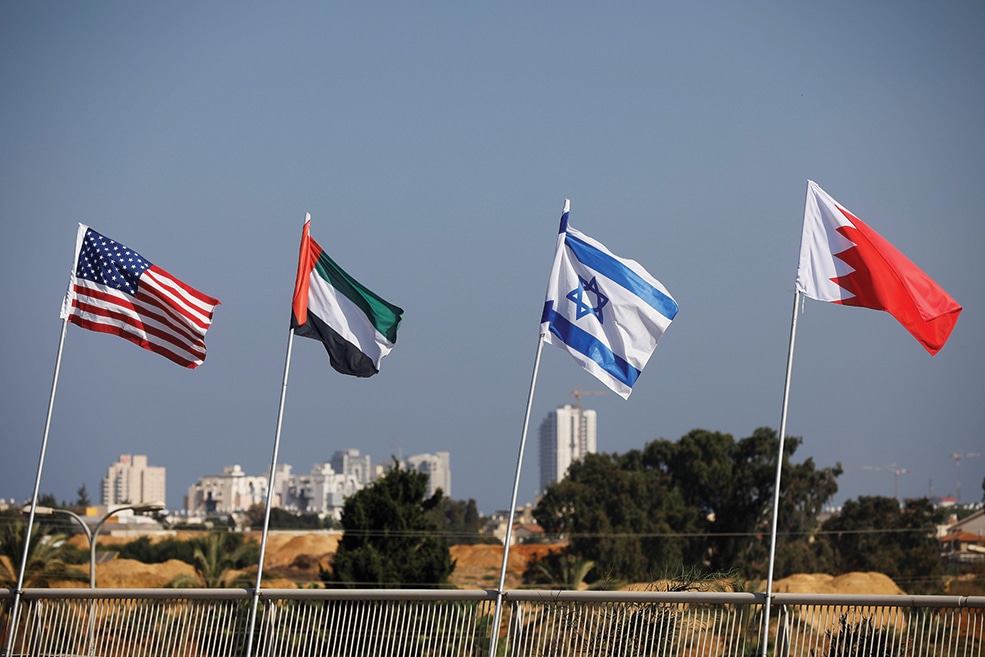
The flags of the United States, United Arab Emirates, Israel, and Bahrain flutter along a road in Netanya, Israel, September 14, 2020. REUTERS / Alamy Stock Phot

Dr. Mitch Glaser:

What practical differences do you think the treaties will make economically, politically, and even to tourism between the Gulf states and Israel?

Joel C. Rosenberg:

Well, if you notice, the first set of memorandums of understanding and other legal documents signed in the days leading up to and following the signing of the Abraham Accords were very practical. They indicate how much benefit both sides will get—or all sides are going to get—from these agreements. There are agreements on civil aviation. For instance, there will be direct flights between Israel and the United Arab Emirates and between Israel and Bahrain. Those are, by the way, going to go through Saudi airspace. The Saudis are not yet ready to make peace with Israel, but they have agreed to let Israeli, Emirati, Bahraini, and other planes fly through their airspace. This concession is a huge step forward.

The other agreements are regarding banking, private property rights, and setting up small business agreements. The United Arab Emirates has now required every hotel in the country to have kosher meals. That has not happened in Egypt; it has not happened in Jordan. We are talking about major financial deals already in motion.

Dr. Mitch Glaser:

Do you think that Oman and some of the other Gulf states are going to follow suit?

Joel C. Rosenberg:

Yes, I think there is a list of countries that are actively considering this. Oman would certainly be near or at the top of the list. The Sultan of Oman invited Prime Minister Netanyahu to visit two years ago, and then publicized that trip with photos and video. That was very dramatic. That sultan has since passed away. There is a new sultan in power, but there is no reason to think that he disagrees with his predecessor. But, does he feel like he has solidified his leadership and is ready to make such a big decision? That is a good question. I do not have an answer for that yet; we will see.

If Sudan were now to make peace with Israel, that would be exciting. It would be dramatic, but I would note that Sudan also figures prominently in a prophecy of a future war against Israel—the conflict known in Ezekiel 38 and 39 as the War of Gog and Magog. I would not hold your breath for a full normalization, but maybe that prophetic war is many, many years off. No one knows for sure, of course.

Dr. Mitch Glaser:

We do not know when these prophetic events will take place, right? So, we should take peace when we can get it!

Joel C. Rosenberg:

Exactly.

Dr. Mitch Glaser:

Have the UAE, Bahrain, or even some of the other countries you have mentioned considered Israel a place where they can invest funds? Such an investment would boost the Israeli economy.

Joel C. Rosenberg:

Yes. In talking to officials from both countries over the last few weeks since the signing of the Abraham Accords, I know that there are numerous business deals and venture capital deals in the works. Again, this is the most significant transformation in Arab-Israeli relations, I think, in the history of the modern State of Israel. These treaties will surpass the peace deals of Egypt and Jordan in the sense that the Abraham Accords are going to set the new model of what peace and normalization can be and what they should be.

Dr. Mitch Glaser:

Joel, I was privileged to follow your travels at times, as your friend, and was even invited to be part of one of those trips to visit some of the Middle Eastern countries. You brought several key evangelicals to visit, get to know, and extend goodwill to those countries. You were able to see the backstory unfolding in a lot of these nations. Can you tell us a little about what you have discovered?

Joel C. Rosenberg:

I would be happy to. It is extraordinary that evangelicals have had a front-row seat to what has been developing over the last several years. The Crown Prince of the United Arab Emirates, Sheikh Mohammed bin Zayed, commonly known by his initials, MBZ, invited me to bring a delegation of evangelical leaders to visit him in the capital of Abu Dhabi in the fall of 2018. I took a group of about ten evangelical leaders with me. Among other meetings that we had in the country, we spent two hours in the palace in an off-the-record meeting with MBZ. There are many things, unfortunately, that I cannot share, but I can share this now:  We communicated to the crown prince that, when it came to the issue of peacemaking and Israel, there were three things we, as evangelicals, wanted him to know.

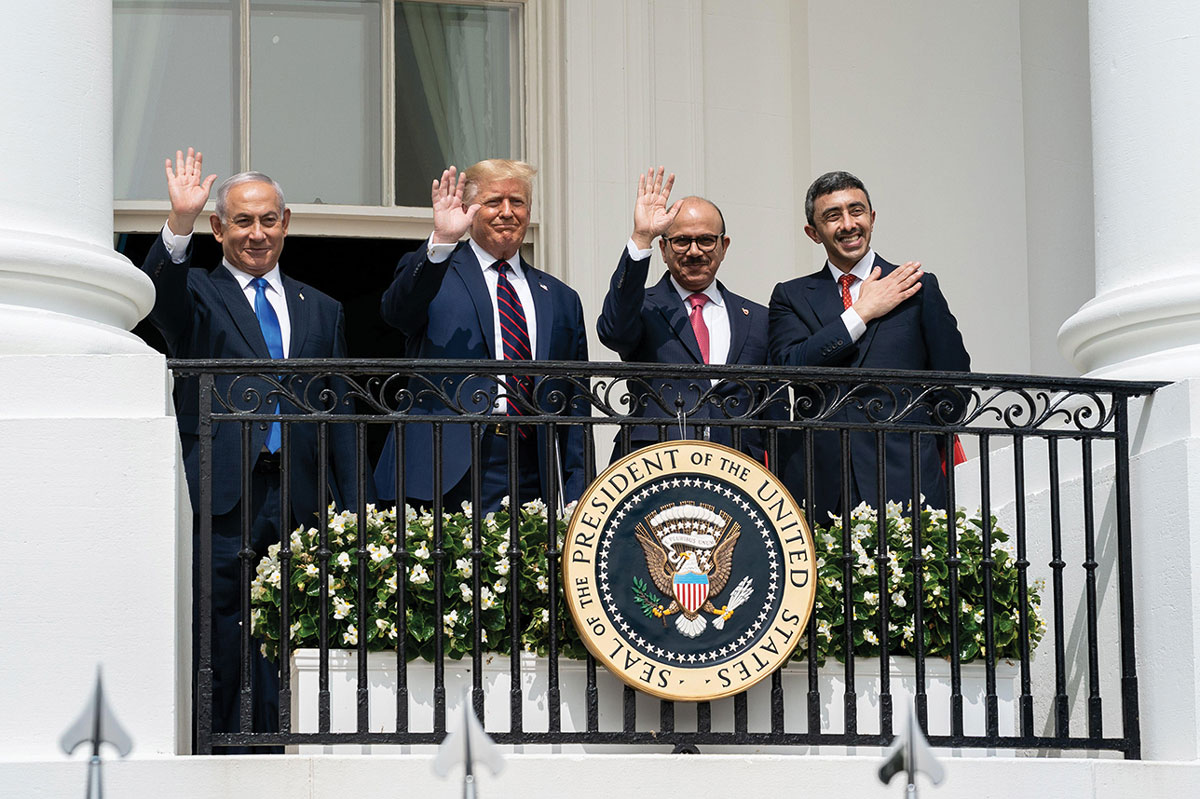
President Donald J. Trump, joined by Bahraini Minister of Foreign Affairs Dr. Abdullatif bin Rashid Al-Zayani, Israeli Prime Minister Benjamin Netanyahu, and the United Arab Emirates Minister of Foreign Affairs Abdullah bin Zayed Al Nahyan, acknowledge applause and wave to the crowd after delivering remarks at the Abraham Accords signing, September 15, 2020, on the South Lawn of the White House, Washington, D.C. Geopix / Alamy Stock Photo

Number one, we love Israel, and we love the Jewish people, and, for evangelicals, this is a theological position, not a political position. He needed to know that we are deeply committed to Israel’s security, freedom, prosperity, and sovereignty. We wanted him to know that. Number two, Jesus commands us to love our neighbors. We did not want him to think that, because we love Israel, we hate the Palestinians, or Arabs, or Muslims more broadly. Some evangelicals have struggled with language or even positions that are not reflective of Jesus’ command. We wanted to communicate to him that we are commanded to love our neighbors. We do not always know how. We find our way, but we wanted him to know that we do not see it as either/or, that we love both. And while we believe that Israel has a special and unique place in God’s plan and purpose in the region, we want there to be peace today, and we want to build better relations with the Arab and Muslim world.

The third point we made to him was that we are commanded in the Scriptures to pray for the peace of Jerusalem. Sixty million evangelicals in the United States alone are praying for the peace of Jerusalem, and we are looking at who will be the next Arab leader to make peace with Israel. As the leader of the delegation, I was the one that made these three points and stressed a little on the third one, “We would love it to be you.” He shocked us by saying, “Joel, I’m ready. I am ready to make peace with Israel, and I believe that the time is coming very soon.” That shocked us because—and I am not saying that we would say these three things in some pro forma way—we did not expect anyone to say back to us what MBZ said. We have said this to numerous Arab leaders in the region; he was the first to say that he was ready.

The question we began to discuss with him is, “How did you get to that point, and where do you go from here?” In these last two years, I have stayed in very close communication with the inner circle around the crown prince. Even up through the summer, I was in direct communications with them because I am writing a non-fiction book that will come out in the fall of 2021, timed with the twentieth anniversary of the 9/11 attacks. Twenty years after 9/11, the book looks at who the bad guys were, who the good guys were, and how our fight with radical Islam is going. It also looks at which Arab countries are fighting radical Islam very actively, and which countries want a much closer relationship with the United States and are even trending toward peace with Israel. The third section will address, “What is the state of the Church and religious freedom in the Middle East?”

I have been working on this book with a lot of exclusive material from these six delegations that I have led. All that to say, it became clear in July, when I was here in Washington meeting with the UAE ambassador, that they were ready, that they had actually put an offer on the table for Netanyahu, through the White House, and that those negotiations were in motion. I said to myself, “You have got to be kidding me.” I knew they were heading in that direction, but it was dramatic.

I will say that I was surprised by how quickly things accelerated this summer, especially when the big topic in Israel was whether Netanyahu would annex or apply Israeli sovereign law over large swaths of Judea and Samaria, which the world commonly knows as the West Bank. That was Netanyahu’s objective all summer, and that seemed to preclude any possibility of peace with the Arab states.

I was making the argument that, while I support the expansion of Israeli sovereignty in Judea and Samaria—the biblical heartland—over time, I believed that a peace treaty with one of the Gulf states was a higher objective for Israel in the near term. And I was making that case publicly and in quite a lonely fashion. It is in part because I knew it was possible, but it still stunned me. It is like when you have been praying, as Christians, as Messianic Jews, for decades for the peace of Jerusalem. It is a little like praying for Peter to be released from prison, then he knocked on your front door, and you cannot even believe that he is standing there.

Dr. Mitch Glaser:

You are a bit stunned by it all.

Joel C. Rosenberg:

Yeah. We know that God can answer these prayers, but we do not always expect the answer to come so quickly! This summer was a game-changing moment.

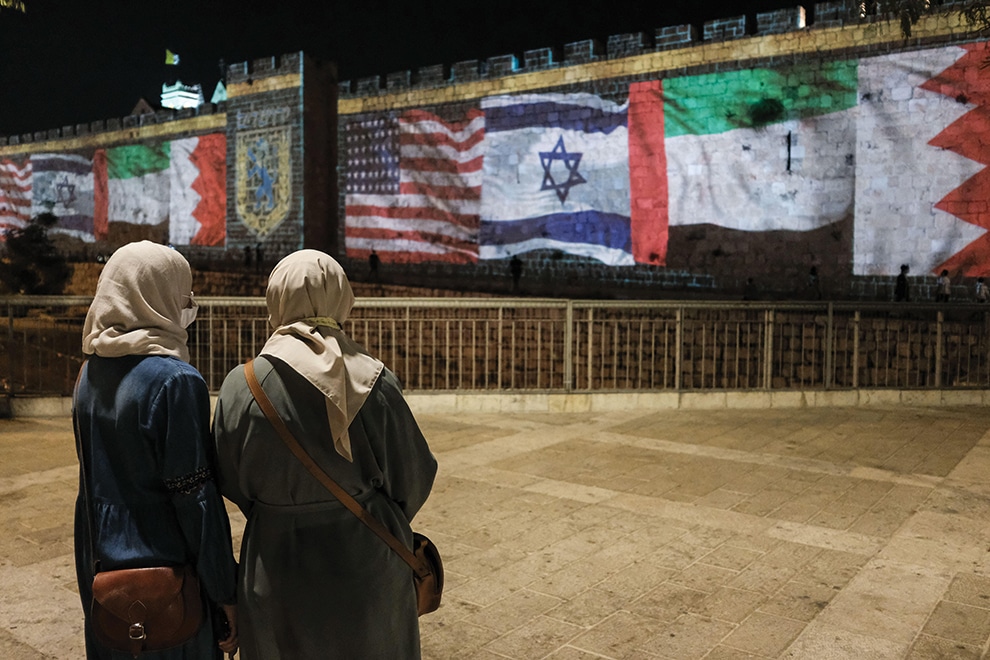
The flags of Israel, the United Arab Emirates, Bahrain, and the United States light up the Old City Walls of Jerusalem to celebrate the signing of the historic peace treaties in Washington, D.C. Nir Alon / Alamy Stock Photo

Dr. Mitch Glaser:

How are the Palestinians reacting to all of this? Then, if you could also tell us, how is the person-on-the-street, the average Israeli, responding to these new events?

Joel C. Rosenberg:

I have not seen any polling yet. Remember, and actually, it is hard to remember at times, that the Palestinian territories are not free societies. They really do not have the freedom to say whatever they want. It does not mean that you will not find Palestinians who tell you, but there, in Gaza, Hamas—the terrorist organization—is in charge. It is very hard to get somebody’s real, direct opinion. In the Palestinian Authority in the West Bank, this is tyranny. Mahmoud Abbas is now serving, I think, the fifteenth year of his four-year elected term. There is no freedom there.

I think we are beginning to see fissures inside Palestinian society. And so, we need to pray, as Christians and as Messianic Jews, for the Palestinian people.

Dr. Mitch Glaser:

Could you take one minute and tell us all about All Arab News and All Israel News, and your role as President and CEO of Near East Media?

Joel C. Rosenberg:

Yes, I am continuing my work to advance the Joshua Fund, which is essentially a mutual fund to invest in the growth and the strength of the Church and the Messianic body in Israel and throughout five neighboring Arab countries, as well as the Palestinian territories. We also believe that the media bias against Israel, against peace, against the values that we hold dear—anti-Christian media—is so bad that I decided to launch two new websites. One is called All Israel News, and the other is All Arab News. All Israel News is allisrael.com, and the Arab news is allarab.news.

We will provide links to all the really good and credible coverage in the Israeli press, Arab press, and American and other media. There is good reporting out there, but most Christians and Messianic Jews do not have the time to go sifting through dozens of websites to figure out what is real, what is important, what is credible. These sites will become what I call one-stop shopping. We link to all the most important stories in the region. We are also providing original reporting, exclusive interviews, and analysis: what is happening, why is it important, and how do we fit it into the larger picture as evangelicals. We are very distinctly and specifically focused on communicating to the world’s 600 million evangelicals what is happening in Israel and the region and why it matters.

Dr. Mitch Glaser:

Joel, thank you so much. I appreciate it, and we pray God’s blessings on All Israel News and All Arab News, and we thank you for your time, so shalom and blessings.

I am grateful for the time you were willing to speak with me. I know that those who read The Chosen People newsletter will appreciate this insightful information and pray for Israel, the Palestinians, the Middle East, and you.

Joel C. Rosenberg:

My pleasure.

I hope you enjoyed the interview! I hope it will help you continue to pray for the peace of Jerusalem. And please remember to pray for our staff who are bringing the gospel to Jewish people worldwide, including Israel.

We are so grateful for you!

Your brother in the Messiah,

Mitch Glaser

P.S. There is much more to this conversation! To hear the full interview, visit ourhopepodcast.com.

Leave a comment

Filed under Israel, Joel Rosenberg, Middle East, Palestinian

God is opening hearts during lockdown!

Dear Friend,

Shalom in our Messiah Jesus.

My heart breaks for Israel and the ultra-religious Jewish community worldwide! These two Jewish communities, one localized and the other spanning the breadth of countries and cities where Jewish people are concentrated, live under life-threatening circumstances.

Israel keeps trying to fight its way back to national normalcy but the coronavirus continues to immobilize the country. Unemployment in Israel is also at an all-time high, and the economy is suffering terribly. The country recently experienced a lockdown that extended through the Jewish high holiday season and beyond.1

The infection, hospitalization rate, and death toll is massive for “little Israel!” The mortality rate per capita surpasses that of the United States. The death toll is highest among the Arab population of Israel and the ultra-religious Jewish community in Israel and worldwide.

The ultra-Orthodox segment of the Jewish population are called Haredim, which in Hebrew means “the ones that fear,” and the One they fear is God. This name expresses the character of the community. These beloved Jewish people dress differently, live their lives according to the most Orthodox version of the Jewish faith, and maintain that gathering for prayer, synagogue services, holidays, and religious events—like the Jewish high holidays—are more important to them than life itself. Followers of Jesus can learn a lot from their dedication.

The impact on the whole population of Israel during this “second wave” lockdown is still fresh, and we may not know if the country will successfully pass the danger point until next month. We hope and pray it will!

You can read more about the numbers of Israelis affected by the disease by visiting https://coronavirus.jhu.edu/region/israel.

A SPIRITUAL SLANT TO THE PRESENT CRISIS

We should remember two great Bible passages penned by King David that are calls for prayer to every believer in Jesus!

King David wrote, “Pray for the peace of Jerusalem: ‘May they prosper who love you’” (Psalm 122:6). This is a biblical mandate for all of us—to pray for God’s peace to fall upon Israel and the Jewish people. And Israel needs our prayers desperately at this very moment.

The second issue is very sensitive! Due to the pandemic, the divisions between the ultra-Orthodox and secular Israelis have grown wider and have become like open wounds.

Would you join me in praying for Israel’s national unity? I believe this unity, which builds bridges between the religious and secular in Israel, will be pleasing to God and good for the nation. The psalmist declares, “Behold, how good and how pleasant it is for brothers to dwell together in unity!” (Psalm 133:1).

Let us pray for the healing of the nation and the people of Israel. Ultimately, this vision for unity will only come about when the Jewish people— secular, Haredim, and in between—cry out to God in repentance and turn to Jesus the Messiah (Romans 11:25; Zechariah 12:10).

Many Haredim and even some secular Israelis recognize the spiritual side of the current crisis. A recent survey of Israelis reported that one-third of the prime minister’s voters believe God sent COVID-19! Most of the Haredim in Israel fall into this group.2 Recently, we have seen God move among Israelis, Haredim, and Jewish people across the globe. Hard times draw people to the Lord, and this season of darkness and difficulty is no different.

May I share some stories illustrating this fruitful season of ministry and how the gospel is breaking through to Jewish people’s hearts?

One of our staff members in the southwest recently had the opportunity to teach on the subject, “Answering Jewish Objections to Jesus.” This class was in person, following all COVID-19 protocols, of course! A friend of our staff member had invited a Jewish woman. After the first class, our worker met with this Jewish woman and asked her what she thinks of Jesus. She said, “I believe He’s the Messiah, the Son of God!”

On the other side of the world, the severe restrictions of the COVID-19 pandemic caused just about all the ministries of Celebrate Messiah, our ministry partner in Australia, to go online. Celebrate Messiah has been hosting special seminars on YouTube and Facebook that have reached thousands of people. Online ministry so far is reaching more people than would typically walk through the doors of our services.

And in the north of Israel, a Jewish woman regularly attended the online services of the congregation led by one of our staff. She actively participated in the meetings, and came to faith in Messiah. Our Israeli worker wrote about the encounter: “She came up to our apartment, and we chatted for about forty minutes, maintaining social distance and wearing masks. The conversation was pleasant and most welcomed. I felt an urgency to ask her about her spiritual life and if she understood that Yeshua is the Messiah, the one who died for our sins and gives the gift of eternal life. She heartily agreed, and in our living room, socially distant, she prayed to receive Yeshua.”

All I can say is, “Hallelujah!” You cannot lock down the Holy Spirit from working powerfully in the lives of those who need salvation! God is moving among ultra-religious and secular Israelis, Jewish people in America, and Haredi enclaves in Brooklyn and across the globe.

WHAT CAN YOU DO?

You can pray for our ministry!

Please pray for the Lord to touch the lives of Israelis, Haredim, and Jewish people around the globe who need the Lord. If you have a Jewish friend and want us to pray for them, please go to chosenpeople.com/pray, write in their name, and we will pray for them. If you wish, we can also send them a free copy of our book Isaiah 53 Explained.

God’s work is not locked down!

I would even say that our ministry has expanded during this season. For example, we held online high holiday services, which were attended by more than 20,000 people worldwide. We have also begun a series of virtual small group discipleship Bible studies across the United States. We have Jewish people who are not yet believers attending these studies. We have never done this before!

We are continuing our digital ad campaigns, which have introduced us to thousands of Jewish people. We are following up through personal emails, Zoom calls, new websites, online Bible studies, virtual discipleship, and more. You can see from the fantastic reports I just shared that this has also led to in-person contact and decisions for the Lord.

Additionally, we have spent $500 per day purchasing Facebook ads in the United States, Israel, and other countries. Again, this has led to interaction with thousands of Jewish people for the Lord.

Online ministries are also incredibly powerful in reaching the Haredim. They do not want their family and friends to know they are considering the gospel. We place Facebook ads in Yiddish—the language commonly spoken by most Haredim. In partnership with the Jesus Film, we also translated the movie about the life of the Messiah into Yiddish. We use geographic-specific advertising in ultra-Orthodox areas to offer an opportunity to view a small clip of the film in Yiddish, which leads them to the full movie.

Am I encouraged? Absolutely!

I do not need convincing that the lockdowns of society, or hearts usually resistant toward the gospel, cannot be opened by the power of God.

Please help us take advantage of these opportunities by praying as we reach Jewish people and anyone else who will listen to the glorious gospel of our Lord Jesus the Messiah.

In HOPE through the Messiah,

Mitch

Endnotes

1 “Government Resolution: 14 Day Total National Lockdown Effective This Friday with Optional Extension,” gov.il, September 24, 2020, https://www.gov.il/en/departments/news/24092020_01.

2 Ben Sales, “One-Third of Netanyahu’s Voters Believe Covid-19 Was Sent by God – Survey,” Jerusalem Post, September 17, 2020, https://www.jpost.com/israel-news/one-third-ofnetanyahus-voters-believe-covid-19-was-sent-by-god-642703.

Leave a comment

Filed under Digital Media, evangelism, Israel, New York City

Finding Hope

Shalom.

Maybe, like me, your sense of hope is running thin as we begin this eighth month of the pandemic. You are not alone. Optimism and hope may well be the most sought after, invaluable, and yet intangible life quality people are seeking today. We are all longing for hope—the belief that the future will be better and brighter than today!

We were entirely unprepared for the impact COVID-19 would have on our everyday lives. Most of us know very little about the Spanish flu of 1918 and how it ravaged American life and killed 675,000 Americans.[1] Some of what happened at that time would seem familiar today, including people wearing masks and socially distancing!

We remember more modern-day plagues like Ebola, AIDS, Legionnaires’ disease, polio, measles, mumps, and many others. Today, thank God, we have vaccines and treatments for most of these scourges.

Few of us remember World War II. However, many of us remember and maybe even served in more recent wars in Korea, Vietnam, Afghanistan, and Iraq, in which we lost a combined total of more than 100,000 beloved American heroes.[2]

I remember the Cold War tensions, the Cuban missile crisis, and the atomic threat that drove school children to hide under their desks periodically (as if this would provide safety from a nuclear attack)!

We endured 9/11, Hurricane Sandy, and massive storms in Florida, Louisiana, and Texas that wreaked terrible devastation and death upon people we love and care about, not to mention costing hundreds of billions of dollars in damage. We can now add the devastating West Coast wildfires to this list.

In some ways, COVID-19 is a crisis unlike any other as we face a deadly enemy we cannot see. Now, it seems that this dreaded disease will impact almost every area of our country, and, at the moment, we are hovering around 200,000 deaths. If we add the economic struggles and social unrest we are experiencing, who could blame someone tempted by hopelessness? How do we cope and find hope during these dark and difficult days? Ignoring what we are facing today is not going to work.

I especially appreciate those around me who are more upbeat and hopeful! May their tribe increase! I am grateful for every pair of smiling eyes peering above a mask, trying to help me look toward the brighter side and face the future in hope. I pray you have a few family and friends who bring you this kind of joy and inspiration, but even these wonderful people cannot always be by our side. So, how can we find hope in a seemingly hopeless situation? Is it possible? I believe it is!

Finding Unwavering Hope During a Pandemic

Hope comes from connecting with someone or something that is above and beyond the shifting circumstances of our day. We need to fix our hope on what is unchanging and eternal if we are going to find security and peace today. I believe we can find the hope we long for so desperately in a personal relationship with the God who made and loves us.

A God Who Keeps His Promises?

I find this hope in the story of the Bible. The Bible teaches us that God created a perfect world, but then something went wrong. Though He placed our first parents in an exquisite garden, they veered off the path He wanted them to follow. We followed suit, and every generation since then has suffered the results of these bad decisions. But, according to the Bible, God will reclaim and recreate the world He made.

God has not abandoned us and will one day heal our broken world.

In Judaism, this idea is called “tikkun olam,” the healing of the world, and it is vital to the Jewish view of life, as men and women may partner with God in the healing of the world. Jewish tradition understands that something is fundamentally wrong!

The Hope of Israel Fulfilled

How do we know what is written in the Bible is true?

So often we need something we can see to help us believe. I did! Let me tell you what convinced me. Briefly, here are three reasons.

He has kept His promises to Israel and the Jewish people. Despite the devastation of the Holocaust, the Jewish people—after multiple millennia and against incredible odds—have returned to the land of promise. This was predicted by the Jewish prophets, like the well-known Ezekiel who wrote thousands of years ago, “For I will take you from the nations, gather you from all the lands and bring you into your own land” (Ezekiel 36:24).

If God can orchestrate Israel’s regathering and return to the land, He can be trusted to fulfill His other promises in the Tanakh (Hebrew Bible) and New Covenant Scriptures. This is undeniable. If the Bible was correct in predicting the unlikely restoration of Israel, then what else in the Bible is true?

The Hope of Messiah Fulfilled

I also believe God demonstrated His trustworthiness by sending the Messiah. His name is Yeshua, or Jesus in English, and there are hundreds of prophecies detailing His identity and mission penned by Israel’s prophets over multiple centuries. If what the Bible promised about His first coming has come to pass, then what is predicted about His second coming should be true as well.  

The prophets of old prophesied His place of birth (Bethlehem) (Micah 5:2), His death for our sins (Isaiah 53:1–12; Psalm 22), His resurrection from the grave (Psalm 16), and so much more! He will return as judge and king to: restore our planet; remove sin, death, and disease; and, according to the Bible, He will wipe every tear from our eyes. Isaiah promised, “He will swallow up death for all time, and the Lord God will wipe tears away from all faces, and He will remove the reproach of His people from all the earth; For the Lord has spoken” (Isaiah 25:8, also Revelation 21:4).

This is a foundation for hope that will never disappoint.

Personal Experience

Finally, without being unrealistic about the level of tragedy we have experienced, I am convinced that God is trustworthy. When I accepted Yeshua as my Messiah, He filled my heart with hope. I cannot easily explain it or prove it logically. When you have a personal relationship with God and believe the promises in the Bible, hope invades your soul and enables you to face the future with confidence.

You will be able to read about the experience of others in this newsletter who had similar experiences to mine.

So, how should we respond to the hope God offers to humanity? We could just give up or become cynical about life in general. We could also choose to put our hope in our fellow human beings working hard to find a vaccine and a cure for COVID-19. Or, we could trust in the God who created us! Maybe a combination of the last two?

I can tell you that, even if we find a cure, we will still experience ongoing tragedies and challenges in this life and that only our relationship with our loving and immovable Creator will shelter us against the storms of life.

One More Thought

It is a mystery as to why God allows His beloved creation to endure difficult times: the loss of loved ones, jobs, educational opportunities, the separation from friends and family, and more that you and I have faced recently. It might be tempting at times to question if God is even good, whether or not you are a person of faith.

Right now, it might be a difficult season for some to keep the faith! It is understandable—times are tough! Maybe you would like to know and trust God but have a hard time believing what the Bible says about His unchanging character.

I wish I could give you an easy answer. I believe God is good by nature. He is Lord of all creation and mysteriously uses life’s most profound disappointments to shape us and make us strong.

I encourage you to hope in God! Even though the road may be dark, He is the Guide we need who lights our path and leads us through the valley of the shadow of death to green pastures.

You might have an unshakable faith in God, secured by the Messiah Jesus, or perhaps you are seeking hope that has been elusive so far. I wish you blessings on the journey, whatever your starting point might be, and thanks again for taking your precious time to read.

I hope you will enjoy the rest of the newsletter!

Sincerely,

Mitch


[1] Nina Strochlic, “U.S. Coronavirus Deaths Now Surpass Fatalities in the Vietnam War,” National Geographic, April 28, 2020, https://www.nationalgeographic.com/history/2020/04/coronavirus-death-toll-vietnam-war-cvd/#close.

[2] Ibid.

Leave a comment

Filed under Jews and Christians, New York City, Uncategorized

Lessons from the Festival of Booths

Shalom and welcome to my Sukkah! Before I enter, I want to stop and say the special prayer.

ברוך אתה יי אלהינו מלך העולם אשר קדשנו במצותיו וצונו לישב בסכה. אמן.

Barukh Atah Adonai, Eloheinu, melekh ha-olam, asher kidishanu b’mitz’votav v’tzivanu leisheiv basukkah. Amein.

Blessed are You, Lord, our God, king of the universe, who has sanctified us with His commandments and commanded us to dwell in the sukkah. Amen.

I wish you could walk around Brooklyn with me this week. It is a BIG PARTY! Sukkah booths are popping up everywhere.

The Feast of Tabernacles is all about joy, unlike Rosh Hashanah and Yom Kippur, which are somber and sober.

And there is much to celebrate, especially for followers of Yeshua the Messiah, even in the midst of this pandemic, economic hardship, and social unrest.

The Bible enumerates a number of Feast of Tabernacles essentials.

Leviticus 23

Again, the Lord spoke to Moses, saying, “Speak to the sons of Israel, saying, ‘On the fifteenth of this seventh month is the Feast of Booths for seven days to the Lord. On the first day is a holy convocation; you shall do no laborious work of any kind. For seven days you shall present an offering by fire to the Lord. On the eighth day you shall have a holy convocation and present an offering by fire to the Lord; it is an assembly. You shall do no laborious work. (Leviticus 23:33–35, emphasis added.)

There is more information about the festival in verses 39–44:

“On exactly the fifteenth day of the seventh month, when you have gathered in the crops of the land, you shall celebrate the feast of the Lord for seven days, with a rest on the first day and a rest on the eighth day. Now on the first day you shall take for yourselves the foliage of beautiful trees, palm branches and boughs of leafy trees and willows of the brook, and you shall rejoice before the Lord your God for seven days. You shall thus celebrate it as a feast to the Lord for seven days in the year. It shall be a perpetual statute throughout your generations; you shall celebrate it in the seventh month. You shall live in booths for seven days; all the native-born in Israel shall live in booths, so that your generations may know that I had the sons of Israel live in booths when I brought them out from the land of Egypt. I am the Lord your God.” So Moses declared to the sons of Israel the appointed times of the Lord. (Leviticus 23:39–44, emphasis added.)

Let us look at some Sukkot basics.

The Date

Sukkot is observed in the seventh month on the fifteenth day of the month for a total of seven days. There is one additional day. and then Jewish tradition adds a ninth day.

Sukkot is also called the Feast of Ingathering

“Also you shall observe the Feast of the Harvest of the first fruits of your labors from what you sow in the field; also the Feast of the Ingathering at the end of the year when you gather in the fruit of your labors from the field. Three times a year all your males shall appear before the Lord God” (Exodus 23:16–17).

Sukkot, like the other feasts, is God’s spiritual classroom

The game “Show and Tell” must have been God’s idea! He uses the physical to teach us about the spiritual. By touching, seeing, hearing (as in the case of the shofar), and even tasting (matzah, etc.), the festivals are His spiritual classrooms, where all of our senses are engaged to teach us profound and beautiful spiritual truths.

The Major Symbols and the Lessons

The holiday is filled with lessons, but we will look at three, based upon the biblical text and traditions of the festival.  

  • God Provides

The lulav and etrog teach us that God provides for His children.

We are commanded to take “the foliage of beautiful trees, palm branches and boughs of leafy trees and willows of the brook, and you shall rejoice before the Lord your God for seven days” (Leviticus 23:40–41).

We weave the following elements together to form what is known as the lulav, which represents the four species mentioned in the biblical text.

Etrog

The foliage of beautiful trees is p’ree eitz hadar (פְּרִ֨י עֵ֤ץ הָדָר֙), which literally means “fruit of beautiful trees” and refers to what we call the etrog—a fruit that looks like a large lemon.

The palm branches

The palm branches, orlulav, is a frond of the date palm tree.

The boughs of leafy trees

The boughs of leafy trees refer to thebranches of a myrtle bush.

The willows of the brook

The willows of the brook refer to the branches of the willow tree.

The palm branch, myrtle, and willow are combined into what is called a lulav. We use three willow branches, two myrtle, and one long palm frond to which the others are tied.

The joyful shaking of the lulav reminds us that God provides through the harvest.

He causes the rain to fall, the sun to shine, and the seeds to germinate. Our job is to harvest what He creates. It is difficult for those of us who are not farmers to appreciate this firsthand. Some of us do not even go to the grocery store these days, choosing instead to have our food delivered!

Still, we are commanded to be happy because God is our Provider! Waving the lulav and etrog is an expression of joy—joy that is tied to the harvest.

Mustering up authentic joy is not easy in the midst of a pandemic. Our lives have been so disrupted, and many of us have endured such significant loss; of a loved one, a friend, a business, income, education, fellowship with others in worship, and the joy of everyday life. We miss our normal lives, and we are eager to recapture what we have lost.

Yet, God commands us to rejoice—even in the midst of suffering.

In some ways, this has been the story of Jewish life and history—smiling while suffering!

For followers of the Messiah Jesus, the command to rejoice during Sukkot reminds us of the words of Rabbi Paul again, who wrote, “Finally, my brethren, rejoice in the Lord. To write the same things again is no trouble to me, and it is a safeguard for you” (Philippians 3:1), and also, “Rejoice in the Lord always; again I will say, rejoice!” (Philippians 4:4).

So, what is the secret to having joy? Should we rejoice when everything around us tells us not to? Are we speaking about some type of Jewish stoicism that ignores the hardships we face?

Not at all!

Sukkot reminds of God’s care for the Israelites through the desert wanderings.

We are encouraged to ask the Lord for the same provision and care today as we travel through the desert of this life. He provided the manna, quails, and even water out of a rock for our ancestors. He has not changed!

The Jewish people, my ancestors, experienced this supernatural provision. According to Moses:

He led you through the great and terrible wilderness, with its fiery serpents and scorpions and thirsty ground where there was no water; He brought water for you out of the rock of flint. In the wilderness He fed you manna which your fathers did not know, that He might humble you and that He might test you, to do good for you in the end. Otherwise, you may say in your heart, ‘My power and the strength of my hand made me this wealth.’ (Deuteronomy 8:15–17)

Yeshua said much the same, but a little differently in the Sermon on the Mount, “For this reason I say to you, do not be worried about your life, as to what you will eat or what you will drink; nor for your body, as to what you will put on. Is not life more than food, and the body more than clothing?” (Matthew 6:25). And also, “But if God so clothes the grass of the field, which is alive today and tomorrow is thrown into the furnace, will He not much more clothe you? You of little faith!” (v. 30). And He concludes, “But seek first His kingdom and His righteousness, and all these things will be added to you. So do not worry about tomorrow; for tomorrow will care for itself. Each day has enough trouble of its own” (vv. 33–34).

Hardship and suffering purify our souls as we learn to distinguish between our needs and wants and to thank God who provides our “daily bread”. This is what we learn from fasting on Yom Kippur and what we learn from the lulav and etrog—God always provides.

Applying the Lesson

Which grows out of the first…

The Lord wants us to serve Him by serving others.

Sukkot calls upon us to be thankful and generous, be grateful to God for all He has done, and to rejoice, but also to remember the poor and those who do not have what they need.

You might look for one needy family this week and give from the abundance God has given to you. I believe God will bless and reward your generosity as you care for others the way God has cared for you.

As Yeshua said, again in the Sermon on the Mount:

So when you give to the poor, do not sound a trumpet before you, as the hypocrites do in the synagogues and in the streets, so that they may be honored by men. Truly I say to you, they have their reward in full. But when you give to the poor, do not let your left hand know what your right hand is doing, so that your giving will be in secret; and your Father who sees what is done in secret will reward you. (Matthew 6:2–4)

  •  God’s Protects

Moses commands the Jewish people to live in booths for seven days. Moses wrote, You shall live in booths for seven days; all the native-born in Israel shall live in booths, so that your generations may know that I had the sons of Israel live in booths when I brought them out from the land of Egypt. I am the Lord your God” (Leviticus 23:42–43).

The Hebrew word for booths is sukkot סֻּכֹּ֥ת—the plural, which is where we get the name for the holiday.

The booths are not built for long term occupancy; they are God’s classroom. These flimsy structures with see-through roofs are supposed to remind us of the structures we lived in while travelling in the Sinai desert for forty years.

Let me put it this way: If built correctly, without nails, with a see-through ceiling, and a fragile foundation, you would not want to be in a sukkah during a strong wind!

The Sukkah also reminds of the frailty of human life.

According to Jewish tradition, we are supposed to eat and sleep in the sukkah booth for seven days. The rabbis compare the sukkah to the human body, which is frail and eventually wears out. It reminds me that we are Chevrolets, built with planned obsolescence—we are designed to eventually wear out.

I love the old hymn that says, “This world is not my home, I’m just passing through.” We need to view ourselves as perpetual tourists and live with the future in mind. A famous rabbi, Samuel ben Maier, commenting on Leviticus 23:43, believes the booths also call us to humility and to appreciate the simple things of life. He wrote:

Why do I command you to do all this? For the Lord your God brings you to a good … and you will eat and be satisfied, etc. As a result, your heart may become haughty and you will credit yourself with all this as your own achievement. (Deuteronomy 8:7–8) In order that this will not happen, and to show the Israelites God’s part in their success, they will move out of their solid houses as a reminder to the time when they had not been blessed with any of these benefits which they enjoy ever since inheriting the land of their forefathers. (Rashbam Leviticus 23:43)[1]

This lesson is repeated in the Shulchan Aruch, which means “the prepared table,” one of the guiding manuals on Jewish spiritual life.[2]

Jewish tradition suggests that God is our sukkah, and He is all we need. He protects us from life’s dangers. He guards and guides us through the twists, turns, and turbulence of life.

Unless He wants us to learn lessons from hardship or maybe He is simply calling us home. We agree with the rabbi from Tarsus, “And we know that God causes all things to work together for good to those who love God, to those who are called according to His purpose” (Romans 8:28). And David wrote in Psalm 23, “Even though I walk through the valley of the shadow of death, I fear no evil, for You are with me; Your rod and Your staff, they comfort me” (Psalm 23:4).

God uses the desert to bring us to our knees. Deserts are not very hospitable to human life. The days are too hot, the nights are too cold, the water is scarce, and the oases few and far between. We have lived in a type of desert for the last six months, and we have learned more than we wish about life and death through the pandemic.

The pandemic has driven many of us into the arms of a loving, caring, and protecting Savior to seek protection. We have been humbled! The pandemic has revealed our weakness and limitations. We also recognize that we cannot easily defeat our enemies, especially when they are invisible. It is really hard to fight what you cannot see. The Apostle Paul reminds us of the battle we are really fighting as believers, “For our struggle is not against flesh and blood, but against the rulers, against the powers, against the world forces of this darkness, against the spiritual forces of wickedness in the heavenly places. Therefore, take up the full armor of God, so that you will be able to resist in the evil day, and having done everything, to stand firm” (Ephesians 6:12–13).

We are fighting against far more than an invisible virus; we are doing battle with the world forces of darkness and spiritual forces of wickedness. This battle will not be won with worldly weapons but with the power of God by His Spirit and the spiritual armor He provides to fight; truth, righteousness, the gospel of peace, and the shield of faith.

So, it is time to read a Jewish children’s story! We learn so much about Jewish life and lessons from these stories. this is one for Sukkot.

Debbie and Danny were very unhappy.

When they tried to fast all day on Yom Kippur they hadn’t been able to go without food past 2 o’clock. Even though their parents had told them that when they were older they would have the self-discipline to be able to fast all day on Yom Kippur, they wanted to do it now.

And when they had tried to blow the Shofar after Rosh Hashanah family services they hadn’t been able to make a real sound; just a little squeak. Now their parents were telling them they were too young to sleep overnight in the Sukkah. It wasn’t fair.

Debbie and Danny had helped their parents build the Sukkah. In fact, the reason their family had a Sukkah of their own this year was because of Debbie and Danny. Their father had said he didn’t have the time to build a Sukkah this year, but the kids had offered to help with everything. When the Sukkah was finished their father was proud of how much they had helped. They carried a table and chairs into the Sukkah and prepared to eat their meals in the Sukkah. But when the kids said they wanted to bring their sleeping bags into the Sukkah and sleep overnight their parents said, “NO”.

First their parents said it was too cold to sleep in the Sukkah. Then they said the kids were too young. Finally, they said that it wasn’t safe.

Debbie and Danny said a Sukkah was as safe as a house. A Sukkah was God’s shelter for the Jewish people for all the years when the Jews lived in the desert after they left Egypt. And a Sukkah was the shelter Jewish people used in the Land of Israel when they were harvesting their crops and thanking God for the harvest. They reminded their parents that:

‘It is a Mitsvah [commandment] to build a Sukkah.’

‘It is a Mitsvah to eat meals in a Sukkah.’

‘And it is a Mitsvah to sleep in a Sukkah.’

Their parents were impressed that Debbie and Danny had such a great desire to do Mitsvot [commandments] so they agreed that the kids could sleep overnight in the Sukkah on Saturday night.

When Saturday night came Debbie and Danny were eager to sleep in the Sukkah. They had decorated the Sukkah with drawings and old Shanah Tovah [Happy New Year!] cards. They had hung different kinds of fruit and vegetables on the Sukkah. Now they got in their sleeping bags, ate a night-time snack from the fruit hanging on the Sukkah, and went to sleep.

In the middle of the night they were suddenly awakened. The Sukkah was shaking, but it wasn’t from the wind. The ground itself was shaking. It was an earthquake. They heard a loud crash. A tree had fallen on their house. They were scared. Then they remembered that they were in God’s Sukkah. They didn’t feel so frightened. They said the Sh’ma [a traditional Hebrew prayer from Deuteronomy 6:4] a few times and they felt even better. The earthquake stopped.

Their parents came out and they seemed to be more upset than the kids. The tree that had fallen had landed on the roof above the bedroom where the children slept. They might have been hurt if they had been sleeping in the house.

Thank God the kids had been sleeping in the Sukkah.[3]

  • Lesson #3.  God Gives us Hope

Like the children of Israel, we have a destination. Ultimately, it is not we who are going to Him, but rather He is coming for and to us.

If we pass from this life and enter His presence, or if we are taken up to meet the Lord in the air, the end of the story is all about His coming back to the world He created to establish His kingdom in a renewed and reclaimed earth.

Heaven ultimately comes to earth.

The sukkah reminds us that, one day, as promised, the earth will be filled with the knowledge of the Lord as the waters fill the sea. In fact, a day is coming when the entire earth will become his sukkah booth and tabernacle. We caught a glimpse of this with the coming of Jesus the Messiah, who, according to the gospel writer John, dwelled—literally tabernacled—among us.

I love Sukkot because it reminds me of the glory ahead. Knowing Him is a foretaste of the glorious future God has prepared for those who love Him. The sukkah reminds us of what is to come! As John wrote:

Then I saw a new heaven and a new earth; for the first heaven and the first earth passed away, and there is no longer any sea. And I saw the holy city, new Jerusalem, coming down out of heaven from God, made ready as a bride adorned for her husband. And I heard a loud voice from the throne, saying, “Behold, the tabernacle of God is among men, and He will dwell among them, and they shall be His people, and God Himself will be among them, and He will wipe away every tear from their eyes; and there will no longer be any death; there will no longer be any mourning, or crying, or pain; the first things have passed away.”

And He who sits on the throne said, “Behold, I am making all things new. And He said, “Write, for these words are faithful and true.” (Revelation 21:1–5)

Invitation:

Are you joyful? Do you feel protected? How are you doing right now in the midst of our season of trouble and trial when it comes to hope?

If you have never received Jesus as your Messiah, now is not too soon.

Pray this prayer with me:

If you are a believer and you are running on one or two but not three of these cylinders; joy, safety, and hope, then maybe you need to dwell in God’s sukkah booth for a while. You have all week to find or build one! Either way, I urge you to turn to the Lord and experience His provision that will give you joy, sense His protection, once again enjoy a sense of safety. In Him, you will also find hope. We are not locked down by the present if we know the Lord and believe that He is with us. In fact, the hope we have for better days is good practice learning how to hope for the best days when He returns.

Chag Sameach and Happy Sukkot…may you always dwell in the presence of the Lord.

God’s Sukkah is Safe

A Story of Hope

With the help of his two young neighbors, Justine and Duane, elderly Mr. Roth builds a sukkah, a little hut built by Jews to commemorate the harvest festival and to remind them of generations of homelessness. After the two children spend the night in the hut, they go to the market with Mr. Roth to buy foods for a festive Sukkoth meal to be shared in the hut. While they are at the market, a firestorm that has erupted in the hills rapidly obliterates their neighborhood. Miraculously, the only building left untouched by the rampaging flames is Mr. Roth’s sukkah. Amid the ghostly stillness at the scene, where not even the crickets have survived to chirp, can be heard another miracle–the cries of Mr. Roth’s cat, Tikvah, who has managed to escape the fire.[4]

And guess what Tikvah means—hope! The author was trying to tell the children that the sukkah was more than a little tent or temporary shack, it is a symbol of the hope we have in a God who always cares for and protects His children.

May the Lord fill your heart with hope, as even if things do not work out well for us on earth, we put our trust in the One who has overcome the world and has gone before us to build a mega-sukkah—a mansion where we will live forever. And nothing—not a wildfire, hurricane, pandemic or far worse—can destroy what He is building for those who love Him.

Let me summarize and close:

God is always faithful to provide for our needs—it is His nature.

Provision should lead to our taking action by providing for others.

He protects us, which should calm our fears and enable us to trust the One who protected the Jewish people in the desert.

We can have hope because a new world is coming for those who love Him, and we will live with our glorious God and Messiah forever.


[1] Rashbam, “Rashbam On Leviticus 23: 43,” Sefaria, accessed October 2, 2020, https://www.sefaria.org/Rashbam_on_Leviticus.23.43.1?lang=bi&with=all&lang2=en.

[2] Shulchan Arukh, Orach Chayim 639:1. According to very important Rabbinic document, the Shulkan Aruch – the Prepared Table, we are told the following about the Sukkah, “What is the Mitzvah of sitting in the Sukkah? That he should eat, drink, sleep, lounge, (Tur) and reside in the Sukkah all seven days, both in the day and in the night, in the same manner in which he resides in his house the rest of year. And all seven days a man makes his house temporary and his Sukkah permanent. How so? The fine dishes and linens, should be in the Sukkah; and drinking vessels, such as glass cups and mugs, in the Sukkah; but eating vessels after eating (Tur), such as pots and plates, outside of the Sukkah. The lantern should be in the Sukkah.” “Shulchan Arukh, Orach Chayim 639,” Sefaria, accessed October 2, 2020, https://www.sefaria.org/Shulchan_Arukh%2C_Orach_Chayim.639?lang=bi.

[3] Allen S. Maller, “A Succot Story for Children: God’s Sukkah Is Safe,” The Jewish Magazine, accessed October 2, 2020, http://www.jewishmag.com/126mag/succah_children/succah_children.htm.

[4] Polacco’s story is based on the firestorm that ravaged her hometown of Oakland, California. Actual framed photos of family members shown on bureau tops and posters of sports idols on a bedroom wall helpÿ20convey the reality of the event and of the personal losses suffered. Polacco’s vibrantly colored illustrations pulse with energy and emotion as the characters bend with the whipping wind, comfort each other in the temporary shelter, and rejoice in the sukkah when Tikvah is found. Good Sukkoth stories are rare; rooted in an actual event as well as in ages-old tradition, this one is a priceless gem

Ellen Mandel, review of Tikvah Means Hope, by Patricia Polacco, Amazon.com,  https://www.amazon.com/Tikvah-Means-Hope-Patricia-Polacco/dp/0385320590?pd_rd_w=7BZfa&pf_rd_p=3fdb7f7b-31a2-4f37-b9bc-1469e3d4fb18&pf_rd_r=4P0M388T0HVKA6JFQ5PY&pd_rd_r=e4469531-db4c-4746-9a31-7579e745830b&pd_rd_wg=met5J.

Leave a comment

Filed under Holidays & Festivals, Jewish Holidays

The Priority of Jewish Evangelism

Shalom in His grace!

I hope and pray this letter finds you healthy, safe, and filled with His joy.

I continue to believe that sharing the gospel with everyone should be our greatest priority in life! My personal burden, and the focus of Chosen People Ministries, is reaching Jewish people for Jesus. But, as surprising as this might be, we actually lead as many or more Gentiles to the Lord as we do Jewish people every year!

Yet my heart’s greatest desire is to see my own Jewish people accept Jesus and receive the gift of everlasting life!

It is essential to ask the question, “If Jewish people number only 15 million among almost 8 billion people on earth, why is Jewish evangelism so essential and urgent?”

As the leader of a traditional mission to the Jewish people, I believe Jewish people must accept Jesus to enter the kingdom of God (John 3:16–17; John 14:6; Acts 4:12).

I do not believe a Jewish person or a Gentile can satisfy God’s demands for righteousness through his or her merit or good works (Galatians 2:15–16; 3:23–25; Romans 10:2ff.). According to the Apostle Paul in the early chapters of Romans, we must all put our faith and trust in God’s Son, who died and rose for our sins.

THE BIBLICAL MANDATE TO EVANGELIZE JEWISH PEOPLE
(ROMANS 1:16 AND ROMANS 9–11)

The following two passages, in particular, provide a sound biblical basis for the urgency of Jewish evangelism.

ROMANS 1:16

The Apostle Paul expressed it this way, “For I am not ashamed of the gospel, for it is the power of God for salvation to everyone who believes, to the Jew first and also to the Greek” (Romans 1:16).

Franz Delitzsch, the well-known Old Testament scholar, wrote, “For the church to evangelize the world without thinking of the Jews, is like a bird trying to fly with one broken wing.”

Of course, Paul was not suggesting that the Roman believers withhold the gospel from the Gentiles until every Jewish person in the world hears the good news. Neither was he implying that the gospel has already come to the Jewish people first, therefore, preaching the gospel to the “Jew first” no longer has any application in 2020. Paul wrote Romans 1:16 in the present tense. So follow the logic of the text with me: If the gospel is still the power of God “for” salvation and is still for “everyone who believes,” then the gospel is still “to the Jew first.”

Paul used the same Greek word for “first” that Matthew used in Matthew 6:33, where Jesus reminded us, “But seek first His kingdom and His righteousness….” The kingdom of God should always be a priority in our lives, even as we pursue other vital life issues. Similarly, reaching Jewish people with the gospel should be a priority for all who know the Lord Jesus as their Savior.

Wherever Paul, the Jewish Apostle to the Gentiles, traveled in his ministry, he always first preached the gospel to the Jewish people living in that area (Acts 13:13–52; 14:1–5; 18:7–11; 19:8–10), which is why he usually began his ministry by preaching in the local synagogues. The salvation of the Jewish people was an ever-present burden for Paul, and his actions in the book of Acts reveal his understanding of what he wrote in Romans 1:16.

But there is more!

ROMANS 9 –11

In Romans 9–11, Paul pointed out some critical insights about the Jewish people and Jewish evangelism. For example, in Romans 9:1–3, we learn of Paul’s burden for the Jewish people; he expressed his willingness to give up his salvation if it meant that Jewish people might enter the kingdom of God. Romans 10:1–3 describes his heartfelt prayers for his people. In chapter 11, Paul concluded that God has not rejected the Jewish people—there is hope for the salvation of individual Jewish people in the present age and nationally at the end of days.

His first line of argumentation for God’s continued faithfulness to the Jewish people was that he—Paul—was Jewish! Paul was living evidence of God’s faithfulness. I, too, am a Jewish believer in Jesus, and there is a remnant of Jews today who are accepting the gift of salvation in Jesus the Messiah!

The work of Your Mission to the Jewish People can be summarized this way: We are Jewish and Gentile believers searching for the promised remnant the Lord has prepared among the Jewish people. We continue this ministry in the United States, Israel, Europe, South America, and in nineteen countries worldwide! I am a part of the remnant of Jewish believers looking for the others!

THE REMNANT TODAY

There is a remnant today as there was in the Old Testament period, as evidenced by Paul’s recounting the story in 1 Kings 18. God revealed to Elijah that 7,000 other men did not bow the knee to Ba’al. This group remained faithful to the God of Israel. Paul concluded that a remnant existed among the Jewish people of his day who, like himself, received Jesus as Lord (Romans 11:5). Messianic Jews today are God’s signposts of His faithfulness and power to save.

JEWISH EVANGELISM AND YOU

The task of reaching this remnant is also a mandate for the church. In Romans 11:11, Paul specifically called upon Gentile members in the body of Christ to make Jewish people jealous with the gospel message. Ultimately, that jealousy would drive the nation to Jesus, as detailed in Romans 11:25–26.

The link between Israel’s salvation and the Messiah’s return is perhaps a mystery, but true nonetheless. This relationship is spelled out in the book of Zechariah from chapter 12 through chapter 14, where we see the connection between the Lord’s return and the repentance and return of the Jewish end-time remnant.

This connection might even explain why Paul gladly accepted the mantle of apostle to the Gentiles, knowing that the salvation of the Gentiles would lead to the salvation of the Jewish remnant, which, in turn, would lead to the glorious consummation of all things!

The practical implications of these few thoughts are clear. The Gentiles within the body of Messiah have a calling to reach Jewish people for Jesus. As a 126-year-old mission to the Jewish people, Chosen People Ministries is happy to equip and train our brothers and sisters to accomplish this prophetic work.

It is part of our organizational mission statement: “Chosen People Ministries exists to pray for, evangelize, disciple, and serve Jewish people everywhere and to help fellow believers do the same.”

We accomplish this mission by encouraging, providing materials and resources, and building strategic bridges with the larger body of Messiah to fulfill this mandate in the twenty-first century.

One of our staff recently spoke to a Jewish man:

When he started reading Isaiah 53, he asked me who it was about. I said, “Who do you think it is about?” He responded, “Jesus.” Then I pointed out that it was written 700 years before Jesus was born. He said he was “blown away.”

Critical Jewish areas like New York City, Los Angeles, Chicago, Florida, and Israel are still facing difficult circumstances as a result of the coronavirus pandemic. Our hearts break, as Paul’s did, for the salvation of our Jewish people. So many elderly Jewish people, including Holocaust survivors in Israel, are frightened and looking for answers. We know that there is only one answer to the problems and challenges of life, whether it be poor health, the loneliness of old age, or economic instability. Many Jewish people today are also concerned about change and the apparent frailty and instability of life.

We have a golden opportunity to reach Jewish people with the gospel. NOW is the time, and because of our success online, we are talking to thousands of Jewish people about Jesus. We try to visit and minister personally when able, but if not, our missionaries are now all adept at making significant online and phone connections with Jewish people.

Once again, we consider the words of that great Jewish apostle to the Gentiles, “Brethren, my heart’s desire and my prayer to God for them is for their salvation” (Romans 10:1).

In Messiah,
Mitch

Leave a comment

Filed under evangelism, Uncategorized

A High Holiday Sermon – Reminder: The Hope of Restoration

Introduction

We gather each year on the first night of Yom Kippur to hear Kol Nidrei, a traditional and moving prayer that serves as Israel’s appeal to wipe away sins by annulling the obligations of the previous year—vows that we made between the previous Day of Atonement and today. It is written in Aramaic, and its origins are disputed. Some scholars say it was written during the Gaonic period (ninth century), but many others have suggested the prayer was born out of the dark days of the Inquisition when many Spanish and Portuguese Jewish people were forced to convert to Catholicism under threat of death or expulsion.[1]

Although we are not sure why or when the prayer was created, once it was paired with the soulful melody that now makes the prayer so moving, the impact of Kol Nidrei on the hearts of Jewish people is certain. Whether religious or secular, this Yom Kippur tradition has become one of the most powerful prayers in Jewish life and faith. It is not unusual to have non-religious Jewish people attend synagogue each year on erev (the evening of) Yom Kippur simply to experience the Kol Nidrei prayer.

There are a variety of ways to present Kol Nidrei, some with unique adaptations. The following version was presented at Beth Sar Shalom—Brooklyn, and I thought it was especially creative and beautiful. Listen to it if you have a moment!

Versions of the Prayer

A traditional version of the prayer:

All vows, obligations, oaths, and anathemas, whether called ‘ḳonam,’ ‘ḳonas,’ or by any other name, which we may vow, or swear, or pledge, or whereby we may be bound, from this Day of Atonement until the next (whose happy coming we await), we do repent. May they be deemed absolved, forgiven, annulled, and void, and made of no effect; they shall not bind us nor have power over us. The vows shall not be reckoned vows; the obligations shall not be obligatory; nor the oaths be oaths.

The leader and the congregation then say together:

“And it shall be forgiven all the congregation of the children of Israel, and the stranger that sojourneth among them, seeing all the people were in ignorance” (Num. xv. 26).[2]

A more modern translation/version:

All vows we are likely to make, all oaths and pledges we are likely to vow, or swear, or consecrate, or prohibit upon ourselves between this Yom Kippur and the next Yom Kippur, we publicly renounce. Let them all be relinquished and abandoned, null and void, neither firm nor established. Our vows are no longer vows, our prohibitions are no longer prohibitions, and our oaths are no longer oaths.

The whole community of the Children of Israel, and the strangers dwelling among them, shall be forgiven, for all of them were without premeditation.—Numbers 15:26

O pardon the iniquities of this people, according to Thy abundant mercy, just as Thou forgave this people ever since they left Egypt.

The Lord said, “I pardon them according to your words.” (three times)—Numbers 14:20[3]

Rabbi Eric Solomon, a reform rabbi, writes so poignantly about the impact of the Kol Nidrei,

Kol Nidre may have been initiated by the personal need of the marranos to repent for a forced conversion, but its power has reached far past that narrow scope. When we daven the Kol Nidre together as a community, we are looking beyond the simple meaning of the words; we are beginning to focus inward, preparing to unleash our darkest memories, and paving the path towards genuine reflection on God and repentance.[4]

The Appeal of the Prayer

Clearly, at the heart of the prayer is the request of the penitent beseeching God to withhold His judgment and to be merciful for not fulfilling vows of obedience, promises of changed behavior and keeping mitzvot. There is also an underlying understanding that when we live in obedience to God, we are blessed and when we do not, we are judged. Kol Nidrei is an appeal, asking God to release us from the promises we could not keep. The prayer expresses a desire to be forgiven for making unkept vows and for not meeting God’s expectations.

At its core, Kol Nidrei expresses our desire for forgiveness and God’s blessings. Somehow, we all know, in the depth of our souls, irrespective of our theology, that we are worthy of judgment and are in desperate need of forgiveness.

I cannot disagree with these sentiments. The Bible is very clear about these matters. Judaism typically does not affirm the depravity of man in the same way that Christianity does. Yet, the regularity of committing sin is obviously recognized by the very nature of Yom Kippur.

Biblical Blessings and Judgments

The Bible teaches that there is a causal relationship between obedience and blessings, and between disobedience and judgment. It is a theme woven throughout Scripture in more places than we can count, and it generally describes the nature of our relationship with God. In very summarized terms, when we do what He says, we are blessed and happy, and if we do not, then we are judged and, well, not very happy. Israel’s experiences of these blessings and judgments vary throughout the Old and New Testaments, but I am sure no one would argue this pattern is fundamental to Scripture.

Blessing and judgments are embedded in the very covenants the Holy One constructed to guide our relationship to Him.

The themes of blessings and judgments are tied to His perfect nature. He is holy and just, and we are sinful. Yet, God calls upon us to act against our nature and live righteously. If we do, we will be fulfilled and happy. If we do not—if we fail to act righteously—then judgment should be expected. If He should ignore our rebellion against His standards and do nothing about it, then He would appear to be unholy, unjust, unrighteous, and even weak, making demands that not even He could fulfill.

Would we really want to worship a God who had no standards? What if there were no ultimate justice? Or would we worship a God who had standards but did not act upon them? As uncomfortable as judgment might be, we would still rather adore and follow a holy and righteous God who enforced His standards…would we not?

Yet, the Bible teaches that this same God is also loving, gracious, and merciful. As He proclaimed to Moses when He passed by him on Sinai,

The Lord descended in the cloud and stood there with him as he called upon the name of the Lord. Then the Lord passed by in front of him and proclaimed, “The Lord, the Lord God, compassionate and gracious, slow to anger, and abounding in lovingkindness and truth; who keeps lovingkindness for thousands, who forgives iniquity, transgression and sin; yet He will by no means leave the guilty unpunished, visiting the iniquity of fathers on the children and on the grandchildren to the third and fourth generations.” (Exodus 34:5–7)

We also read in the Bible of His willingness to override His justice and to show mercy, which is not getting what you deserve for your sinful behavior, and grace, defined as receiving what you could never merit.

God’s Covenants

Again, these relationships, on a larger and national level for Israel, are embedded within the covenants He made with mankind, including a promise to not destroy the world again by a flood (Genesis 9:9–17) and built into the two great covenants that form the foundation of Jewish national existence; the Abrahamic Covenant and the Mosaic Covenant.

In the Abrahamic Covenant, the Lord promised Abram and his seed that He would preserve them as a people (Genesis 12), they will possess a land with boundaries outlined in Genesis 15, receive blessings from God (Genesis 12), and be used by God to bring these blessings to the world (Genesis 12:3).[5]

This covenant is described as without time or conditions. The Lord takes responsibility to fulfill these promises sometime in the future without fail.

The promised blessing (Genesis 12:2, “And I will bless you”) may be understood as including the people, the land, and Abram’s reputation, but seems to focus on the promise that God’s blessings are linked to His presence with His people.

The blessings go beyond the land to the hope given by God that His presence will remain with the Jewish people throughout their existence as a nation. Israel would be a nation that would ultimately know the presence of God in their midst. As the Lord promised to Abraham,

I have made you exceedingly fruitful, and I will make nations of you, and kings will come forth from you. I will establish My covenant between Me and you and your descendants after you throughout their generations for an everlasting covenant, to be God to you and to your descendants after you. I will give to you and to your descendants after you, the land of your sojournings, all the land of Canaan, for an everlasting possession; and I will be their God.” (Genesis 17:6–8)

These manifold blessings will be mediated through Abraham, reside with those who bless the children of Abraham, and flow to the entire non-Abrahamic world. If Israel is disobedient, then according to the covenant with Abraham, the Lord Himself will take the responsibility of turning the hearts of the Jewish people to Himself (Romans 11:25–29). Leviticus 26: 45 says, “But I will remember for them the covenant with their ancestors, whom I brought out of the land of Egypt in the sight of the nations, that I might be their God. I am the Lord.”

The Mosaic Covenant is a bit different. The covenant God made with Moses is causal in nature, and both judgments and blessings are linked to the behavior of the Jewish people; blessings for obedience and judgments for disobedience.

These two covenants determined the history of Israel. When the Jewish people were faithful, they were blessed and remained in the land, and when we were disobedient, the Jewish people experienced God’s judgment and were removed from the Land on the basis of the Mosaic Covenant.

722 BCE – The Assyrians dispersed the northern tribes.

604–586 BCE – The southern tribes go into Babylonian captivity and the Temple is destroyed.

AD 70 – The Romans disperse the Jewish people and destroy the Second Temple.

AD 132 – The Jewish people are further dispersed by Roman Emperor Hadrian.

However, the Lord never allowed His chosen people to languish in captivity for too long and brought Israel back from exile—on the basis of the Abrahamic covenant. Today, almost seven million Jewish people have been gathered back to the land of Israel, but certainly not on the basis of obedience to the Mosaic Covenant! Their return is tied to the unmerited grace described in the Abrahamic Covenant and is part of His unfolding purposes predicted in Ezekiel 36–37 and Romans 11:12; 15; 25–29.

Two Passages that Predict the Future of Israel Based Upon the Covenants

Perhaps the two passages of Scripture that are well-known and speak so profoundly to this causal relationship and pattern—Disobedience:Judgement::Obedience:Blessings—are found in Leviticus 26 and Deuteronomy 28, which are perhaps my least favorite passages of the Bible.

Deuteronomy Chapter 28

This chapter outlines the blessings and judgments that would befall Israel on the basis of the Mosaic Covenant. There are fourteen verses of blessings and fifty-four of judgment. The following three verses at the end of Moses’ discourse summarize the nature of these judgments:

It shall come about that as the Lord delighted over you to prosper you, and multiply you, so the Lord will delight over you to make you perish and destroy you; and you will be torn from the land where you are entering to possess it. Moreover, the Lord will scatter you among all peoples, from one end of the earth to the other end of the earth; and there you shall serve other gods, wood and stone, which you or your fathers have not known. Among those nations you shall find no rest, and there will be no resting place for the sole of your foot; but there the Lord will give you a trembling heart, failing of eyes, and despair of soul. (Deuteronomy 28:63–65)

We see that this has transpired and is a sober and serious reminder of God’s judgment for our sin.

Leviticus Chapter 26

This chapter is similar but includes more of a focus on grace and the Abrahamic Covenant. The two covenants are interwoven in this text. Chapter 26 begins with two additional reminders of God’s Mosaic commandments, and then, in verses three through thirteen, outlines the promised blessings of obedience.

For example,

If you walk in My statutes and keep My commandments so as to carry them out, then I shall give you rains in their season, so that the land will yield its produce and the trees of the field will bear their fruit. Indeed, your threshing will last for you until grape gathering, and grape gathering will last until sowing time. You will thus eat your food to the full and live securely in your land. (Leviticus 26:3–5)

However, Moses then presents twenty-five verses (Leviticus 26:14–39) of severe judgment for disobedience. Again, this is a reflection of the Mosaic Covenant and the result of our disobedience to the covenant demands. The Mosaic Covenant is a standard of holiness that reminds us of God’s expectations and standards that we will never achieve on our own.

Principles of Spiritual Restoration

We can learn so much from God’s plans and purposes for the nation of Israel. These principles govern our lives as well. Though the Mosaic Covenant is specific to the Jewish people and the Jewish people are the main focus of the Abrahamic Covenant, by virtue of its promises, it extends to the nations as well. 

The hope of restoration is also seen in the midst of His judgments—a reminder of the promised future God has prepared for the nation of Israel on the basis of the Abrahamic Covenant. We read in Leviticus chapter twenty-six:

If they confess their iniquity and the iniquity of their forefathers, in their unfaithfulness which they committed against Me, and also in their acting with hostility against Me—I also was acting with hostility against them, to bring them into the land of their enemies—or if their uncircumcised heart becomes humbled so that they then make amends for their iniquity, then I will remember My covenant with Jacob, and I will remember also My covenant with Isaac, and My covenant with Abraham as well, and I will remember the land. For the land will be abandoned by them, and will make up for its sabbaths while it is made desolate without them. They, meanwhile, will be making amends for their iniquity, because they rejected My ordinances and their soul abhorred My statutes. Yet in spite of this, when they are in the land of their enemies, I will not reject them, nor will I so abhor them as to destroy them, breaking My covenant with them; for I am the Lord their God. But I will remember for them the covenant with their ancestors, whom I brought out of the land of Egypt in the sight of the nations, that I might be their God. I am the Lord. (Leviticus 26:40–45)

Personally, as a Jewish believer, I do not view the high holiday season as valuable for purely evangelistic reasons, though many Jewish people come to faith in Jesus during this special time of the year. I also do not fast and pray on Yom Kippur simply on behalf of the sins of my Jewish people and family. I have learned that the true value of the high holiday season, for me and all who cherish their Messianic heritage, is remembering that the God of Abraham, Isaac, and Jacob is a renewing and restoring God, and I take advantage of this season of the year to seek forgiveness and find the renewal that I believe is tearfully sought by the Kol Nidrei prayer.

I suggest we can draw two principles from God’s covenantal relationship with Israel that apply to our lives and are especially evident during the high holiday season.

The Lord will respond to our repentance with grace, mercy and forgiveness. Remember the words of Leviticus 26:40–42,

If they confess their iniquity and the iniquity of their forefathers, in their unfaithfulness which they committed against Me, and also in their acting with hostility against Me—I also was acting with hostility against them, to bring them into the land of their enemies—or if their uncircumcised heart becomes humbled so that they then make amends for their iniquity, then I will remember My covenant with Jacob, and I will remember also My covenant with Isaac, and My covenant with Abraham as well, and I will remember the land.

Notice the language. Moses certainly has the Abrahamic Covenant in mind. This covenant was made with Jacob, Isaac, and Abraham…in backwards order. This is the covenant that promises grace as the Lord staked His holy reputation on fulfilling what He promised. The day will come when Israel will experience these blessings again as the Lord will cause the hearts of the Jewish people to turn back to Him.

It is the reason we cry out for mercy on this holy day—because God is a God of restoration who keeps His promises. One day, Israel will turn from her disobedience and be totally restored as they live in the land, experience the blessings of God presence, and the nations will also enjoy the benefits of God’s kingdom on earth.

Theses verses remind us that judgment falls upon the chosen people because of our failure to obey the commandments in the Mosaic Covenant. But, the hope for Israel’s restoration is based upon a different covenant and different promises—those found in the Abrahamic Covenant. Even when Israel sins and is in exile, the Lord will still keep His holy hand upon His people. Not because of their obedience, but because of His faithfulness. “Yet in spite of this, when they are in the land of their enemies, I will not reject them, nor will I so abhor them as to destroy them, breaking My covenant with them; for I am the Lord their God. But I will remember for them the covenant with their ancestors, whom I brought out of the land of Egypt in the sight of the nations, that I might be their God. I am the Lord” (Leviticus 26:44–45).

If we were completely honest with one another, we would admit that our lives are a battleground! We are constantly struggling and battling against sin. The reason most people do not see this is because the battle is within. We are constantly sinning, repenting, and asking the Lord for renewal and transformation by the power of His Spirit. If not, then we are feeling defeated or, even worse, have given up. The good news is that God is a forgiving God by nature, and constantly extends His grace and mercy to those who have been bought by the blood of Yeshua! There is always hope for overcoming the sins that beset us. Victory is available but it might not look like the spiritual victory described in some Christian books or trite spiritual formulas. The battle for holiness that rages in our souls is one we will fight until we are perfected.

My hope and prayer for all of us is that we will seek the Lord and His strength while realistically recognizing the darkness of our souls. We should continue to fight the battles within our souls. Why? Because we know that the war was won on Golgotha as He said, “It is finished.” But we must keep fighting until He comes, knowing that He understands our frame and weakness and is always available to give us help, strength, and as Paul wrote, “Who is the one who condemns? Messiah Yeshua is He who died, yes, rather who was raised, who is at the right hand of God, who also intercedes for us (Romans 8:34).

So, please do not give up! Remember that the fight for spiritual growth is part of walking with God. It is a battle worth winning though there will certainly be losses along the way. We need to expect some losses and remember that restoration is always available and begins with repentance.

I love Kol Nidrei. It is an honest prayer reminding me of my failures and the multitude of ways even the best among us break our promises to God and man. We might as well admit it! Though we believe in Yeshua, we still break His holy commandments written in both the Old and New Testaments. Does God cast us off for our sins? No! Jesus told us that time and again.

“All that the Father gives Me will come to Me, and the one who comes to Me I will certainly not cast out” (John 6:37).

And again,

“If we confess our sins, He is faithful and righteous to forgive us our sins and to cleanse us from all unrighteousness. If we say that we have not sinned, we make Him a liar and His word is not in us” (1 John 1:9–10).

Like Israel, we are secured by a grace covenant through the death and resurrection of the Messiah Yeshua. When we find ourselves drifting from Him, we must remember that He will not forget us as He does not forget Israel—He always has His hands upon us. There is always hope for grace and restoration, and Yom Kippur and the entirety of the high holiday season is a wonderful time to rededicate ourselves to the Lord, repent of our sins, and find grace that leads to restoration. This repentance and seeking His grace should continue every day of our lives.  We really need to live a repentant lifestyle, which leads to a grace-filled life, filled with His powerful and comforting presence every day.


[1] For more on the origins of this important Jewish prayer, see Rabbi Lawrence A. Hoffman, ed., All These Vows: Kol Nidre, Prayers of Awe (Woodstock, Vt.: Jewish Lights Pub., 2011).

[2] Jewish Encyclopedia, s.v. “Kol Nidre,” http://www.jewishencyclopedia.com/articles/9443-kol-nidre.

[3] Rabbi Ruth Adar, “What Does Kol Nidre Mean?,” Coffee Shop Rabbi (blog), September 29, 2015, https://coffeeshoprabbi.com/2015/09/29/what-does-kol-nidre-mean/.

[4] Rabbi Eric Solomon, “Kol Nidrei Collection,” SaveTheMusic.com, accessed September 25, 2020, https://savethemusic.com/collections/the-kol-nidre-collection/.

[5] See the excellent Journal article in the Masters Seminary Journal by Dr. Keith Essex on the Abrahamic covenant: Keith H. Essex, “The Abrahamic Covenant,” The Master’s Seminary Journal 10, no. 2 (Fall 1999): 191-212, https://www.tms.edu/m/tmsj10n.pdf.

Leave a comment

Filed under Holidays & Festivals, Jewish Holidays, Jews and Christians, Judaism, Messianic Jewish, Uncategorized