Tag Archives: Bible

Reflections from the Bomb Shelter: A Journey from Uncertainty to Hope

Below are some thoughts and reflections from our Chosen People Ministries staff in Israel that we hope will encourage you to pray for us and for Israel.

Since February 28, life has taken on a very different rhythm—one shaped not by calendars or plans, but by sirens, alerts, and the urgent need to move speedily. People have tried to piece together what is happening and what it might mean to the country and to them personally. But beneath it all is a growing awareness that this would not pass quickly. 

What began as rising tension soon became something far more personal and sustained. In the early days, there was panic, confusion, and a quiet disbelief. Phones buzzed constantly with updates. News came in rapidly from all around our small country. Missiles were launched, shrapnel fell, property was damaged, people sustained injuries, and the prayer of our hearts was, “Please Lord, save my family and me.” 

Then the sirens disrupted the day and pierced the night. At first, running to bomb shelters caused an almost surreal feeling. Families moved fast, gathering what they could, and trying to remain calm, especially for the sake of the children. Adrenaline was rushing through us, keeping us alert amid the ever-present danger. Thankfully, we had moments of quick clarity and were able to thank God that humans are fearfully and wonderfully made—especially when threatened.

So, we turned to the Lord: “I will lift up my eyes to the mountains; from where shall my help come? My help comes from the Lord, who made heaven and earth” (Psalm 121:1–2). These words, once familiar, have become deeply lived. Not recited casually, but held onto—sometimes tightly—in moments when there is little else to steady the heart.

As the days turned into weeks, the interruptions changed everything. We were at war, our family routines were hard to keep, and stability was elusive. Life became fragmented. Meals were interrupted. Conversations stopped mid-sentence. Sleep became shallow—never fully settled, we were always ready to respond. The body learned to remain alert. Our minds never fully rested.

The bomb shelters themselves became places of refuge and quiet tension. Adults exchanged glances that carried more weight than words. Some tried to ease the atmosphere for the children by telling stories and making small jokes. Others sat silently, listening for updates, calculating risks, and praying.

In those confined spaces, faith was not theoretical but immediate: “The Lord will guard your going out and your coming in from this time forth and forever” (Psalm 121:8). For many, this promise became a literal lifeline—and not some distant truth. The Lord held us close even as we were in and out of shelters three, four, five, or sometimes six times a day. We would lie awake at night and wonder what the next hour might bring. Would the ballistic missiles be intercepted, and our Israeli defenses hold secure? As the weeks continued, the question of safety shifted. What does it mean to feel safe when unpredictability is what is most predictable? Life advances cautiously, thoughtfully, and sometimes hesitantly. 

For the children, this season has been especially challenging. Days, months, and years of preparation and drills at school had taught the children how to respond. They are strong and resilient yet hold so much fear. On the playgrounds, they drop their balls and jump ropes and swiftly move to the nearby bomb shelter. Some children are anxious and need reassurance over and over again. Others appear outwardly calm, quickly reacting when the siren sounds, yet carrying a quiet angst beneath the surface. You can see it in their eyes, in how closely they stay near their parents, in how they listen, and in their body language. 

Parents are carrying a double burden; they are managing their own fears while absorbing the fears of their children. They try to speak honestly, yet calmly, even when they feel uncertain. They wonder how they will pay their bills while unable to work.

But we are a resilient people. As soon as the ballistic missile and falling shrapnel threats pass, people come back to their seats in the café and continue their work meetings or exercise routines. Life goes on because the Jewish people have been through this before; we have lived through persecution, pogroms, expulsion, and exile. Yet, the people of Israel have survived. We constantly remind ourselves that this time, we get to persevere in our own land! Our people have had it much worse than this. Community endures. In many ways, it has deepened. People check on one another more intentionally, they share what they have, and they show up, even when tired or uncertain.

The hopeful words of the Psalms have taken on new meaning. “Pray for the peace of Jerusalem: ‘May they prosper who love you’” (Psalm 122:6) is no longer merely a sentiment, but rather a deeply personal, urgent, and constant cry to the God of Israel for help. It is prayed in homes, in shelters, and in quiet moments between interruptions.

Spiritually, this season has been both stretching and refining. In the early days, prayers were immediate and direct: “Lord, protect us,” “Keep the children safe,” “Provide for our needs, “Keep our soldiers safe,” and “Let this end quickly.” Those prayers remain, but they have been transformed and internalized so they are now as automatic as breathing itself. We are having honest, unfiltered moments of wrestling. We ask ourselves, “How long will this last?” “How do we reconcile fear with faith?” “What does trust look like when circumstances remain unresolved?” and “Where is hope?” 

Yet, amid this tension, something deeper is forming within our very souls because “we know that God causes all things to work together for good to those who love God, to those who are called according to His purpose” (Romans 8:28). Difficult as it is at times, we grasp this truth; but more importantly, we hang on to the Lord of that promise. Even when circumstances feel chaotic, there is a growing conviction that God is not absent but is still working, even here and now. Faith, in this season, is not abstract. Faith is life itself. It is lived out in bomb shelters, in whispered prayers, and in quiet decisions to trust again and again without full clarity.

We know that national salvation can be a long process, just as it was for the ancient Israelites wandering in the wilderness. National redemption requires endurance. It is a marathon, especially when there is no finish line in sight. The adrenaline has faded, and Spirit-empowered perseverance is the order of the day. We have learned survival lessons that will help us stand the test of time until He comes, and there will be no need to fight! We have learned how to respond urgently, how to comfort children more effectively, how to build small routines in unstable conditions, and how to care for one another. 

Yet, the cost is both real and a burden to carry. There is physical, emotional, and spiritual fatigue. There are moments when the weight feels unbearable. And yet, there is something else: a quiet strength that seeps into our souls. It is not loud or dramatic, but deeply real. We are determined to endure, to serve the Lord above all, to entrust ourselves into His mighty and loving arms, and to stay true to His promises to us personally and to our people. 

We know He has the last word on the redemption of the Jewish people, and we wait in hope for that day to come. As the apostle Paul, our great Messianic Jewish forefather, wrote, “Therefore, my beloved brethren, be steadfast, immovable, always abounding in the work of the Lord, knowing that your toil is not in vain in the Lord” (1 Corinthians 15:58). 

Stand with Our Israel Staff

Our team in Israel continues to serve through this crisis by providing biblical counseling, distributing food and supplies, and sharing the hope of Jesus the Messiah.

Please join us in prayer for: 

Our staff families in Israel—that parents would have wisdom as they carry their own fears while comforting their children through ongoing uncertainty.

The children—that God would guard their hearts and minds and that the trauma of sirens and shelters would not define their sense of safety.

Endurance—that Spirit-empowered perseverance would sustain them through a season with no clear end in sight.

Provision—that families unable to work due to the crisis would have their material needs met and not carry the burden of financial anxiety alone.

The peace of Jerusalem—that God would bring the people of Israel both physical safety and a deeper awareness of the God who redeems.

Thank you for your prayers and support.

Leave a comment

Filed under Israel, Uncategorized

Training Tomorrow’s Jewish Ministry Leaders

Part of what amazes me about the Gospels is how much time Jesus spent pouring into a relatively small number of people. Jesus taught crowds and healed the masses, but during His three years of ministry, He called just a few disciples to hear His teachings firsthand and observe the ways He served and healed others.

He chose twelve disciples who, with the exception of Judas, would go on to lead and guide His growing number of followers after His resurrection and ascension. Those years of hearing the words and seeing the works of the Master prepared them to be His witnesses “in Jerusalem, and in all Judea and Samaria, and even to the remotest part of the earth” (Acts 1:8). Sitting at the feet of Jesus prepared these disciples for a lifetime of ministry to others.

This training illustrates how crucial it is for us to pour our lives into others. Taking the time to equip disciples who will go into the world to disciple others creates a ripple effect that shapes the church for generations. This is why 
I am so proud of our Charles L. Feinberg Center for Messianic Jewish Studies. We offer a Master of Divinity or certificate in Messianic Jewish Studies in partnership with Biola University’s Talbot School of Theology. These students are dedicated men and women, both Jewish and Gentile, training to reach Jewish people around the world with the gospel.

A Unique Curriculum

Students at the Feinberg Center take the same kinds of courses as most future pastors and missionaries, including in-depth biblical studies, evangelism, preaching, and counseling. We also add specialized courses that prepare our students for service among God’s chosen people. Our course in Jewish history sensitizes students to the turning points that have shaped Jewish life over the centuries. Rabbinic theology equips our students to better understand the religious Jewish community, which is growing and mostly unreached.

A tailored class in messianic apologetics trains our students to respond to Jewish objections to the gospel. One of our instructors says, “What sets the Feinberg Center apart as truly unique is the fact that Jewish history, Jewish culture, Jewish religious thought, and Jewish literature are all integrated into everything we do, every class we offer.” And this is what is needed in today’s complex world to train missionaries to the Jewish people.

A Tight-Knit Community

Our Feinberg program is not just an academic course of study. As one of our current students says, “I also see Feinberg not just as a seminary, but as a family 
I belong to and where I am making roots, ultimately to serve the Messiah.” Students learn in community. Currently, we have students from eight countries. Some had built careers or obtained advanced degrees before discerning a call to full-time ministry. Whatever their unique journey, they are bound by a common love for the Messiah, Israel, and the Jewish people.

A Strategic Setting

Our location in New York City is strategic. This is especially true for our in-person cohort, who often pray, study, and eat together. As one of our instructors says, “It’s not just a classroom experience. Learning and serving in Brooklyn with the Jewish community right outside your door enhances what you are learning in the classroom as our students meet Jewish people in the most Jewish city in the world outside of Israel.”

Students actively serve alongside experienced missionaries, some of whom teach in the seminary program. Some distribute tracts on the streets. Others volunteer at a Jewish soup kitchen. Several students are part of our House of Living Waters outreach among Jewish students at New York University and Columbia University. One current student noted that the Feinberg Center has been a wonderful way to include practical training with a great seminary education. As they serve together, they form not only friendships but also ministry partnerships for years to come.

We welcome online students committed to Jewish ministry as well. This expands our reach around the world, especially to those in Israel. Several of our Israeli staff who cannot feasibly relocate deepen their theological knowledge and ministry skills while continuing their much-needed work in the Holy Land. I cannot overstate the importance of strengthening ministry leaders in Israel, especially in light of the war and trauma that Israelis have endured since October 7, 2023.

A Historic Partnership

The Feinberg program is a partnership between Chosen People Ministries and Biola University’s Talbot School of Theology. We combine our years of experience in ministry among the Jewish people with Talbot’s expertise as one of the largest seminaries in the country. Talbot shares our belief in biblical inerrancy and a conviction about God’s ongoing plan for the people of Israel. Students take most of their theology courses with Talbot professors. The Jewish studies courses are taught by our well-educated and experienced staff.

We first offered accredited courses through Talbot in 2007, but our connection to the school goes back decades. In the 1930s, Charles Feinberg, who was preparing to go to rabbinical school, came to faith in Jesus the Messiah, in part through the witness of the American Board of Missions to the Jews (now Chosen People Ministries). Having devoted his life to ministry and theological education, he was one of the founders of Talbot School of Theology and became its first dean. He also published several books, especially on Old Testament topics, which were key in his coming to faith.

Dr. Feinberg was one of my heroes in the faith. He was a legend among the young Jewish believers like me who came to the Lord during the Jesus movement of the 1970s. His scholarship and leadership shaped a generation of Christian leaders and a whole generation of new missionaries to the Jewish people. We were proud to name the building where we offer these classes the Feinberg Center in his honor. Both Talbot and Chosen People Ministries are thrilled to see Dr. Feinberg’s legacy continue through these students who study the Word of God at the Feinberg Center.

A Far Reach

It is a great joy to watch people grow as they progress through the program. One young Jewish woman from the Middle East who is finishing her first year wrote,

I am so honored and grateful to be part of Feinberg. Since my training here, I have grown in my Jewish identity and faith, which has allowed me to be in ministry in a much more impactful way. I am receiving a full curriculum that helps me develop both theologically and spiritually. Through the teaching, I am able to articulate why Jesus is the Messiah for the Jewish people and stand against antisemitism in a much stronger way.

I host Sabbath meals, and we welcome many Jewish people who hear about Jesus, some for the first time. This is such an honor, and I am so grateful for the provision God has allowed and for the support of people.

Another current student shared,

The Feinberg program has significantly deepened my theological understanding. I am thankful for the opportunity to take rigorous theology courses that utilize varied learning approaches. For example, in one class I am studying a biblical language, in another deepening my prayer life, and in a third conducting theological research. The diverse learning experiences in each course mean that each day is fresh yet challenging. All of this while living in Brooklyn, New York, the Jewish capital of the United States. The Feinberg program has been a great experience!

An Affordable Path

We offer heavily subsidized tuition to all students. This is possible because our instructors, including myself, are Chosen People Ministries missionaries who raise our own support. We do not receive a salary for our teaching; it is part of our normal ministry work. The Feinberg Center also has apartments for in-person students who relocate for the program. New York City is one of the most expensive areas of the country, so this heavily subsidized housing has helped many students who otherwise could not have come.

Leave a comment

Filed under Uncategorized

Christians Still Support Israel

The results of our latest survey are so encouraging! The graphs presented here are only a small sample of the much larger study, but represent the significance of the findings. As you review them, it is important to understand some of the terminology. 

The NAE is the National Association of Evangelicals. For the purpose of this survey, evangelicals are people who hold to the four core beliefs established by the NAE as primary characteristics of evangelicals. An evangelical believes: (a) the Bible is the ultimate authority; (b) people must be transformed through a “born-again” relationship with Jesus; (c) Jesus’s sacrifice on the cross makes such a transformation possible; and (d) faith should find expression in action, especially in sharing the good news of Jesus with others.

We hope you find these results as exciting as we do! The full survey will be available soon, so watch for the link in upcoming letters. Until then, be of good cheer, we are not alone! 

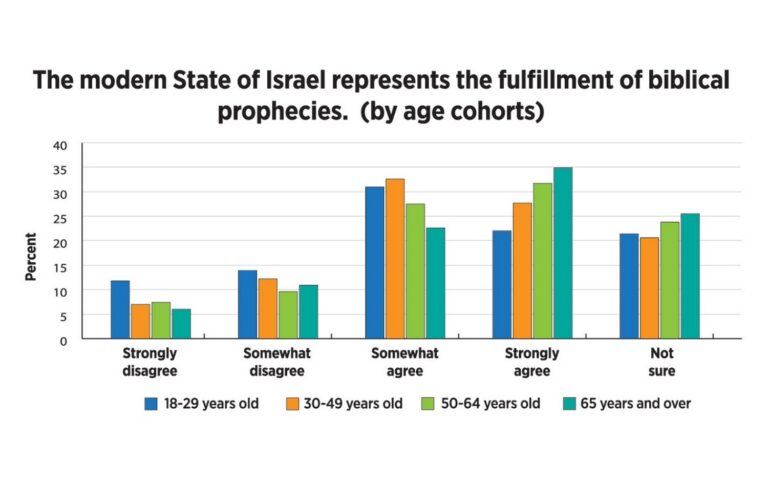
If you think that younger people are turning away from God, think again! Roughly 77 percent of evangelicals sixty-five and older believe that the State of Israel fulfills biblical prophecy. The number drops to just under 60 percent for the fifty to sixty-four group, and remains at 60 percent for those between thirty and forty-nine. Though there are fewer eighteen-to-twenty-nine-year-olds, it is still more than half, at 53 percent, and an additional 21 percent say they are not sure. God is at work in our young people, which we can see across all of the charts.

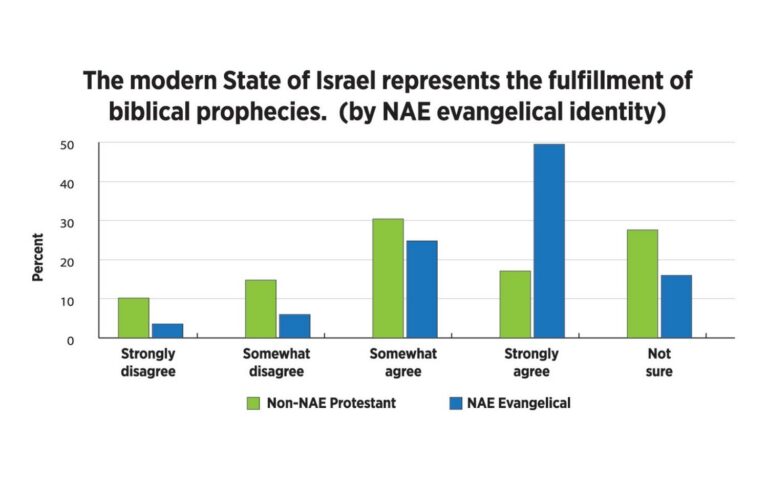
When you take into consideration how people identify themselves regarding the definition of “evangelical,” it is not surprising that those with a high view of the Bible are more likely to see Israel as fulfillment of prophecy. More than 75 percent of those who identify as evangelical agree that Israel is the realization of ancient prophecy. 

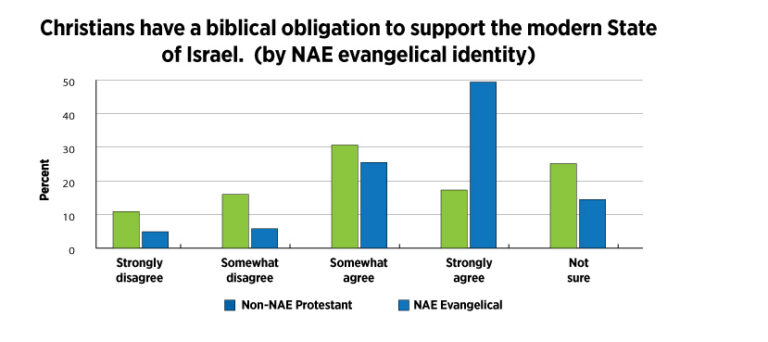
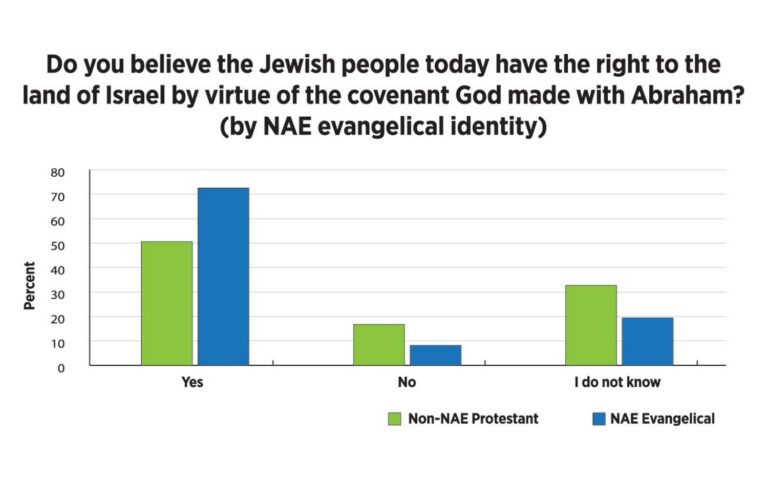
Supporting the modern State of Israel is not political. It is not giving the country’s administration a license to do as they please. However, biblical support of Israel acknowledges their right to exist and their God-given right to the land. Among evangelicals, just under 75 percent view such support of Israel as a biblical obligation for believers.

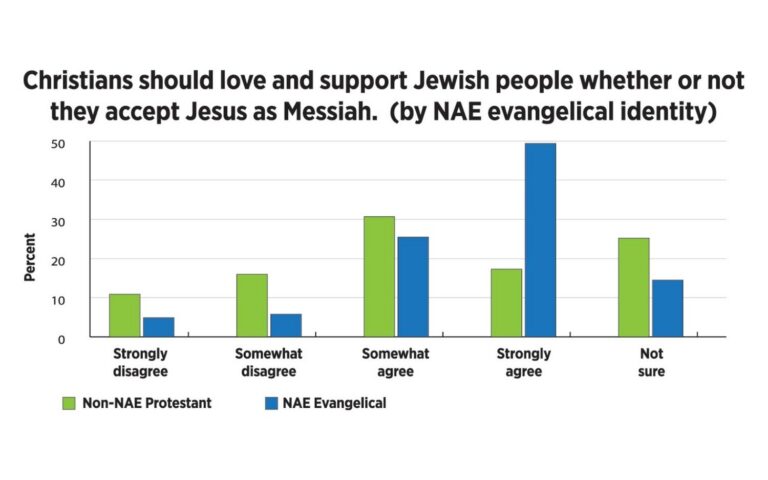
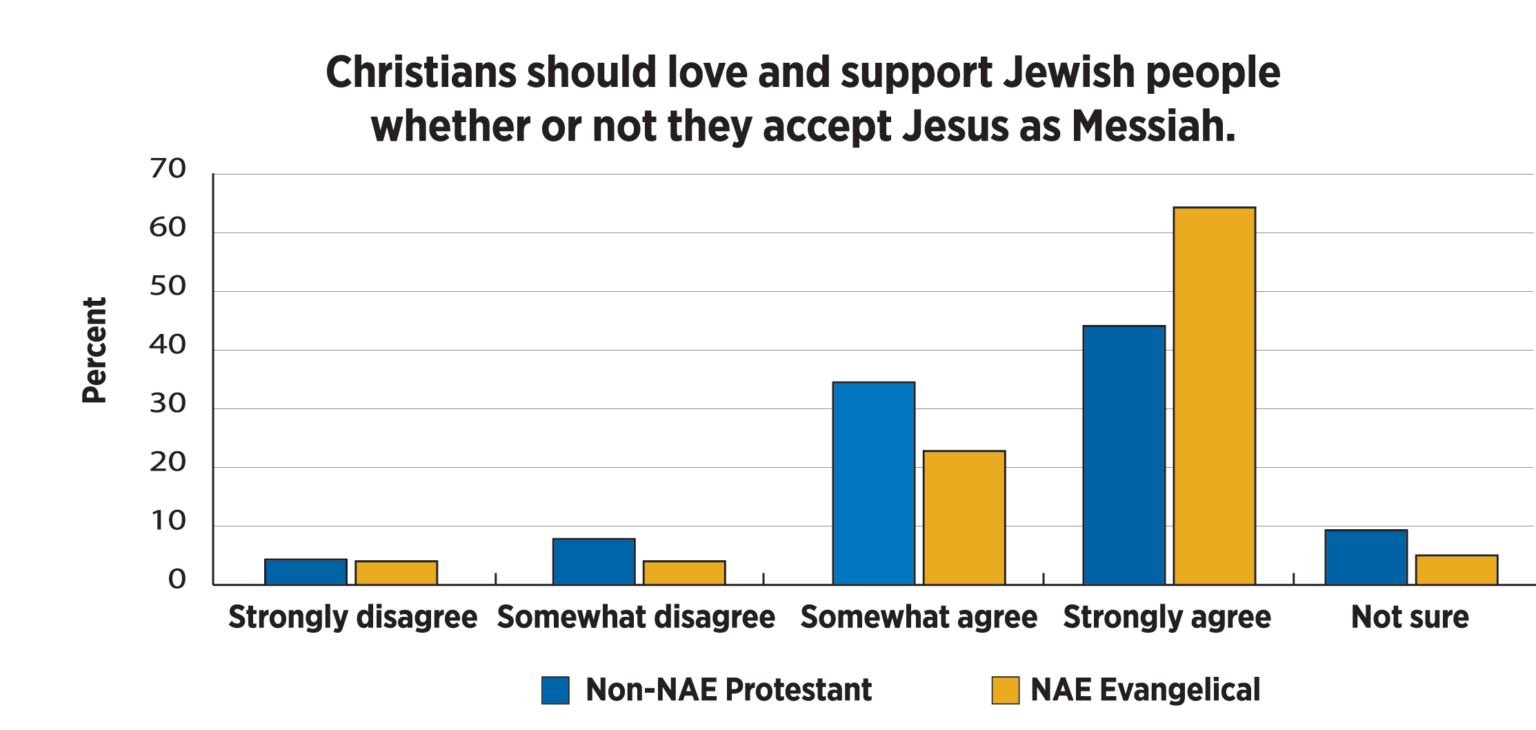
This graph is one of the most encouraging in the study. Many Jewish people view Christian evangelism as self-serving in some way. That is, Christians are only interested in Jewish people to convert them. According to the survey, nothing could be further from the truth! An astonishing 87 percent of evangelical Christians agree that believers should love and support Jewish people without consideration of whether or not they accept Jesus as Messiah.

Consistent with other results, evangelicals, who view the Bible as authoritative, generally see the Abrahamic Covenant as the source of the Jewish people’s right to the land of Israel. Less than 10 percent said otherwise.

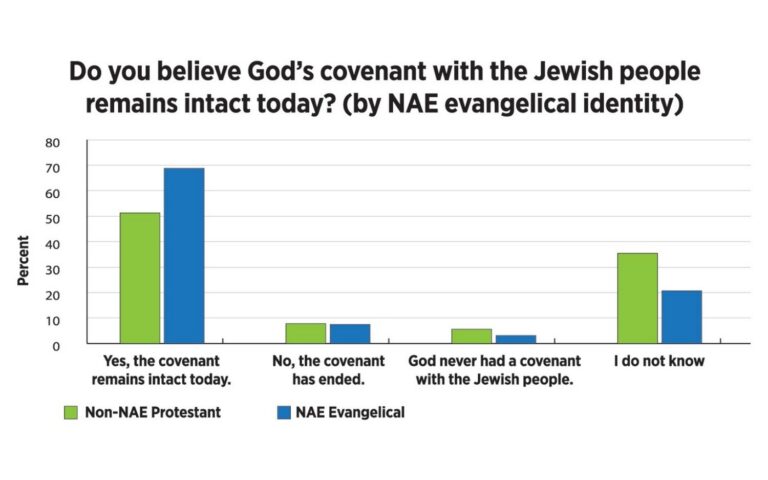
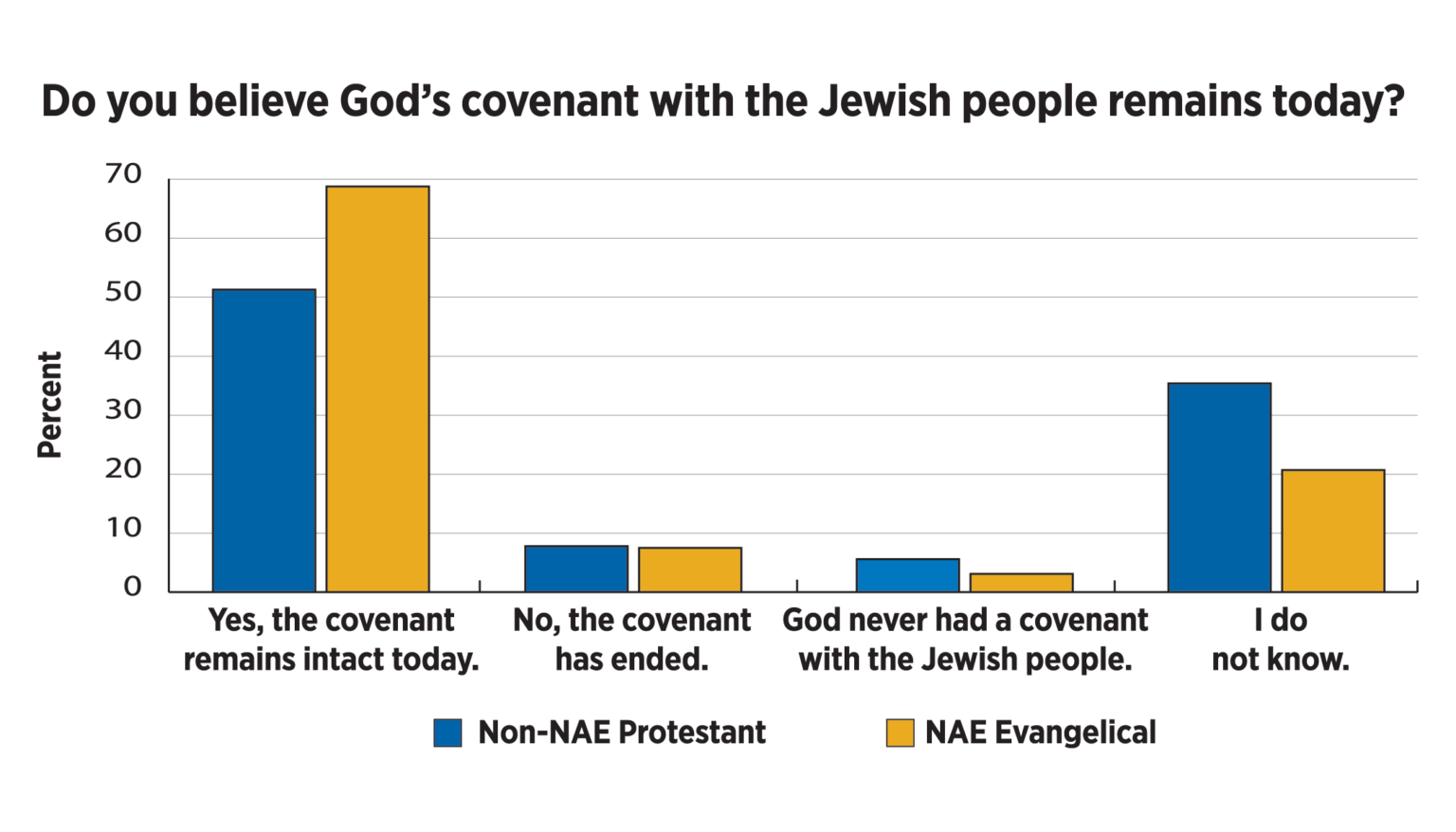
This graph is also very encouraging! As the world grows more and more hostile toward Jewish people, almost 70 percent of evangelicals acknowledge that God’s covenant with the Jewish people is still intact. With this view, God still has a plan and a purpose for the Jewish people and the nation of Israel in the future.

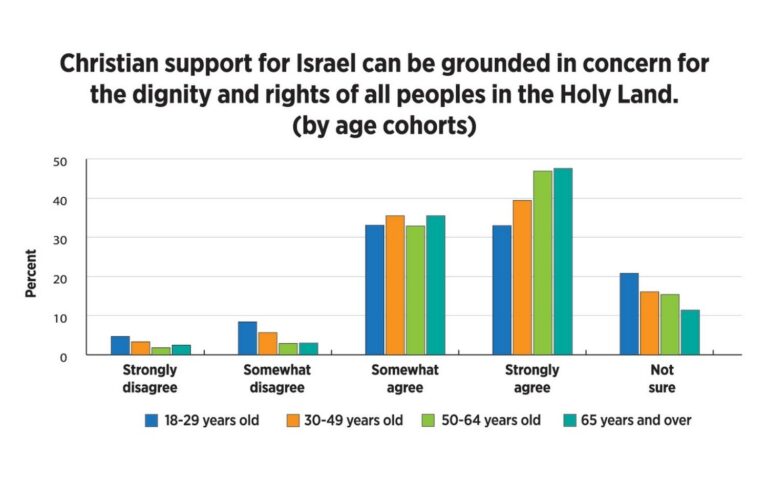
Israel’s right to the land need not exclude non-Jewish residents. Of those evangelicals who believe that the land of Israel belongs to the Jewish people, 82 percent are also concerned with the rights and the dignity of all others in the land. The others include Palestinians, Druze, Muslims, and various Christian minorities.

Leave a comment

Filed under Uncategorized

Most Christians in the United States still support Israel and the Jewish people!

We know this because we sponsored a survey in December 2025 where we asked American Christians about their views on Israel and the Jewish people. An independent firm deployed the survey and analyzed the data to ensure it was high quality and as objective as possible.

We were almost certain that Christians would be less supportive of Israel because of all the negative reporting about Israel and the rise of global antisemitism, especially in the aftermath of October 7, 2023. But I am happy to tell you after our recent and very comprehensive survey of Christians that this fear is unfounded. While the anti-Israel antagonists received a lot of attention, they do not outnumber the number of Christians who still love Israel and the Jewish people.

This letter is my way of saying thank you! Thank you for standing with Israel, praying for Israel, and supporting our work to reach God’s chosen people around the world. I hope you are as encouraged as I am as you read our analysis about these new survey results. Most Christians, especially those with a high view of Scripture, support Israel. As the leader of a historic, 132-year-old Mission to the Jewish people, I know that Christian attitudes toward God’s people make a world of difference in our witness. A genuine love and concern for Jewish people should be our motivation to share the gospel.

Christians Remain Strongly Pro-Israel

The numbers are clear. What encourages me is not only the steadfast support of Israel but the reasons for Christian support of Israel. Far too often Christian Zionists are accused of caring about Israel only because some see Israel as playing a key role in the end times.

While I believe Israel’s critical role in the end times is biblically accurate (Matthew 23:37–39Romans 11:25–29Zechariah 12:10), we found that Christians love Israel for a deeper and very biblical reason! The survey shows that Christians stand with Israel because they believe that God’s covenantal promises to the Jewish people are as true today as in the days of our forefather Abraham.

Let’s take a moment and explore this more deeply.

Why Do Christians Support Israel?

Core Theological Commitments

I need to explain a distinction we made—for the first time—on this round of surveys. We wanted to know how evangelicals’ views compared with other Christians who held positions outside the standard evangelical beliefs. So we asked respondents whether they agreed with these four statements from the National Association of Evangelicals (NAE):

  1. The Bible is the highest authority for what I believe. 
  2. It is very important for me personally to encourage non-Christians to trust Jesus Christ as their Savior. 
  3. Jesus Christ’s death on the cross is the only sacrifice that could remove the penalty of my sin. 
  4. Only those who trust in Jesus Christ alone as their Savior receive God’s free gift of eternal salvation.

Those who strongly agreed with all four statements were labeled “evangelicals,” and we compared their answers to others who identified as Christians but could not strongly agree with these beliefs. This makes a huge difference.

Belief in the authority of the Bible, the centrality of Christ, and the need for evangelism consistently correlate with stronger support for Israel and Jewish people. This connection does not surprise me at all! But now we have the numbers to show it.

The survey also revealed another truth that is foundational to our ministry: Standing with the Jewish people and believing that Jesus the Messiah is the only way to salvation are not mutually exclusive! Respondents were asked whether they agree with the statement “Christians should love and support Jewish people whether or not they accept Jesus as Messiah.” Among those who reported strong agreement that salvation is in Christ alone, 87 percent agreed with this statement.

We do not stand with Jewish people as some type of evangelistic strategy. We share the gospel because we believe spreading the message of eternal life is the most loving act we can do. Our love and concern for Jewish people are not a means to an end. We love because that is what our Messiah calls us to do.

God’s Covenant with Israel

Most evangelicals (69 percent!) and others who profess Christianity (51 percent) believe that God’s covenant with the Jewish people remains intact today. Note that evangelicals (who agreed that the Bible is the highest authority for what they believe) were 18 percent more likely to affirm God’s ongoing covenant. The survey analysis states that this belief “consistently emerges as one of the strongest reasons for why a Christian supports Israel.”

In our most recent survey, those who affirmed that the Abrahamic covenant (Genesis 12:1–3) is still valid were 81 percent more likely to express strong support for Israel. This confirms what I have observed over decades of speaking in churches and meeting Christian leaders from around the world: Affirming the covenant God made with Abraham and taking it literally leads to the support of Israel today. 

God repeatedly and specifically promised to give a particular land to the descendants of Abraham, Isaac, and Jacob (Genesis 15:18–2128:13). If we take these promises at face value, and pair this with the fact that the modern State of Israel is now home to more than half the world’s Jewish community, then we can conclude that Christian support for Israel today is not grounded in ever-changing Middle East politics but in God’s unchanging Word. Believing that God has an eternal covenant with the Jewish people does not mean endorsing everything Israel’s government does. But it does mean we accept the right of the Jewish people to live in, protect, and govern the land of Israel.

Another promising insight from this part of the survey is that 21 percent of evangelicals and 35 percent of other types of Christians were not sure whether the covenant is intact. In a way, this is good news because these people—a significant portion of respondents—are not ruling out the ongoing nature of the covenant. They just do not know either way. This represents an opportunity to educate our brothers and sisters in the biblical view of Israel. These numbers should encourage you to persevere in praying for Israel, sharing the gospel with Jewish people, and equipping other Christians to do likewise.

Our Rebuilding Israel Tour

One of the best ways to experience the importance of Israel—in the Bible, now, and in the future—is to visit. I am excited to invite you on our Rebuilding Israel tour from October 20–30, 2026. This is your opportunity to see the land of the Bible and discover how God is working in Israel today. We will tour biblical sites, visit our Messianic centers in Jerusalem and Tel Aviv, and meet Israelis who have come to faith in the last few years. To learn more and register, go to chosenpeople.com/event/rebuilding-israel-tour/. Again, I want to thank you for standing with Israel. Because of you, we are not alone!

You are a blessing to our worldwide staff who are bringing the good news to Jewish people in Israel, the United States, and a total of twenty countries around the world through Your Mission to the Jewish People.

Leave a comment

Filed under Uncategorized

Finding Hope

Shalom.

Maybe, like me, your sense of hope is running thin as we begin this eighth month of the pandemic. You are not alone. Optimism and hope may well be the most sought after, invaluable, and yet intangible life quality people are seeking today. We are all longing for hope—the belief that the future will be better and brighter than today!

We were entirely unprepared for the impact COVID-19 would have on our everyday lives. Most of us know very little about the Spanish flu of 1918 and how it ravaged American life and killed 675,000 Americans.[1] Some of what happened at that time would seem familiar today, including people wearing masks and socially distancing!

We remember more modern-day plagues like Ebola, AIDS, Legionnaires’ disease, polio, measles, mumps, and many others. Today, thank God, we have vaccines and treatments for most of these scourges.

Few of us remember World War II. However, many of us remember and maybe even served in more recent wars in Korea, Vietnam, Afghanistan, and Iraq, in which we lost a combined total of more than 100,000 beloved American heroes.[2]

I remember the Cold War tensions, the Cuban missile crisis, and the atomic threat that drove school children to hide under their desks periodically (as if this would provide safety from a nuclear attack)!

We endured 9/11, Hurricane Sandy, and massive storms in Florida, Louisiana, and Texas that wreaked terrible devastation and death upon people we love and care about, not to mention costing hundreds of billions of dollars in damage. We can now add the devastating West Coast wildfires to this list.

In some ways, COVID-19 is a crisis unlike any other as we face a deadly enemy we cannot see. Now, it seems that this dreaded disease will impact almost every area of our country, and, at the moment, we are hovering around 200,000 deaths. If we add the economic struggles and social unrest we are experiencing, who could blame someone tempted by hopelessness? How do we cope and find hope during these dark and difficult days? Ignoring what we are facing today is not going to work.

I especially appreciate those around me who are more upbeat and hopeful! May their tribe increase! I am grateful for every pair of smiling eyes peering above a mask, trying to help me look toward the brighter side and face the future in hope. I pray you have a few family and friends who bring you this kind of joy and inspiration, but even these wonderful people cannot always be by our side. So, how can we find hope in a seemingly hopeless situation? Is it possible? I believe it is!

Finding Unwavering Hope During a Pandemic

Hope comes from connecting with someone or something that is above and beyond the shifting circumstances of our day. We need to fix our hope on what is unchanging and eternal if we are going to find security and peace today. I believe we can find the hope we long for so desperately in a personal relationship with the God who made and loves us.

A God Who Keeps His Promises?

I find this hope in the story of the Bible. The Bible teaches us that God created a perfect world, but then something went wrong. Though He placed our first parents in an exquisite garden, they veered off the path He wanted them to follow. We followed suit, and every generation since then has suffered the results of these bad decisions. But, according to the Bible, God will reclaim and recreate the world He made.

God has not abandoned us and will one day heal our broken world.

In Judaism, this idea is called “tikkun olam,” the healing of the world, and it is vital to the Jewish view of life, as men and women may partner with God in the healing of the world. Jewish tradition understands that something is fundamentally wrong!

The Hope of Israel Fulfilled

How do we know what is written in the Bible is true?

So often we need something we can see to help us believe. I did! Let me tell you what convinced me. Briefly, here are three reasons.

He has kept His promises to Israel and the Jewish people. Despite the devastation of the Holocaust, the Jewish people—after multiple millennia and against incredible odds—have returned to the land of promise. This was predicted by the Jewish prophets, like the well-known Ezekiel who wrote thousands of years ago, “For I will take you from the nations, gather you from all the lands and bring you into your own land” (Ezekiel 36:24).

If God can orchestrate Israel’s regathering and return to the land, He can be trusted to fulfill His other promises in the Tanakh (Hebrew Bible) and New Covenant Scriptures. This is undeniable. If the Bible was correct in predicting the unlikely restoration of Israel, then what else in the Bible is true?

The Hope of Messiah Fulfilled

I also believe God demonstrated His trustworthiness by sending the Messiah. His name is Yeshua, or Jesus in English, and there are hundreds of prophecies detailing His identity and mission penned by Israel’s prophets over multiple centuries. If what the Bible promised about His first coming has come to pass, then what is predicted about His second coming should be true as well.  

The prophets of old prophesied His place of birth (Bethlehem) (Micah 5:2), His death for our sins (Isaiah 53:1–12; Psalm 22), His resurrection from the grave (Psalm 16), and so much more! He will return as judge and king to: restore our planet; remove sin, death, and disease; and, according to the Bible, He will wipe every tear from our eyes. Isaiah promised, “He will swallow up death for all time, and the Lord God will wipe tears away from all faces, and He will remove the reproach of His people from all the earth; For the Lord has spoken” (Isaiah 25:8, also Revelation 21:4).

This is a foundation for hope that will never disappoint.

Personal Experience

Finally, without being unrealistic about the level of tragedy we have experienced, I am convinced that God is trustworthy. When I accepted Yeshua as my Messiah, He filled my heart with hope. I cannot easily explain it or prove it logically. When you have a personal relationship with God and believe the promises in the Bible, hope invades your soul and enables you to face the future with confidence.

You will be able to read about the experience of others in this newsletter who had similar experiences to mine.

So, how should we respond to the hope God offers to humanity? We could just give up or become cynical about life in general. We could also choose to put our hope in our fellow human beings working hard to find a vaccine and a cure for COVID-19. Or, we could trust in the God who created us! Maybe a combination of the last two?

I can tell you that, even if we find a cure, we will still experience ongoing tragedies and challenges in this life and that only our relationship with our loving and immovable Creator will shelter us against the storms of life.

One More Thought

It is a mystery as to why God allows His beloved creation to endure difficult times: the loss of loved ones, jobs, educational opportunities, the separation from friends and family, and more that you and I have faced recently. It might be tempting at times to question if God is even good, whether or not you are a person of faith.

Right now, it might be a difficult season for some to keep the faith! It is understandable—times are tough! Maybe you would like to know and trust God but have a hard time believing what the Bible says about His unchanging character.

I wish I could give you an easy answer. I believe God is good by nature. He is Lord of all creation and mysteriously uses life’s most profound disappointments to shape us and make us strong.

I encourage you to hope in God! Even though the road may be dark, He is the Guide we need who lights our path and leads us through the valley of the shadow of death to green pastures.

You might have an unshakable faith in God, secured by the Messiah Jesus, or perhaps you are seeking hope that has been elusive so far. I wish you blessings on the journey, whatever your starting point might be, and thanks again for taking your precious time to read.

I hope you will enjoy the rest of the newsletter!

Sincerely,

Mitch


[1] Nina Strochlic, “U.S. Coronavirus Deaths Now Surpass Fatalities in the Vietnam War,” National Geographic, April 28, 2020, https://www.nationalgeographic.com/history/2020/04/coronavirus-death-toll-vietnam-war-cvd/#close.

[2] Ibid.

Leave a comment

Filed under Jews and Christians, New York City, Uncategorized

Understanding the Hebrew Scriptures

Shalom!

For decades we have dedicated the October edition of our newsletter to addressing both those who already believe in Jesus and those who are seeking the Lord. If you are one of those curious and brave individuals who is pursuing a relationship with the living God, let me especially thank you for taking the time to read the newsletter. This month, we are focusing on the Hebrew Scriptures, or as it is known to many, the Old Testament. Of course, if you are Jewish and do not accept the New Testament as holy Scripture, then there really is no such thing as an Old Testament! The Hebrew Scriptures is simply known as the Jewish Bible, with the first five books being referred to as the Torah.

We will discuss the impact and importance of the Hebrew Scriptures in Western society and in the hearts of those who believe these words were spoken by God Himself at Mount Sinai and through the mouths of prophets.

The Hebrew Scriptures impact every area of life: from issues of the heart, to practical wisdom, amazing prophetic predictions of the age to come, and of course our moral code and behavior. The older testament—if you can appreciate this new terminology—has been extremely influential in our lives, personally and corporately, even when we did not realize it! In fact, as the article will suggest, the Hebrew Scriptures have helped shape our culture and society more than the Constitution and Bill of Rights combined. Additionally, a good argument can be made to demonstrate that these documents that were so foundational in the formation of our country were based upon the words of the Hebrew Scriptures.

It would be virtually impossible for me, as a Messianic Jew, to believe in Jesus if I did not believe that the Hebrew Scriptures referred to Jesus in the promises and prophecies regarding the coming of the Messiah. This rationale for faith in Yeshua (His Hebrew name) is critical for a Jewish follower of the Messiah and also for those who are not Jewish. When more than a thousand years of biblical prophecy are so remarkably fulfilled in this one person, it gives us tremendous confidence in Him and also in the Old Testament where He is described. So much of what we understand about salvation, the nature of God, and His plan for each of us is firmly rooted in the Hebrew Scriptures. As King Solomon wrote so beautifully,

Trust in the Lord with all your heart and do not lean on your own understanding. In all your ways acknowledge Him, and He will make your paths straight. (Proverbs 3:5–6)

Admittedly, at times, the Hebrew Bible is not the easiest to understand, especially in light of today’s cultural trends and ideas about morality. Frankly, the Hebrew Bible might seem out of sync with our modern world upon a first, surface-level glance. But, consider that the voice of the Hebrew Scriptures, though contrary to many of our current cultural values, might very well be a voice worth listening to. It has led so many of us to a fulfilling and meaningful life. The Psalmist David wrote about those who read, meditate, and obey what is written in the Hebrew Scriptures:

How blessed is the man who does not walk in the counsel of the wicked, nor stand in the path of sinners, nor sit in the seat of scoffers! But his delight is in the law of the Lord, and in His law he meditates day and night. (Psalm 1:1–2)

I hope that you will enjoy the rest of the newsletter. My prayer is that it will motivate you to study the Hebrew Scriptures, to learn more about God’s plan for you, and that the very specific predictions about the coming of the Messiah will become personally meaningful to you. There is so much in these 39 books of the Old Testament to understand, and I hope you will take the time to read through the entirety of the Hebrew Scriptures to try and better understand one of the world’s great works of literature. You might not take my position in believing that the Old Testament is the inspired Word of God, but I think, if you have an open heart, you will find so many of the statements in these ancient pages to be comforting, relevant, and life-changing.

Enjoy the journey, and, if you are seeking the Lord, may I encourage you to take a look at followmessiah.com, which is a 16-part video study of the Scriptures, both the Old and New Testaments, which will help guide you towards a deeply personal relationship with the God of Abraham, Isaac and Jacob.

A belated Happy Jewish High Holidays!

Mitch

Leave a comment

Filed under Jews and Christians, Judaism, Messianic Jewish, Uncategorized